Analysis · Security
Pots Money exploit leaves IBS near zero against a $1 floor
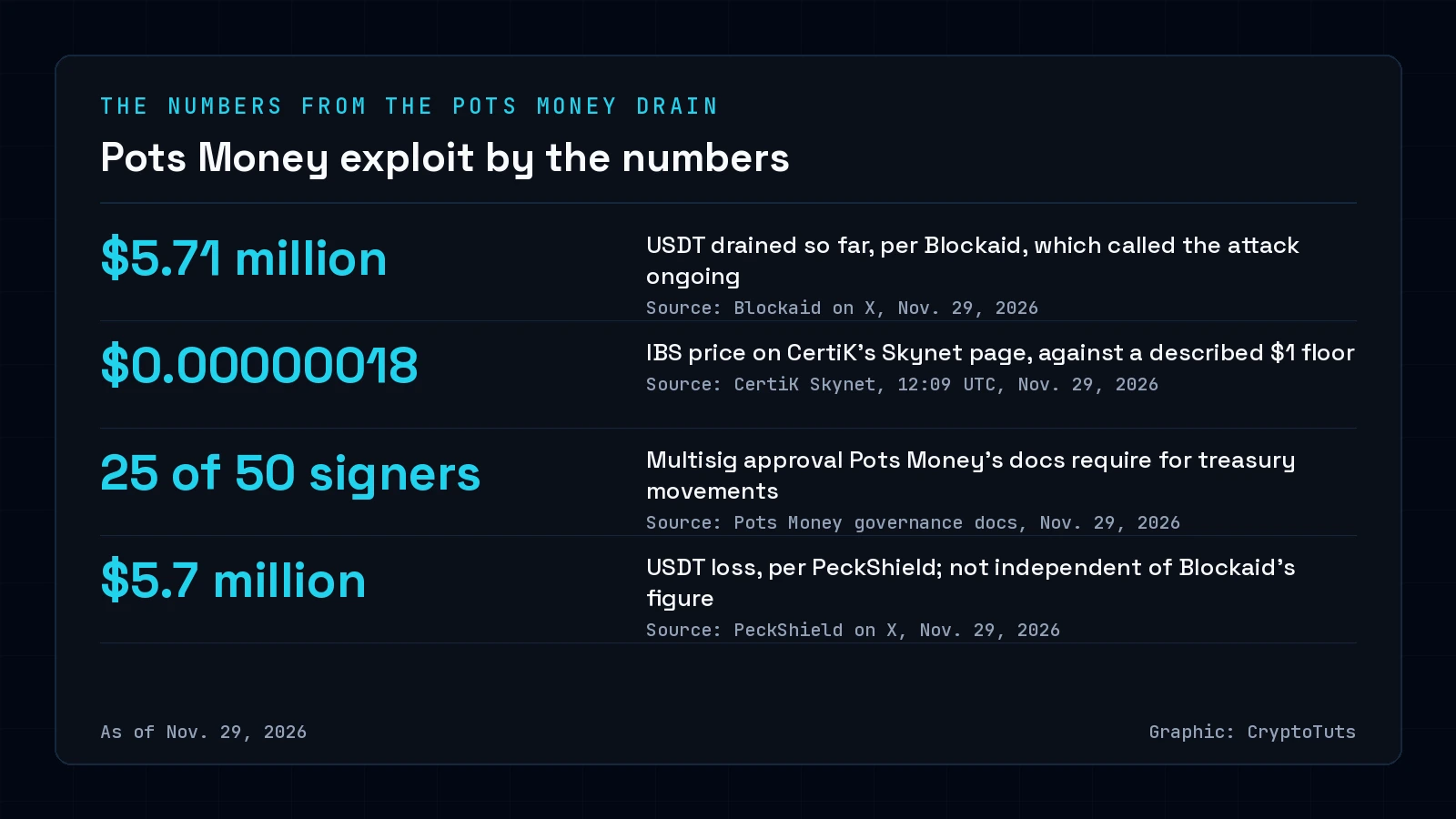
CertiK's Skynet page showed IBS at about $0.00000018 at 12:09 UTC on Nov. 29. Pots Money describes the token as designed to trade above $1.
By Phil5 min read

A privileged governance account was emptying Pots Money's IBS/USDT pool on BNB Smart Chain on Nov. 29, 2026, according to Blockaid. Its alert put the USDT drained so far at about $5.71 million and called the attack ongoing. Pots Money's own governance docs say treasury movements need multisig approval by 25 of 50 signers. A multisig is a wallet that requires several signers to approve a transfer.
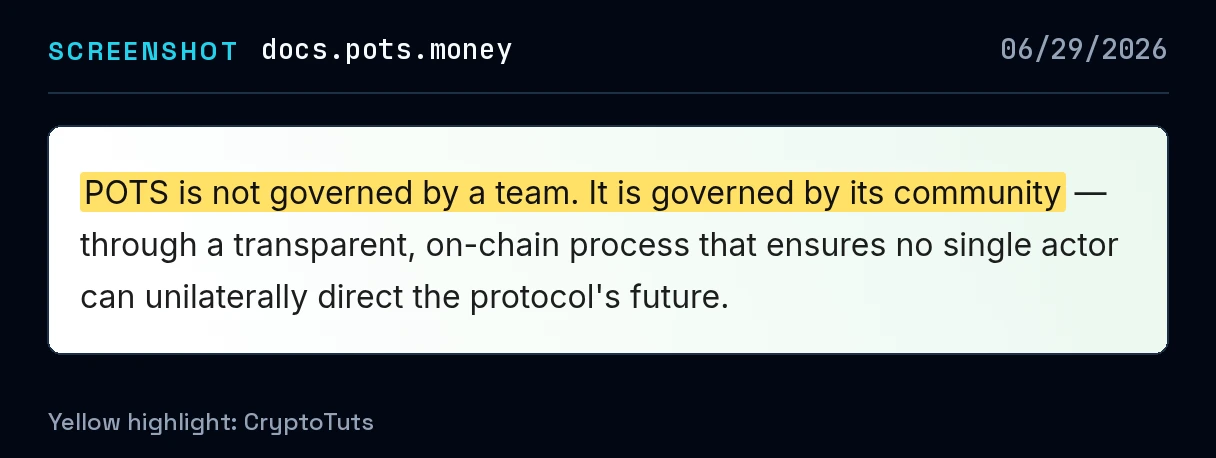
The same page presents POTS as run by its community rather than a team, so that no single actor can direct the protocol on its own. Blockaid describes one account doing the work, minting 1 billion IBS into the pool and swapping them for USDT across about two mint-and-dump sequences. A liquidity pool holds two tokens that traders swap against, so dumping freshly minted tokens pulls out the other side.
Blockaid ties the drain to a privileged governance account. A second monitor, Defimon Alerts, ties it to the governance role of a Pots Money vault proxy. Such a role is a permission that lets one account change rules or move funds, like an admin key in DeFi contracts. Who controlled that access, whether an outsider or an insider used it, and whether liquidity providers get money back remain open; a Pots Money incident statement or a Tether freeze notice would answer part of it.
Pots Money's docs promise math, not trust
Pots Money's contract-address page describes its contract logic as immutable and its rules as enforced by mathematics, not by trust. Its governance page describes a 48-hour timelock for passed proposals before execution, though a heading on the same page says 24 hours, and marks the delay as adjustable by the DAO. A treasury movement then also needs the 25-of-50 multisig. The DAO can change that threshold too, and the page was last updated about five months before the attack.
Two monitors describe two different mechanisms
Defimon Alerts described a withdrawal where Blockaid saw trades against the pool. Its post at 07:15 UTC on Nov. 29 said Pots Money's IBS vault proxy at 0xCBA9...394C was drained of 5.71 million USDT. The route was transferToTreasury(uint256), a function gated to the contract's governance role. The post labeled the incident a private key compromise.
The two monitors point at two different gates. Defimon's route runs through a function reserved for the vault proxy's governance role, while Blockaid's mint-and-swap spends newly minted IBS into the pool. Pots Money's docs, for their part, require 25 of 50 signers for treasury movements.
Pots Money's documentation lists 0xCBA922f6aff0EC8CB0703D44249456Ef779A394C as its RBS Stabilizer, a Range Bounded Stability contract. That address shares its first and last characters with the shortened one in Defimon's post. The docs call it a stabilizer, while Defimon calls its contract a vault proxy.
BigGo Finance, citing transaction records from press coverage, reported two sales about a minute apart. At 04:47:23 UTC, 1 billion IBS went for 5,710,306.09 USDT. At 04:48:25 UTC, 100 billion IBS went for 14,212.91 USDT. Together the two sales come to 5,724,519 USDT.
That second sale alone is 100 times the 1 billion IBS Blockaid describes as minted, so the minted total is in dispute. In BigGo's timeline, Blockaid's alert came at 04:59 UTC, about 12 minutes after the first sale.
IBS sat near zero against its $1 floor
Pots Money describes IBS as an algorithmic, collateral-backed token designed to trade above $1, as Cointelegraph and BigGo Finance report. CertiK's Skynet page showed IBS at about $0.00000018 at 12:09 UTC on Nov. 29. Its 24-hour change was displayed as 100.00%. PeckShield put the drop at 100%.
That reading is less than one five-millionth of the $1 floor. If you hold 1 million IBS, the 12:09 UTC reading values them at about 18 cents, against $1 million at the floor.
The same page listed a high of $4.35 and a low of about $0.00000003 for IBS, without a stated period.
CertiK listed monitoring as disabled
CertiK's Skynet page, checked at 12:09 UTC on Nov. 29, showed monitoring as not enabled for the Pots Money profile. Blockaid and PeckShield flagged the drain on X instead.
The same page gave two audit statuses at once. One panel showed the audit in progress with findings 99% remediated, while another showed a final report "delivered on 5/2/2026."
At that check, CertiK listed no CertiK bug bounty and no third-party bounty for the project. BigGo Finance reports that the project's own security page advertises a $1 million USDP bug bounty through CertiK.
CertiK's centralization scan showed the IBS contract's owner address as all zeros. That empty owner field sits beside a separate governance role, which in Blockaid's and Defimon's accounts could mint tokens or move funds.
PeckShield placed the USDT in one wallet
PeckShield put the loss at $5.7 million in USDT. It placed the stolen funds in a wallet it gave in shortened form as 0x25D21c...ccceD2, as of its post. Tether, the issuer of USDT, can freeze tokens at an address it flags.
Cointelegraph reported that Pots Money had not identified affected liquidity providers by its press time. BigGo Finance reported that Pots Money's documentation describes the pool's liquidity as permanently locked and owned by the project. The contract-address page lists the IBS token at 0x255e746aBb8D9Acac00d6d023e5E63E3b8DFA7cd and the IBS/USDT pool at 0x2a4b99a9c4544d35e8d266111c50b67fea01d53d. BigGo put the remainder in the pool at about 76 USDT after the second sale, and the same report gives about $2,200 of liquidity left in the pair.
Sources
- Blockaid post on X detecting the Pots Money IBS exploit · Blockaid
- PeckShieldAlert post on X about the Pots Money IBS exploit · PeckShield
- Defimon Alerts post on X about the IBS vault proxy · Defimon Alerts
- Pots Money docs: Governance · Pots Money
- Pots Money docs: Contract Address · Pots Money
- CertiK Skynet project page: Pots Money (IBS) · CertiK
- Cointelegraph: Pots Money IBS exploit drains $5.71M in USDT on BNB Chain · Cointelegraph
- BigGo Finance: Privileged Mint Wipes Out POTS Money's IBS Pool as $5.72 Million in USDT Is Drained on BNB Chain · BigGo Finance
About the author

Phil
Founder & Editor-in-Chief · In crypto since 2017
Phil is the founder of CryptoTuts and has explored Bitcoin, cryptocurrencies and blockchain technology since 2017. He explains complex topics clearly, with data and without empty promises.
- XRP and the XRPL
- Bitcoin
- Crypto tax records
- Exchange comparisons
- On-chain analysis