Analysis · Security
Binance hack: NEAR meme coins carried about 1% of stolen NEAR
ChainAnalyzer counts about 1% of the 12,410,067 NEAR stolen on Oct. 29. Elliptic ties the six tokens to North Korean launderers, who trade stolen NEAR through their own pools.
By Phil6 min read
Six meme tokens minted on NEAR, coins created with no business behind them, have carried about 1% of the NEAR stolen from Binance, by ChainAnalyzer's onchain count as of Nov. 9, 2026. Elliptic, which detailed the tokens in a Nov. 9 report, ties them to North Korean launderers. TRM Labs wrote on Nov. 3 that no government had attributed the theft.
Of the 12,410,067 NEAR taken on Oct. 29, about 786,000, or 6.3%, had left the first receiving account by Nov. 9. The meme-coin route is a thin slice of the theft: roughly 93.7% of the stolen NEAR still sat in that one account.
A liquidity pool is a smart contract holding two tokens that anyone can trade against, like a vending machine swapping one coin for another. One set of wallets pays stolen NEAR into a pool for a new token. A second set sells the token back into the same pool for NEAR, so no direct transfer links the two.
Elliptic's wallet count gives the clearest answer to whether anyone outside the launderers traded the coins: DABI, MMLI and SINU each had a single buying wallet and a single selling wallet.
Six pools logged about 143,700 NEAR in buys
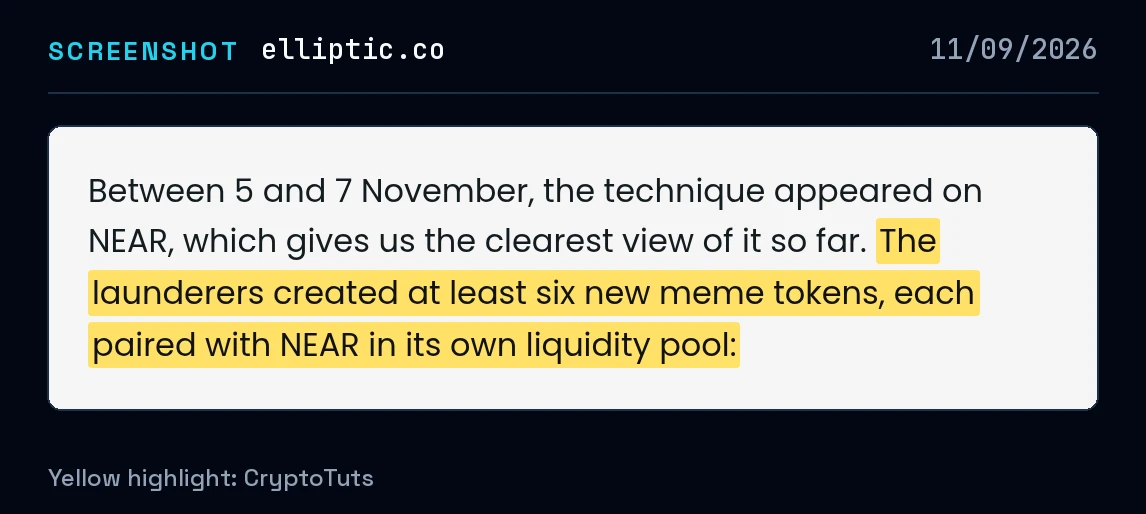
Elliptic identified at least six new tokens created on NEAR from Nov. 5 to 7, each paired with NEAR in its own liquidity pool. ChainAnalyzer's independent trace found the same six.
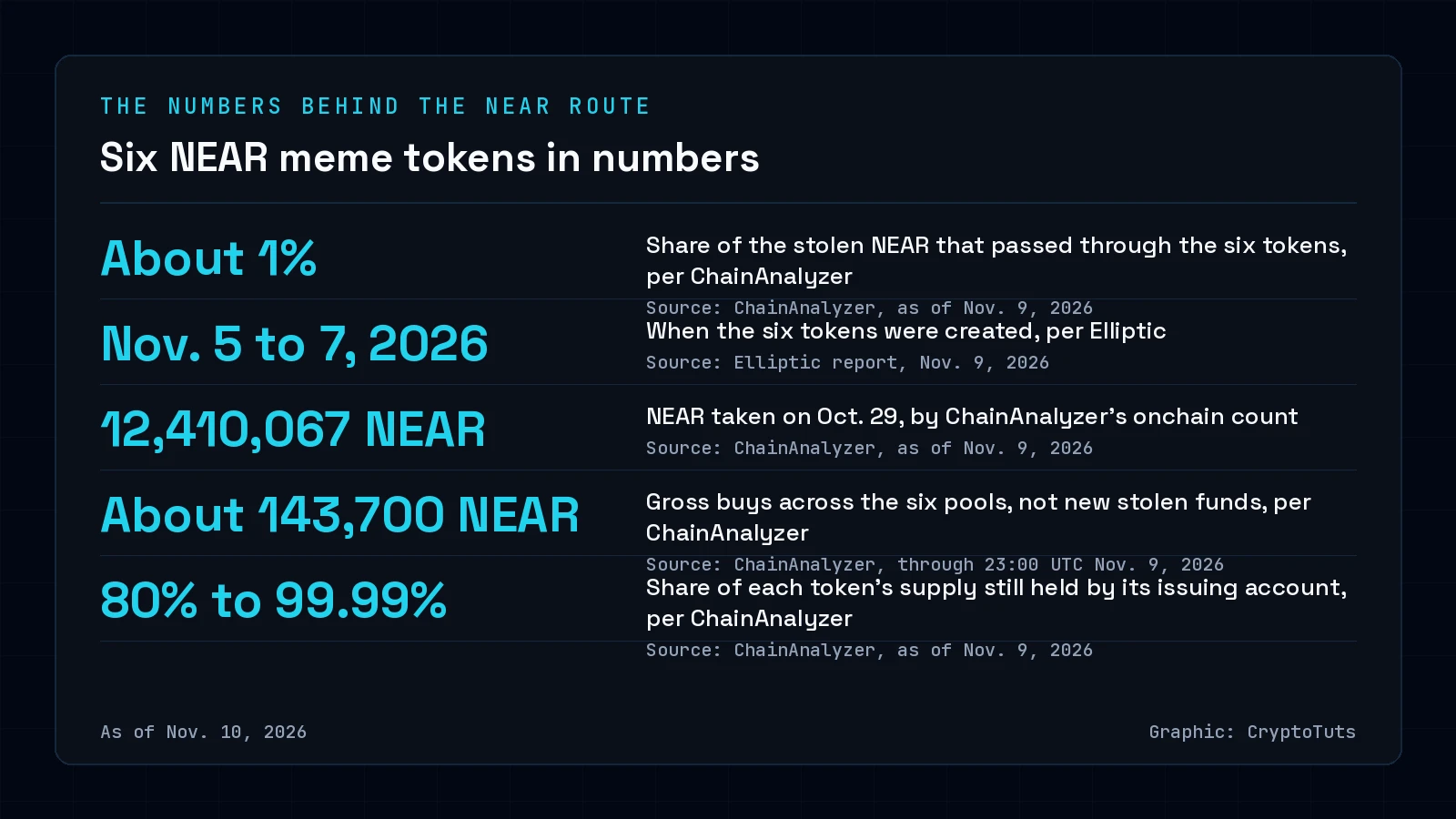
ChainAnalyzer counted 2,559 buys totaling about 143,700 NEAR and 2,573 sells totaling about 143,100 NEAR across the six pools through 23:00 UTC on Nov. 9. It attributes the gap of about 570 NEAR to trading fees. Gross buys measure trading, and the same NEAR can pass through a pool more than once. The figure can therefore run above the amount of new stolen funds.
The NEAR leg sits inside a far larger theft. Elliptic counts $6.43 billion stolen from Binance on Oct. 29, at values at the time of theft; Binance estimated around $6.3 billion.
Each token cost about 25 NEAR to launch
Elliptic's report lays out the method token by token. Each of the six cost about 25 NEAR, around $90, to create. FUK came first, at 00:25 UTC on Nov. 5. OLCCL, MEILI, MMLI and DABI followed between 07:19 and 14:27 UTC on Nov. 6, and SINU at 10:06 UTC on Nov. 7.
The proceeds of one token paid for the next. Five of the six token creators were funded by a wallet that had been selling an earlier token 2 to 13 minutes before the new launch. Each token was first sold within three hours of launch and did at least three-quarters of its trading within a single day. In every case, the stolen NEAR that went in matched the NEAR that came out.
The launderers used the token-launch tool, the exchange and the wallet app as any user could, and in Elliptic's view the services did nothing wrong.
The North Korea link rests on Elliptic's account. It reports that the FBI on Oct. 31 attributed the Binance theft to TraderTraitor, the FBI's name for a North Korean state-sponsored hacking group. ChainAnalyzer also reports an FBI alert attributing the attack to North Korea.
The issuers still hold most of each token
ChainAnalyzer's onchain reading as of Nov. 9 shows six closely held tokens. Each issuing account created its own pool with 40 to 374 NEAR and still holds 80% to 99.99% of the token supply. No token has more than 15 holders. Holders and traders are different counts, since a wallet that bought and sold a token can end up with an empty balance.
Four pools lost their remaining liquidity on Nov. 8, when their creators withdrew 265 to 419 NEAR per token. The tracers split on what came next. Elliptic says none of the six traded after Nov. 8, while ChainAnalyzer says trading was still going on Nov. 9. The timestamps behind the Nov. 9 tally of buys and sells would show which reading holds.
The proceeds left through Chainflip for Bitcoin
Past the pools, about 310,000 USDC reached three Ethereum addresses on Nov. 8 and 9 and was sent on to Chainflip deposit addresses. Chainflip is a cross-chain swap service that pays out in another blockchain's asset. ChainAnalyzer cannot tie all of that USDC to the six tokens.
The Bitcoin paid out went to 20 addresses, with no exchange deposits found as of Nov. 9. Elliptic assesses that every step remains recorded onchain and that the technique slows investigators down rather than hiding the funds.
The trick predates the Binance hack
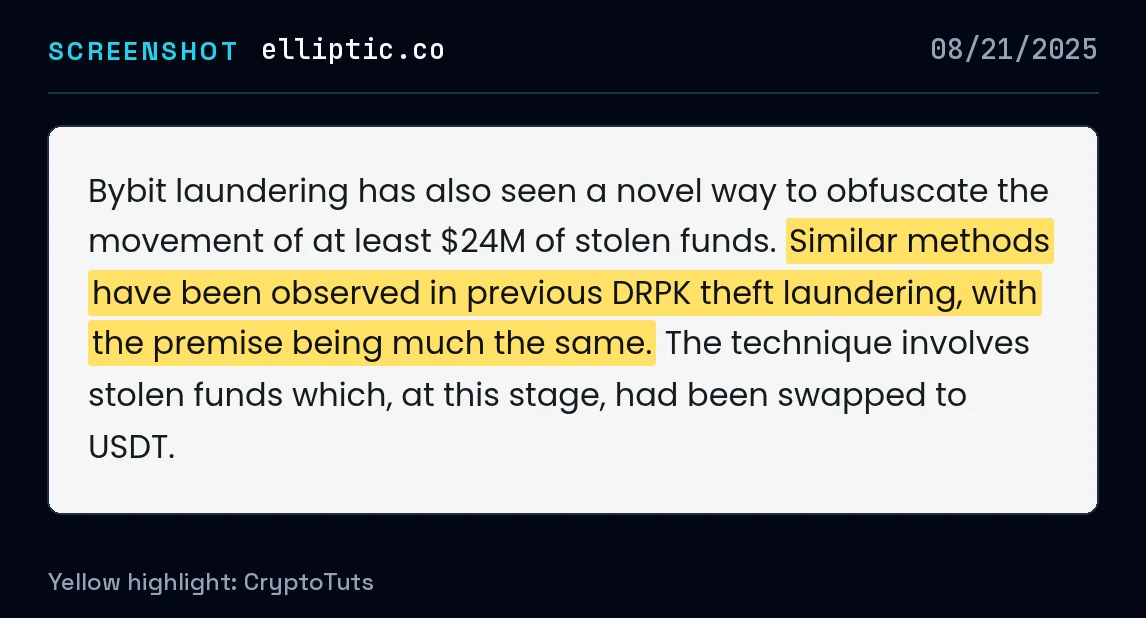
Elliptic has met the pattern before. In the 2025 Bybit theft, launderers created a worthless Tron token, paired it in a liquidity pool and moved at least $24 million through it. Elliptic's August 2025 analysis of that case said similar worthless-token methods had appeared in earlier North Korean laundering.
The Binance trace has a Tron token too. Elliptic identified one on Nov. 2, created solely to launder Binance funds. TRM Labs separately describes a Tron token that an address already in the trace created on Oct. 31. Only its creator can mint it, its only market is a single liquidity pool, and no transfer connects the buyer wallets to the seller wallet.
On Solana, the launderers used existing tokens instead. On Nov. 3, stolen SOL was swapped into existing wrapped and thinly traded Solana tokens, then sold for USDC and moved to other blockchains.
For compliance teams, Elliptic advises against treating funds from a liquidity pool as clean by default. Its warning signs:
- Tokens created in the last few days
- Pools with a handful of traders
- Wallets that only buy or only sell
As of Nov. 1, the last update of Elliptic's tracker of the hack, the funds stolen on Bitcoin, the XRP Ledger, Solana and NEAR all remained unfrozen. Native assets have no issuer that can freeze them. On the XRP Ledger, issuer freezes apply to issued tokens on trust lines, as the Deep Freeze explainer shows, and XRP itself is the native asset. Background on your own exposure is in how much XRP the Binance hack took and Binance's net outflow after the hack.
Whether the remaining NEAR will move the same way is the open question. The points to watch:
- New outflows from the first receiving account
- Any exchange deposit of the traced Bitcoin
- New trades in the six pools
So far, the meme-coin route has carried about 1% of the stolen NEAR, while about 93.7% still sat in the first receiving account on Nov. 9.
Sources
- Elliptic: North Korea is minting meme coins to launder the Binance hack (Nov. 9, 2026) · Elliptic
- ChainAnalyzer: Binance drain NEAR leg, hand-offs through trades in six new meme coins, then Bitcoin via Chainflip (Nov. 10, 2026) · ChainAnalyzer
- Elliptic: Binance largest hack in history (Oct. 30, 2026, last updated Nov. 1) · Elliptic
- Elliptic: How compliance teams can identify funds from the Binance hack (Nov. 2, 2026) · Elliptic
- TRM Labs: Binance Hack Update: North Korea Launders Proceeds Through Self-Minted Tokens and Chained Bridges (Nov. 3, 2026) · TRM Labs
- Elliptic: Bybit exploit six months on: novel laundering tactics, techniques and procedures (Aug. 21, 2025) · Elliptic
About the author

Phil
Founder & Editor-in-Chief · In crypto since 2017
Phil is the founder of CryptoTuts and has explored Bitcoin, cryptocurrencies and blockchain technology since 2017. He explains complex topics clearly, with data and without empty promises.
- XRP and the XRPL
- Bitcoin
- Crypto tax records
- Exchange comparisons
- On-chain analysis