Analysis · Security
MoldyRoost iPhone ads: GhostWave looks for up-to-date iOS 18
Confiant says the branch is built for phones already patched against DarkSword. Its iOS 26.3 fallback file was missing from the leaked code, and Confiant cannot say whether the iOS 26 branches work.
By Phil5 min read

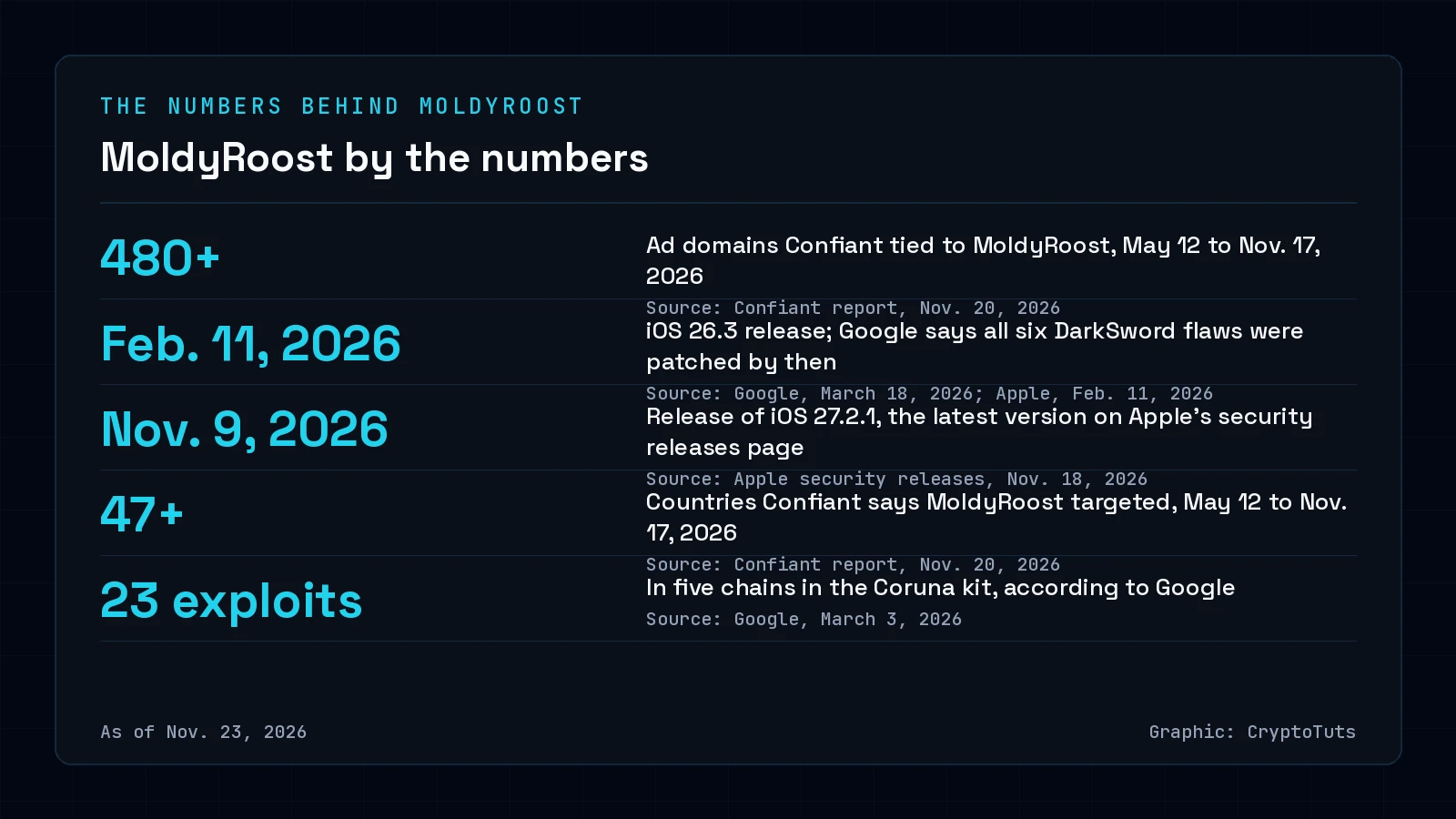
Apple had patched every flaw in DarkSword, an iPhone attack kit served through MoldyRoost's online ads, by iOS 26.3 on Feb. 11, 2026. Most fixes shipped in earlier releases, and the last one landed three months before May 12, when Confiant's count of MoldyRoost ad domains begins. Yet the security firm says another branch, GhostWave, is built for phones already patched against DarkSword and looks for up-to-date iOS 18 iPhones. Your iOS version decides how exposed you are.
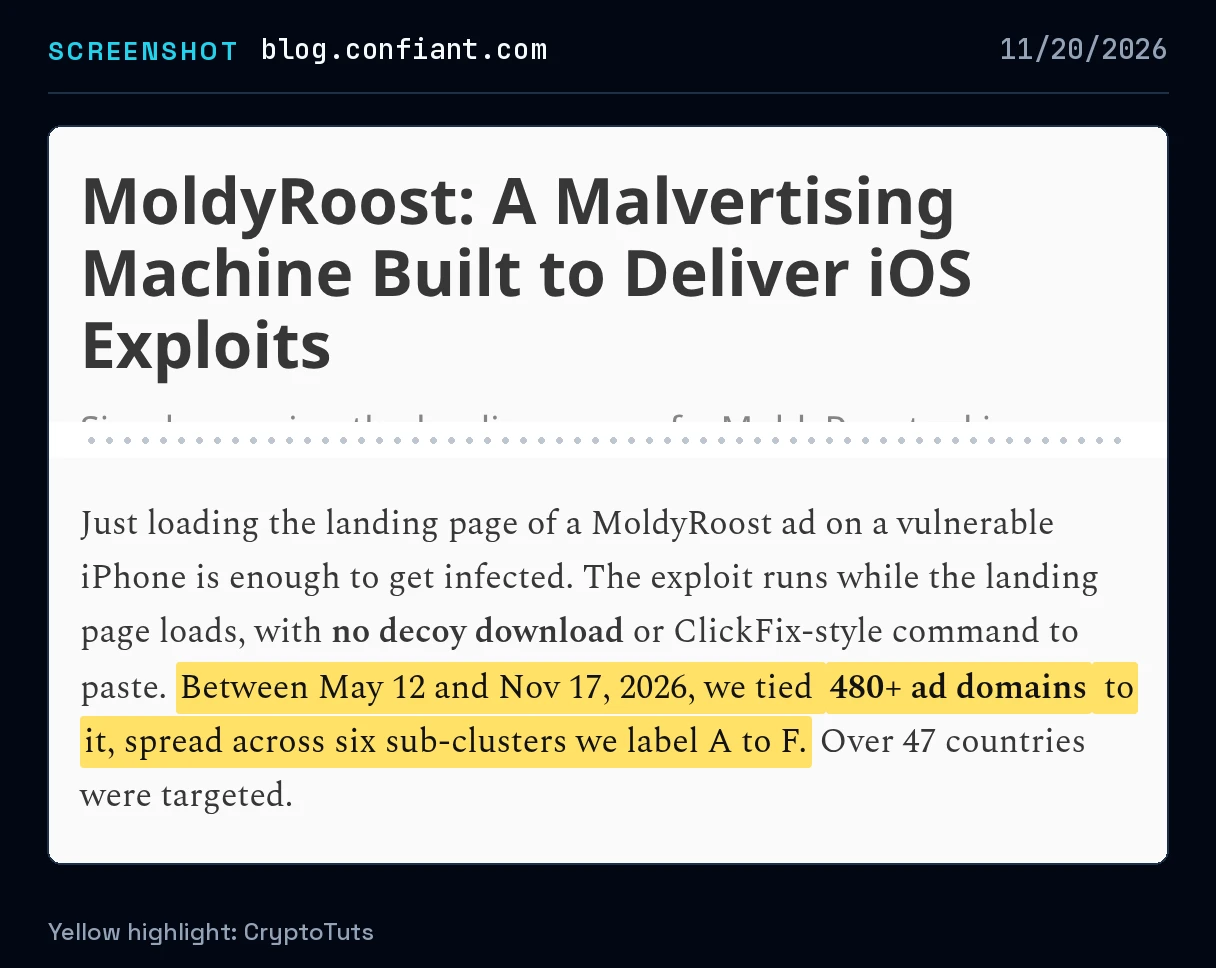
In a threat report published Nov. 20, 2026, the firm tied more than 480 ad domains to MoldyRoost between May 12 and Nov. 17. The iPhone malvertising operation targeted users in more than 47 countries. Malvertising is malicious code delivered through ordinary-looking online ads, the way a fake listing can sit among real ones. On a vulnerable iPhone, merely loading one of these ads' landing pages can be enough to infect it, with no download needed.
Your iOS version is the first thing to check
Apple's security releases page, as of its Nov. 18, 2026, update, lists iOS and iPadOS 27.2.1, released Nov. 9, as the latest version. The same day brought iOS 26.7.3 for iPhone 11 and later and iOS 18.7.12 for iPhone XS, XS Max and XR. These are parallel tracks, so an iOS 26 fix and an iOS 18 fix are separate releases.
In its March 2026 reports on Coruna and DarkSword, Google Threat Intelligence Group urged iPhone users to update to the latest iOS. Where an update is not possible, it advised turning on Lockdown Mode. Lockdown Mode is an optional iPhone setting that switches off features attackers often abuse, Apple's strictest protection setting.
Cointelegraph reported that blockchain security firm CertiK issued a Nov. 6 warning about DarkSword with four steps for iPhone users. CertiK's steps: install software updates, keep seed phrases out of Notes, photos and screenshots, avoid unfamiliar links and use a hardware wallet for larger holdings.
Each kit targets its own iOS range
According to Confiant, MoldyRoost picks among up to four exploit kits by iOS version: Coruna, SilkPath, DarkSword and GhostWave. An exploit kit is a ready-made bundle of attacks that picks the one matching the visitor's software, like a key ring tried on a lock. The selector, found in leaked MoldyRoost code, covers every iOS version from 13.0 to 26.
Coruna covers the oldest software. Google's March 3 analysis puts its range at iOS 13.0 through 17.2.1, with 23 exploits in five full chains. The version analyzed in March bails out when the phone is in Lockdown Mode or the user is in private browsing. It was also ineffective against the latest iOS at that time.
One flaw Coruna used sits in WebKit, the engine behind Safari (CVE-2024-23222). Apple fixed it in iOS 17.3 on Jan. 22, 2024, noting a report that it may have been exploited. That fix came more than two years before the May 12, 2026, start of the domain count.
DarkSword covers iOS 18.4 through 18.7 and chains six flaws, three of them used as zero-days. A zero-day is a flaw attackers exploit before the vendor has a fix.
Apple fixed DarkSword's flaws in stages
By Google's March 18 patch table, five of the six were fixed for iOS 18 by iOS 18.7.3, released Dec. 12, 2025. Apple's notes for iOS 18.7.3 and iOS 26.2, out the same day, confirm two of those fixes (CVE-2025-43529 and CVE-2025-14174).
The table lists the sixth, CVE-2026-20700, as fixed only in iOS 26.3. For iPhones that stay on iOS 18, Apple's notes for later iOS 18 updates are where that fix would appear.
The flaw sits in dyld, the component that loads program code. DarkSword uses it as a user-mode Pointer Authentication Code (PAC) bypass. PAC is a chip feature that signs memory addresses so tampered ones are rejected. Apple flagged a report that the flaw may have been exploited against specific targeted individuals on versions before iOS 26.
The kits hunt seed phrases and wallet apps
Confiant says all four kits are built to steal crypto wallet seed phrases, keychain (password manager) data, messages and photos. A seed phrase, also called a recovery phrase, is the word list that restores a wallet and its funds.
Coruna, as Google documented it in March, decodes QR codes from images on the device. It also scans text for BIP39 word sequences, the standard format for recovery phrases, and for keywords such as "backup phrase." Matches found in Apple Memos go to the attackers' server. Coruna modules also place hooks in wallet apps including MetaMask, Phantom and Trust Wallet to pull out wallet data.
DarkSword's data miner, GHOSTBLADE, takes iMessage, Telegram and WhatsApp data, device keychains, saved Wi-Fi passwords and cryptocurrency wallet data. It also collects the Notes database, photo metadata, hidden photos, screenshots and iCloud Drive files. That list comes from earlier DarkSword attacks, and MoldyRoost's own version has been described only in broader terms.
GhostWave and iOS 26 remain unproven
Confiant's view of GhostWave and the iOS 26 branches rests on partial code. The leaked repository lacked GhostWave's fallback file for iOS 26.3, along with the separate SilkPath loader. The firm has seen no iOS 26 exploit code and cannot say whether those branches work.
The 480-plus domain count sizes the ad network that delivers the kits. The operation's backend credits each stolen wallet to the channel that brought the victim in. The firm publishes no count of victims, infected devices or stolen funds.
The firm assesses that one supply chain and delivery platform sit behind all six sub-clusters of domains. Whether a single crew runs them or rents them to affiliates is still undetermined.
The next step to watch is a payload analysis of GhostWave and SilkPath, or an Apple advisory naming the flaws they use.
Sources
- MoldyRoost: A Malvertising Machine Built to Deliver iOS Exploits · Confiant
- Coruna: The Mysterious Journey of a Powerful iOS Exploit Kit · Google Threat Intelligence Group
- The Proliferation of DarkSword: iOS Exploit Chain Adopted by Multiple Threat Actors · Google Threat Intelligence Group
- Apple security releases · Apple
- About the security content of iOS 26.3 and iPadOS 26.3 · Apple
- About the security content of iOS 26.2 and iPadOS 26.2 · Apple
- About the security content of iOS 18.7.3 and iPadOS 18.7.3 · Apple
- About the security content of iOS 17.3 and iPadOS 17.3 · Apple
- MoldyRoost malware can drain iPhone wallets with one tap · Cointelegraph
About the author

Phil
Founder & Editor-in-Chief · In crypto since 2017
Phil is the founder of CryptoTuts and has explored Bitcoin, cryptocurrencies and blockchain technology since 2017. He explains complex topics clearly, with data and without empty promises.
- XRP and the XRPL
- Bitcoin
- Crypto tax records
- Exchange comparisons
- On-chain analysis