Analysis · Regulation
Peraire-Bueno acquittal: what a 1994 Rule 29 note leaves open
Prosecutors failed to prove a material misrepresentation, Judge Jessica Clarke ruled Nov. 16, 2026. No source says whether the government can appeal an acquittal entered after a hung jury.
By Phil6 min read
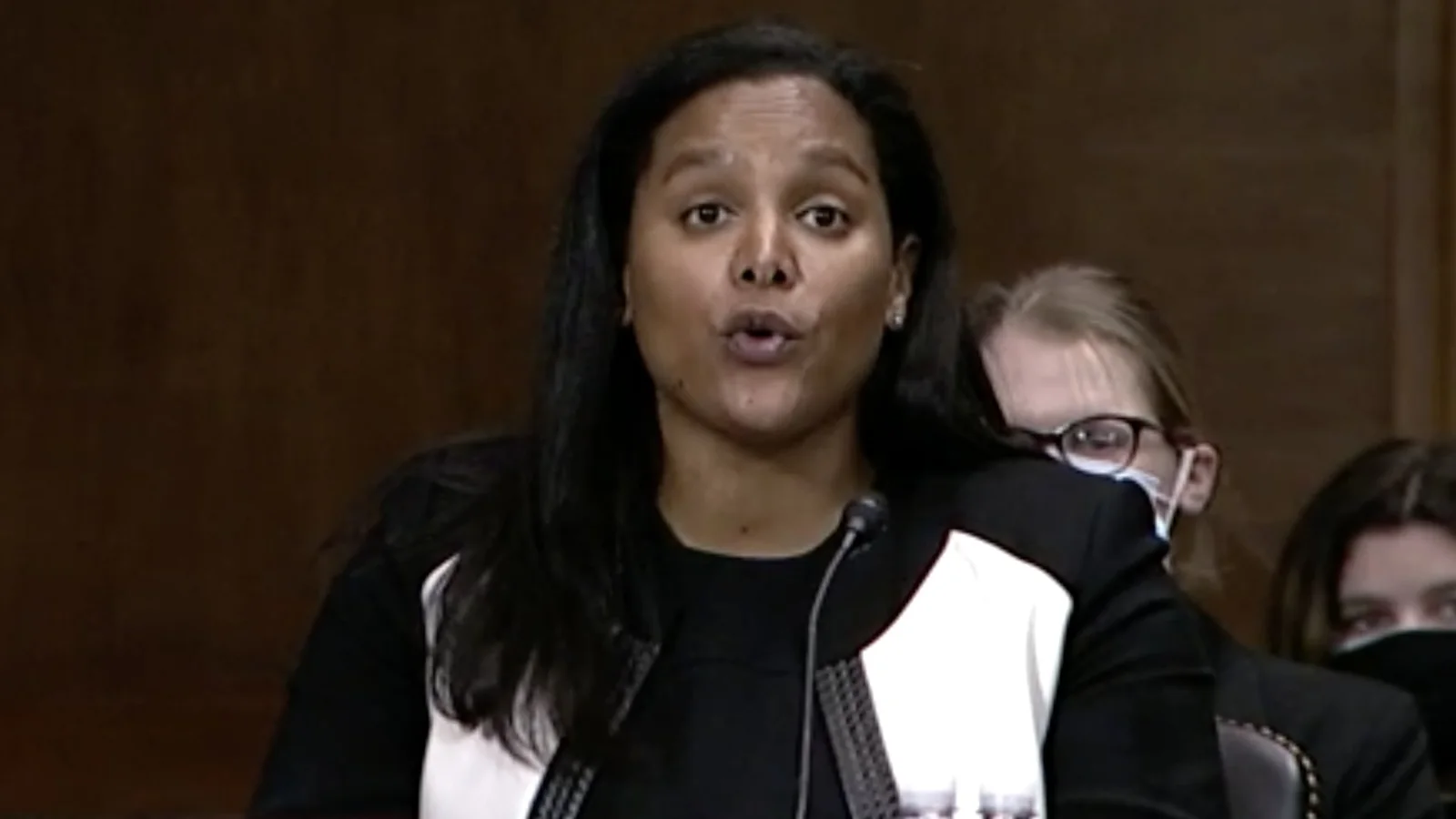
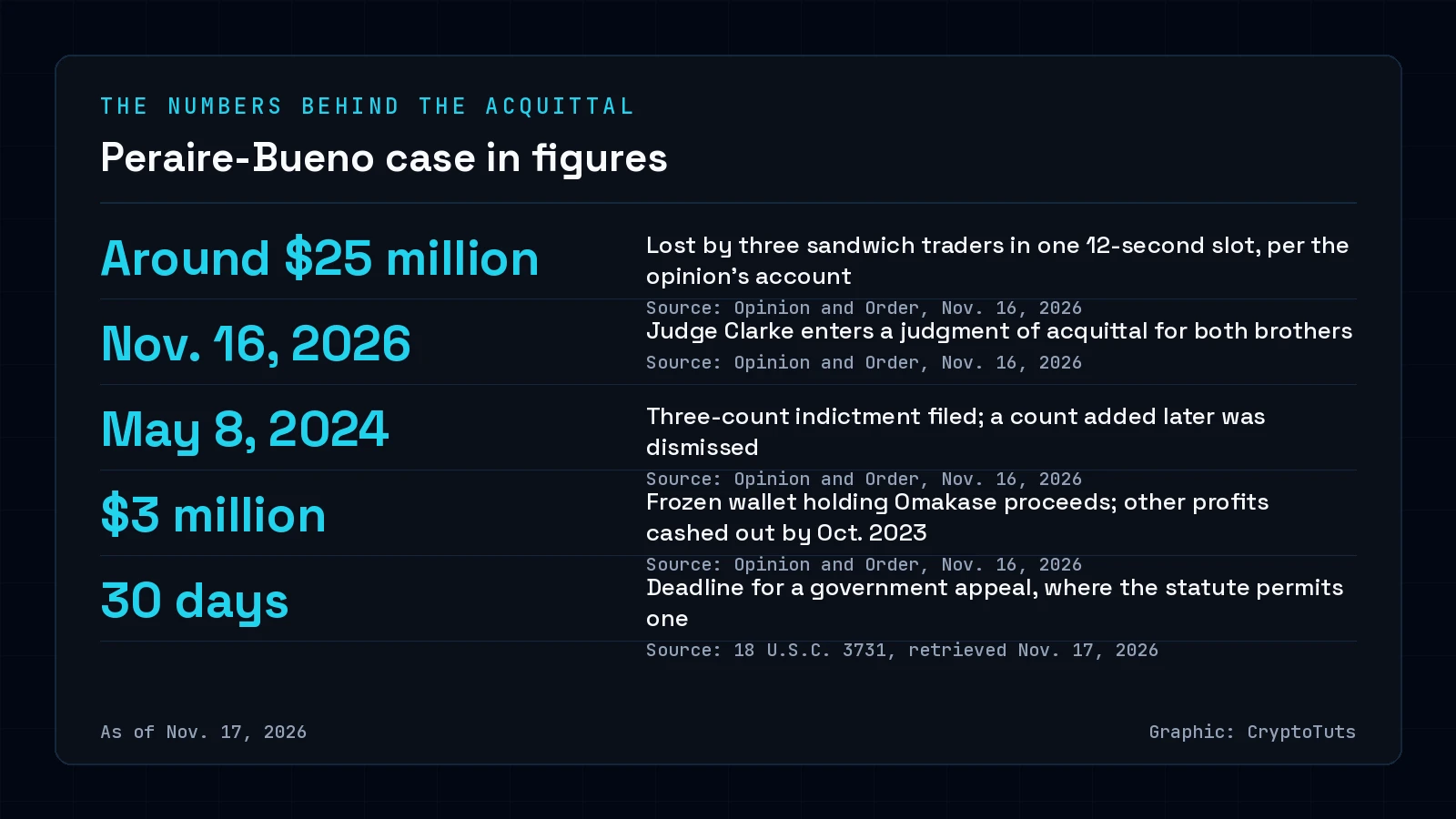
Judge Jessica Clarke acquitted the Peraire-Bueno brothers on Nov. 16, 2026, in the case over an April 2023 Ethereum trade that took around $25 million, by the court's account. Her opinion and order finds that prosecutors failed to prove a material misrepresentation, a false statement or impression capable of swaying a victim, which wire fraud requires.
A 1994 note to Rule 29 allows a government appeal of an acquittal only after a guilty verdict, and this jury returned none. Whether that limit ends the case for good is the question for anyone who trades or builds on Ethereum.
The judgment of acquittal clears Anton and James Peraire-Bueno of wire fraud, conspiracy to commit wire fraud and conspiracy to commit money laundering. A judgment of acquittal is a judge's ruling that the evidence cannot support a conviction, issued here after the jury failed to agree.
The 1994 advisory committee note to Rule 29 grounds its limit in the double jeopardy clause: an appeal is possible only if no new trial would be needed. Federal law (18 U.S.C. 3731) lets prosecutors appeal certain criminal rulings, except where the double jeopardy clause prohibits further prosecution.
The order directs the clerk of court to close the case. Decrypt reported that the ruling ends it without a retrial. A notice of appeal on the docket (No. 24-cr-293) or a statement from the U.S. Attorney's Office for the Southern District of New York would settle whether it stays closed.
A hung jury came before the acquittal
The opinion traces the case to May 8, 2024, when prosecutors charged the brothers in a three-count indictment: conspiracy to commit wire fraud, wire fraud and conspiracy to commit money laundering. A superseding indictment added a count of conspiracy to receive stolen property, which was later dismissed.
The trial ran nearly four weeks. After three days of deliberations, the jury could not reach a unanimous verdict, and Clarke declared a mistrial. The mistrial came in November 2025, according to Decrypt and Cointelegraph.
The brothers had moved for acquittal at the close of the government's case and again after the mistrial. Under Rule 29(b), Clarke ruled on the evidence as it stood at that first motion and found the remaining trial evidence confirmed the result. Rule 29 also lets a court enter a judgment of acquittal when the jury has failed to return a verdict.
The trade fit inside one 12-second slot
The opinion describes a trade built on MEV, the profit a block builder or trader can capture by choosing the order of transactions in a block, like cutting in line at a checkout. Three sandwich traders lost the money within one 12-second block slot. Sandwich traders are bots that place trades just before and after another user's trade to profit from the price move it causes.
Validators, the network participants who propose Ethereum blocks, take turns, one block per slot. MEV-Boost is software that lets them take blocks built by outside builders. A relay passes the block to the validator with its contents hidden, or blinded. It reveals the contents only after the validator signs the block's header, a short summary of the block.
The brothers' validator set two fields in that header, the parent and state roots, to their default of zero and signed it. The Ultrasound Relay left those fields unchecked at the time, approved the signature and released the block's contents.
Within 24 hours, Flashbots patched the relay code to verify that a blockheader could produce a valid block before revealing its contents. It also worked with other relays on similar updates.
Proposing two blocks for one slot got the validator slashed, a penalty built into Ethereum that the opinion puts at 1 ETH, or a few thousand dollars. Set that against the roughly $25 million the traders lost in a single 12-second slot. A wallet holding $3 million of the proceeds was frozen. By October 2023, the brothers had converted all other profits into U.S. dollars.
Clarke saw a possible scheme, but no lie
Clarke granted that the trial evidence could arguably show a scheme to obtain cryptocurrency from sandwich traders on Ethereum. What failed was the lie: none of the government's many theories let a reasonable juror infer a material misrepresentation.
The court boiled those theories down to three features of Omakase, its name for the scheme: the bait trades it calls lure transactions, a false signature and the failure to follow MEV-Boost's specifications. On the trial evidence, none of the three could be a material misrepresentation.
Prosecutors compared the lure transactions to spoofing, the practice of placing orders meant to be canceled so prices move. Clarke rejected the analogy. The lure transactions were executed and published in a block within a minute, outside any regulated market with rules prohibiting the conduct.
The court found that prosecutors presented no evidence of rules binding the brothers. MEV-Boost ran without terms of use or any independent mechanism to enforce behavior. Omakase “may have frustrated the spirit” of MEV-Boost's design, Clarke wrote, but the brothers made no misrepresentation in carrying it out that could support fraud.
Prosecutors had disclaimed an omission theory, so they needed to show an affirmative or implied misrepresentation. Evidence that the brothers knew their conduct was wrong and hid it goes to intent. Intent is a separate element of wire fraud and cannot make up for a missing misrepresentation.
The money laundering count fell with wire fraud. It charged a conspiracy to launder wire fraud proceeds, so without wire fraud the predicate unlawful activity was absent. Clarke acquitted on that count as a matter of law.
Only one trader who lost money testified
Of the three traders who lost money, only David Yakira, CEO of Savannah Technologies, took the stand, according to the opinion. Prosecutors called no expert witness on the Ethereum trading environment. They also called no witness from Ultrasound, the company that hosted the relay used in Omakase.
The case had cleared an earlier test. Before trial, the same court largely denied a motion to dismiss, finding the superseding indictment's allegations of material misrepresentations sufficient. That ruling tested what prosecutors alleged; the acquittal tested what the trial evidence showed.
In a footnote, Clarke declined to decide whether the superseding indictment violated the brothers' due process rights. She acknowledged that the prosecution raises serious due process concerns. The acquittal itself rests on the missing misrepresentation.
Clarke called a May 23, 2025, ruling by Judge Arun Subramanian of the same court instructive. In United States v. Eisenberg, Subramanian granted Avraham Eisenberg's Rule 29 motion after a jury had convicted him. He found insufficient evidence of falsity on the wire fraud count, said he would enter a judgment of acquittal on it and vacated the commodities convictions for lack of venue. The two rulings came at different stages: Eisenberg's after a guilty verdict, Clarke's acquittal after a hung jury.
The ruling covers only the charged crimes
Clarke drew the limits of the ruling herself. The question, she wrote, was not whether the brothers' conduct was right or moral, or whether it violated uncharged crimes. It was only whether the trial evidence could support wire fraud and the related charged offenses. For you as an Ethereum trader or MEV developer, the ruling is a finding about one trial's evidence on three charges.
Where the statute permits a government appeal, prosecutors must take it within 30 days, so that window is the one to watch. An order on forfeiture or release of the frozen $3 million would show what happens to that money.
Sources
- Opinion and Order granting judgment of acquittal, United States v. Peraire-Bueno, No. 24-cr-293 (S.D.N.Y.), Nov. 16, 2026 · U.S. District Court for the Southern District of New York (copy hosted by Thomson Reuters)
- Federal Rule of Criminal Procedure 29, Motion for a Judgment of Acquittal, with advisory committee notes · Legal Information Institute, Cornell Law School
- 18 U.S.C. 3731, Appeal by United States · Legal Information Institute, Cornell Law School
- Opinion and Order, United States v. Eisenberg, No. 23-cr-10 (S.D.N.Y.), May 23, 2025 · U.S. District Court for the Southern District of New York
- Judge acquits MIT brothers in $25M Ethereum MEV case, ending prosecution · Decrypt
- US judge acquits brothers in $25M Ethereum MEV exploit · Cointelegraph
About the author

Phil
Founder & Editor-in-Chief · In crypto since 2017
Phil is the founder of CryptoTuts and has explored Bitcoin, cryptocurrencies and blockchain technology since 2017. He explains complex topics clearly, with data and without empty promises.
- XRP and the XRPL
- Bitcoin
- Crypto tax records
- Exchange comparisons
- On-chain analysis