Analysis · Regulation
Fidelity Chainlink ETF: CME LINK futures pass a six-month mark
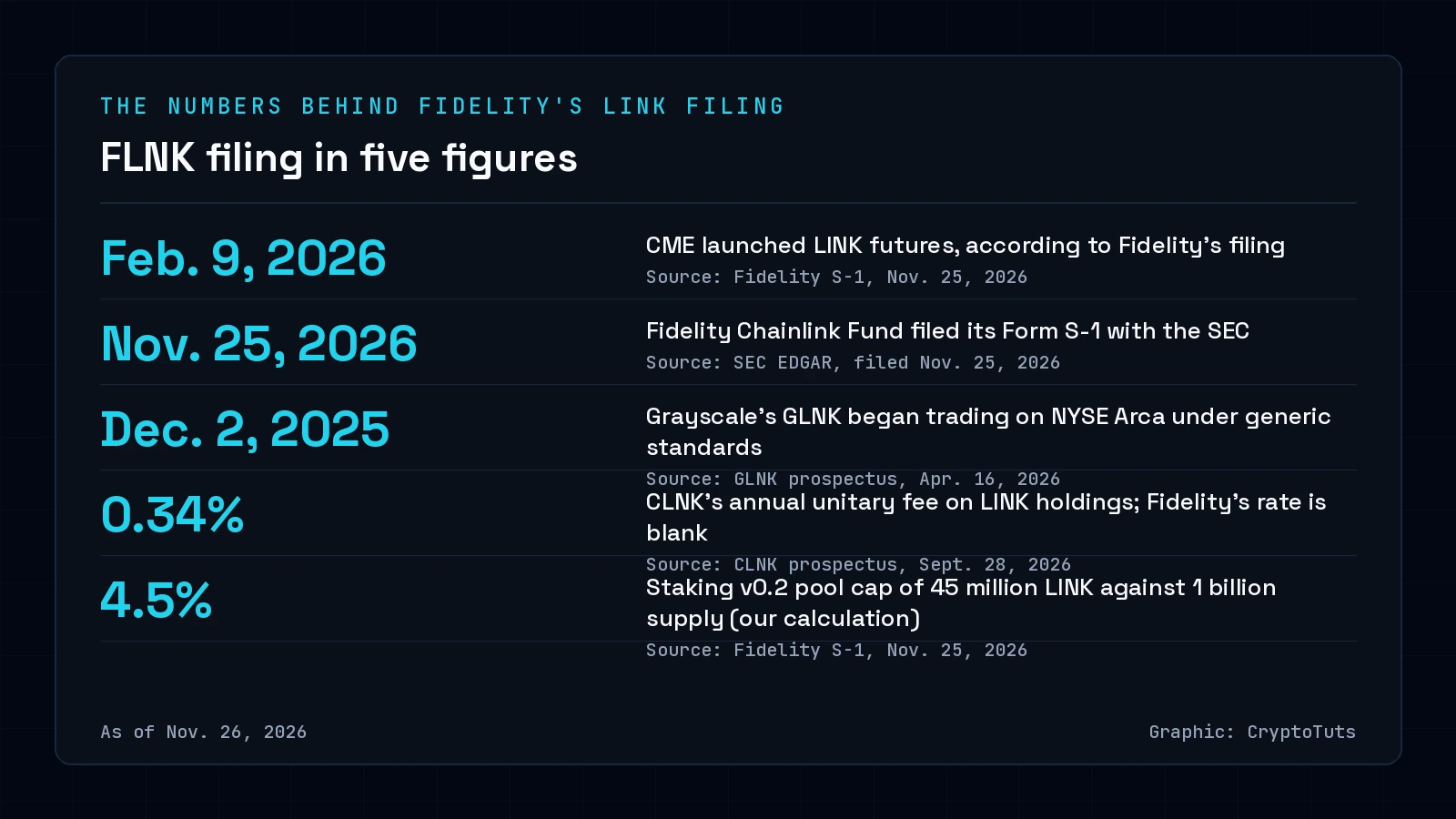
The Nov. 25, 2026, filing dates CME LINK futures to Feb. 9, 2026, 289 days earlier. Whether Nasdaq can use a generic listing route is still open, and so is the fee.
By Phil5 min read

The Fidelity Chainlink Fund, a spot LINK fund, filed a Form S-1 registration statement with the SEC on Nov. 25, 2026. Its shares are expected to trade on Nasdaq under the proposed ticker FLNK. The preliminary prospectus says CME launched LINK futures on Feb. 9, 2026, 289 days, or about 9.5 months, before the filing. That is longer than the six-month futures minimum in one generic Nasdaq route.
Which route Nasdaq takes is still open. A Rule 19b-4(e) posting or a separate Rule 19b-4 filing for the fund will settle it. The sponsor fee rate is also still a blank percentage.
For a LINK holder choosing a product, the filing already shows how FLNK would differ from Grayscale's and Bitwise's LINK ETFs. It names three custodians, where GLNK and CLNK each use Coinbase Custody as LINK custodian. CLNK may also keep a trading balance with Coinbase, Inc., its prime execution agent. The filing also rules out staking, which means locking tokens in a protocol in return for rewards.
Generic listing standards are exchange rules the SEC approved in a Sept. 17, 2025, order. Nasdaq can list commodity-based trust shares that meet them under Rule 19b-4(e), without SEC approval of each proposal. One route in Nasdaq's listing rule requires a futures contract on the commodity. That contract must have been available on a designated contract market, a futures exchange registered with the CFTC, for at least six months.
The same route also requires a comprehensive surveillance-sharing agreement with that futures market. Nasdaq can hold it directly or through common membership in the Intermarket Surveillance Group (ISG), a forum where markets share trading data.
Grayscale's GLNK already took the generic route
The prospectus of Grayscale's Chainlink Trust ETF shows the generic path in practice. NYSE Arca certified the fund's listing under the generic standards on Dec. 1, 2025. The shares began trading as GLNK the next day, Dec. 2, 2025.
LINK futures trade on two designated contract markets. Coinbase Derivatives has offered them since mid-2024, Fidelity's filing says, well ahead of CME's launch.
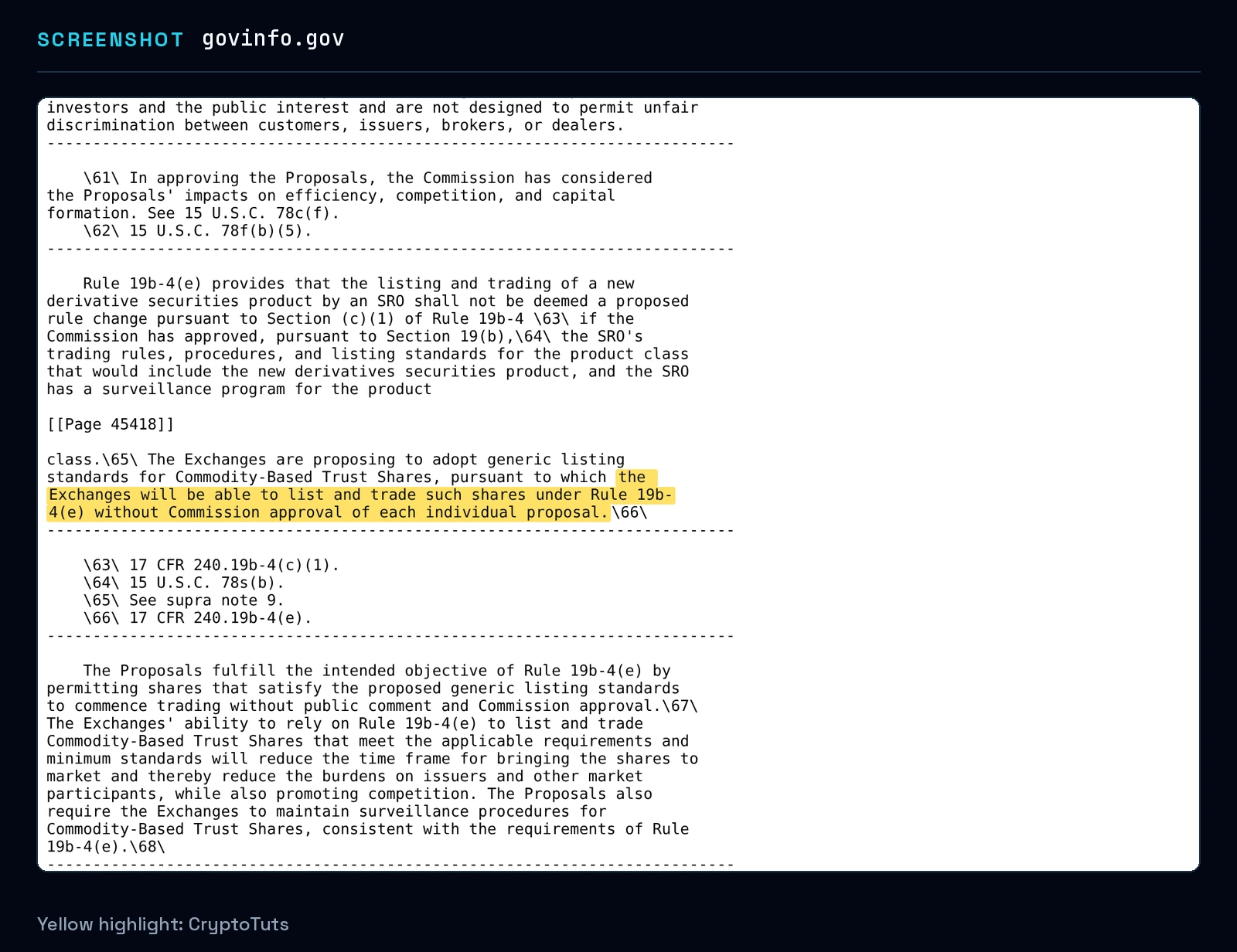
Through common ISG membership, NYSE Arca can obtain surveillance information on Coinbase Derivatives' LINK futures, Grayscale's prospectus says. That shared membership is the kind of link the futures route requires.
Another route depends on a fund already trading
Another route in the standards works for initial listing only. It relies on an exchange-traded fund that already trades on a national securities exchange. That fund must be designed to provide economic exposure of at least 40% of its net asset value to the commodity. The SEC's order defines such a fund under the Investment Company Act.
Products that meet none of the standards still need a separate rule filing under Rule 19b-4. In that case, the SEC rules on the proposal itself.
Three custodians where GLNK and CLNK use one
Fidelity's filing names Anchorage Digital Bank NA, BitGo Bank & Trust, N.A. and Coinbase Custody Trust Company, LLC. Together they would hold all of the fund's LINK, under custody agreements still to be entered into. The Grayscale and Bitwise prospectuses each name Coinbase Custody Trust Company as the sole LINK custodian. Coinbase, Inc. serves the Bitwise fund as prime execution agent.
The fund would hold only LINK that exists on the Ethereum blockchain, although LINK is also available on other chains.
Authorized participants, the trading firms that create and redeem ETF shares in bulk, deal with the fund directly. Fidelity lets them place creation orders in LINK or in cash. Its filing also describes cash redemptions. GLNK and CLNK each create and redeem shares in baskets of 10,000.
Custody costs would come out of the unified sponsor fee, set as a percentage of the fund's LINK holdings. The sponsor would pay ordinary operating expenses from that fee, including custody and listing costs. CLNK pays its sponsor a unitary fee of 0.34% a year of its Chainlink holdings, as of its Sept. 28, 2026, prospectus.
Rivals keep a staking option FLNK rules out
The preliminary prospectus keeps the fund's LINK out of staking, so shareholders would receive no staking rewards through it. Both rivals keep the option open. CLNK did not stake as of its Sept. 28, 2026, prospectus but could amend its registration to do so. GLNK may stake only if its Staking Condition is met and at the sponsor's discretion, with no assurance that it will.
Chainlink's current Staking v0.2 pool has a maximum capacity of 45 million LINK. Against the fixed supply of 1 billion LINK, that ceiling equals 4.5% of total supply. The figure caps the pool; the amount actually staked is a separate number.
Fidelity's filing spells out its own risks
Fidelity's filing says a March 17, 2026, joint SEC-CFTC interpretation names Chainlink as an example of a digital commodity that is not itself a security. The label matters for a commodity trust, the product generic standards cover, yet the interpretation is not formal rulemaking and a future administration could modify or withdraw it.
The sponsor is FD Funds Management LLC, a wholly owned subsidiary of FMR LLC. A sponsor affiliate, Fidelity Product Services LLC, developed the reference index methodology and serves as index provider. The filing flags that tie as a possible conflict of interest. Coin Metrics, Inc. is the third-party calculation agent.
Another sponsor affiliate, FMR Capital, Inc., is named as seed capital investor in a bracketed passage. Its dates, share counts, per-share prices and proceeds are still blank.
The sponsor also has no policies and procedures requiring personnel to pre-clear trading in certain digital assets, including LINK.
Sale to the public would begin as soon as practicable after the S-1, the offering document, becomes effective. The filing sets no date for it.
Link disclosure: Sponsored module: Kalshi sponsors CryptoTuts, and we are compensated when readers sign up through the marked link (*). The reporting is independent of it. Read more
Sources
- Fidelity Chainlink Fund, Form S-1 registration statement and preliminary prospectus (filed Nov. 25, 2026) · U.S. Securities and Exchange Commission (EDGAR)
- SEC Release No. 34-103995, Order Granting Accelerated Approval of Generic Listing Standards for Commodity-Based Trust Shares · Federal Register
- SEC Release No. 34-105995, Order Approving SR-NASDAQ-2026-032 to Amend Nasdaq Rule 5711(d) · U.S. Securities and Exchange Commission
- Grayscale Chainlink Trust ETF (GLNK), prospectus Form 424B3 dated April 16, 2026 · U.S. Securities and Exchange Commission (EDGAR)
- Bitwise Chainlink ETF (CLNK), prospectus Form 424B3 dated Sept. 28, 2026 · U.S. Securities and Exchange Commission (EDGAR)
About the author

Phil
Founder & Editor-in-Chief · In crypto since 2017
Phil is the founder of CryptoTuts and has explored Bitcoin, cryptocurrencies and blockchain technology since 2017. He explains complex topics clearly, with data and without empty promises.
- XRP and the XRPL
- Bitcoin
- Crypto tax records
- Exchange comparisons
- On-chain analysis