Analysis · Regulation
Bitcoin reserve bill dies with Congress unless both chambers act
The House Financial Services Committee reported H.R. 8957 on Nov. 24, but the 119th Congress ends Jan. 3, 2027, and no floor schedule lists the bill yet.
By Phil6 min read

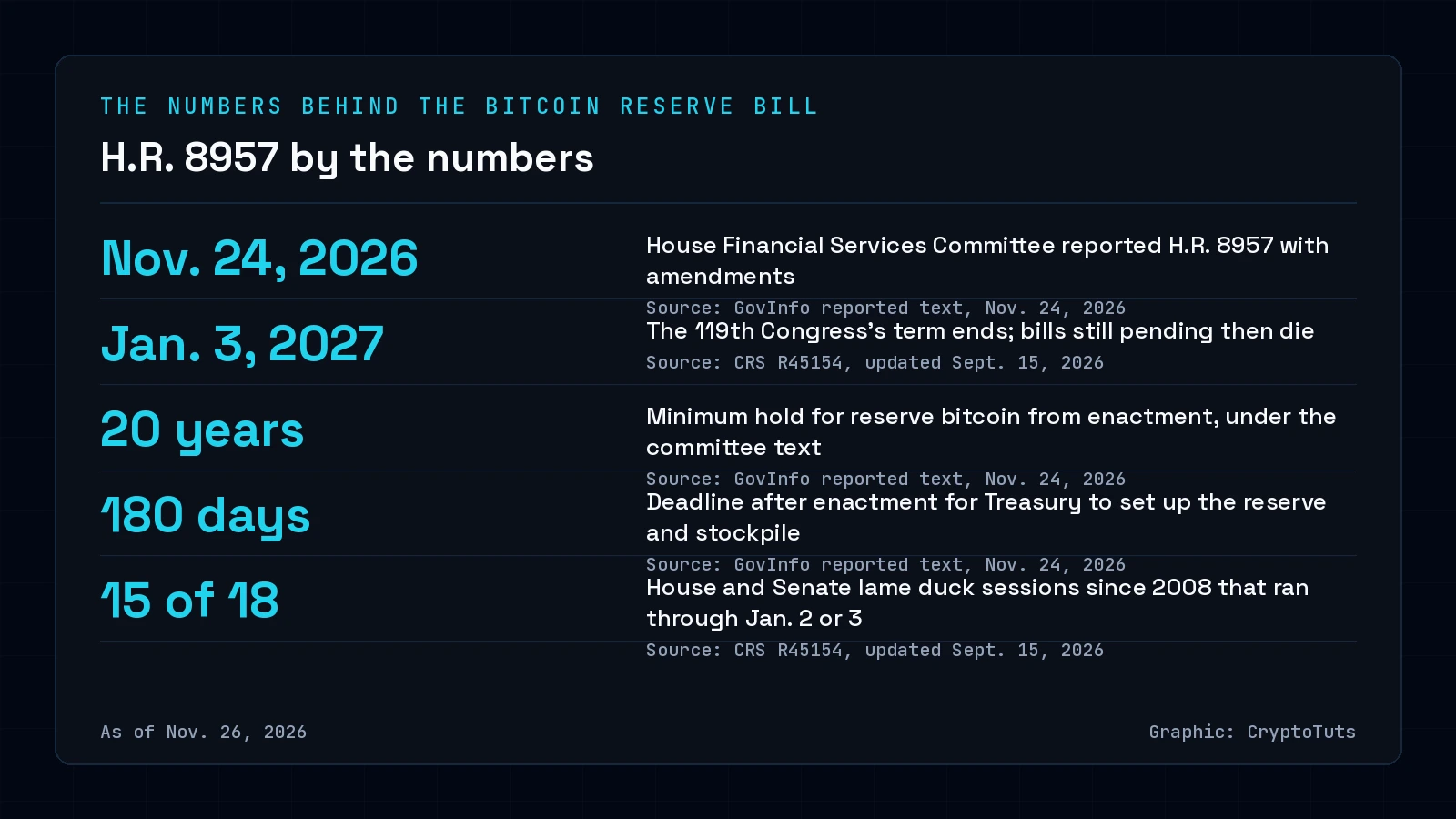
The House Financial Services Committee reported H.R. 8957, the bill that would create a Strategic Bitcoin Reserve, on Nov. 24, 2026. That left 40 days until the 119th Congress's term ends Jan. 3, 2027. Unless the House and the Senate both pass the bill before Congress adjourns for good, it dies.
The window is narrow but open. The committee-reported text places the bill on the House calendar as Union Calendar No. 789. Under modern practice described by the Congressional Research Service, a reported bill can receive action until the final sine die adjournment of a Congress's last session. Sine die means adjournment with no set day to return.
No floor schedule lists the bill yet
The House floor schedule for the week of Nov. 16, last updated Nov. 18, predates the report and does not list the bill. As of Nov. 26, 2026, H.R. 8957 can still pass. A majority leader's floor schedule naming it for December, or Senate action on its congress.gov page, would show it is moving.
Both chambers must pass the same text before the term ends. The signature can come later. The president has 10 days, Sundays excepted, and may sign the bill even after Jan. 3. If that window runs out after the term ends, the president can pocket veto the bill, letting it die unsigned.
Lame duck sessions often run to the last day
Since 1935, a Congress's term has run from Jan. 3 of an odd-numbered year to Jan. 3 of the next one. Any meeting between the November election and that date is a lame duck session. It belongs to the sitting Congress.
Such sessions are now routine. According to a Congressional Research Service report updated Sept. 15, 2026, lame duck sessions took place in all 13 Congresses from the 106th through the 118th. That span covers 1999 to 2024. Between 1935 and 1998, 12 of 32 Congresses held one.
Those sessions tend to use the full calendar. Since 2008, 15 of 18 House and Senate lame duck sessions extended through Jan. 2 or Jan. 3. In eight of the past nine Congresses, at least one chamber adjourned on one of those two dates.
The counterweight is political. Democrats won control of both the House and the Senate in the November midterms, about three weeks before the bill reached the calendar, Unchained reported. Any vote on H.R. 8957 this term would still come from the members of the sitting Congress.
The reserve would lock bitcoin for 20 years
The committee text directs the Treasury secretary to set up a Strategic Bitcoin Reserve within the Treasury Department. The deadline is 180 days after enactment. A separate Digital Asset Stockpile would hold other qualifying digital assets.
Rep. Nick Begich sponsors the bill. The reported text lists 23 cosponsors: 21 original plus Reps. Byron Donalds and Maria Elvira Salazar. GovInfo's metadata lists 22.
Treasury would have to hold the reserve's bitcoin for at least 20 years from enactment. Until then, reserve bitcoin could not be sold, swapped, auctioned, encumbered or otherwise disposed of for any purpose. If the bill became law on Jan. 1, 2027, for example, the lock would run until at least Jan. 1, 2047.
After that minimum hold, the secretary may recommend selling up to 10% of the reserve's assets in any two-year period. The 10% bounds what the secretary may recommend.
Within a year of enactment, the secretary would also owe Congress a study on early sales. It would cover when reserve bitcoin could be sold before the 20 years end. It would also carry legislative recommendations for exceptions such as national security and financial stability.
Until the reserve and the stockpile are set up, agencies would transfer custody of qualifying holdings to Treasury where practicable and consistent with law. Holdings that cannot be moved stay with the agency. The introduced version had agencies keep custody until the reserve was certified operational. Each executive agency would also give Treasury a complete accounting of its bitcoin and other digital assets within 60 days of enactment, then every year.
For a bitcoin holder, the reserve is a holding plan rather than a buying plan. The text directs no bitcoin purchases, and acquiring more is the subject of a study.
The committee changed four rules from May
The committee reported the bill with amendments to the May 21 introduced text. Four changes reach holders and taxpayers directly:
- Which bitcoin counts: all bitcoin the federal government owns that no law requires for another purpose, forfeited coins included. The May version covered only bitcoin finally forfeited or taken to satisfy civil money penalties.
- Where sale proceeds go: to the costs of managing the reserve or stockpile, with any excess going to the Treasury to reduce the national debt. The May version used stockpile proceeds only to add bitcoin to the reserve or reduce the debt.
- When the hold ends: 20 years from enactment for every coin, so later deposits reach the minimum on the same date. The May version counted 20 years from the date of deposit for bitcoin added later.
- How often Treasury reports: once a year, in a Proof of Reserve report on total holdings, transactions and control of private keys, replacing quarterly reports. An independent auditor still verifies it, and the Comptroller General oversees it.
The acquisition study, due within 180 days of enactment, looks at budget-neutral ways to acquire bitcoin. Its list of mechanisms drops two the May version named: Federal Reserve surplus remittances and revaluation of the Fed's gold certificates. The study section also expressly authorizes no borrowing, other financing, pledging of U.S. assets as collateral, new taxes or deficit spending to buy bitcoin.
Forked assets in the reserve or stockpile face a one-year disposal bar from the date of the fork, down from five years, unless a law explicitly allows a sale. The bar covers airdropped assets too, but the committee text ties its start only to the fork date.
The committee text ends at Section 10. It drops the May version's Section 11, which had Exchange Stabilization Fund reports account for bitcoin transactions and holdings.
If time runs out, the reserve never starts
If the 119th Congress adjourns for good before both chambers pass H.R. 8957, the bill dies. The reserve, the 20-year lock and the acquisition study would then never start.
If the bill reaches the floor, compare any amendment with the Nov. 24 committee text, especially the 20-year hold and the proceeds rule. The reported bill carries House Report No. 119-894. That report and any Congressional Budget Office cost estimate are the next documents to read.
Link disclosure: Sponsored module: Kalshi sponsors CryptoTuts, and we are compensated when readers sign up through the marked link (*). The reporting is independent of it. Read more
Sources
- H.R. 8957 (RH), American Reserve Modernization Act of 2026, reported in House · U.S. Government Publishing Office (GovInfo)
- GovInfo content details: BILLS-119hr8957rh · U.S. Government Publishing Office (GovInfo)
- H.R. 8957 (IH), American Reserve Modernization Act of 2026, introduced text · U.S. Government Publishing Office (GovInfo)
- House floor documents: bills scheduled for the week of Nov. 16, 2026 · U.S. House of Representatives
- CRS Report R42977, Sessions, Adjournments, and Recesses of Congress · Congressional Research Service (via EveryCRSReport)
- CRS Report R45154, Lame Duck Sessions of Congress, 1935-2024, updated Sept. 15, 2026 · Congressional Research Service (via EveryCRSReport)
- Strategic Bitcoin Reserve Bill Reaches the House Calendar, Awaiting a Floor Vote · Unchained
About the author

Phil
Founder & Editor-in-Chief · In crypto since 2017
Phil is the founder of CryptoTuts and has explored Bitcoin, cryptocurrencies and blockchain technology since 2017. He explains complex topics clearly, with data and without empty promises.
- XRP and the XRPL
- Bitcoin
- Crypto tax records
- Exchange comparisons
- On-chain analysis