Analysis · Regulation
Binance hack USDC: the attorney general decides any return
The Justice Department says it filed Nov. 23 to forfeit over $1.1 billion. Any return to Binance comes after a forfeiture order, by remission or restoration.
By Phil6 min read
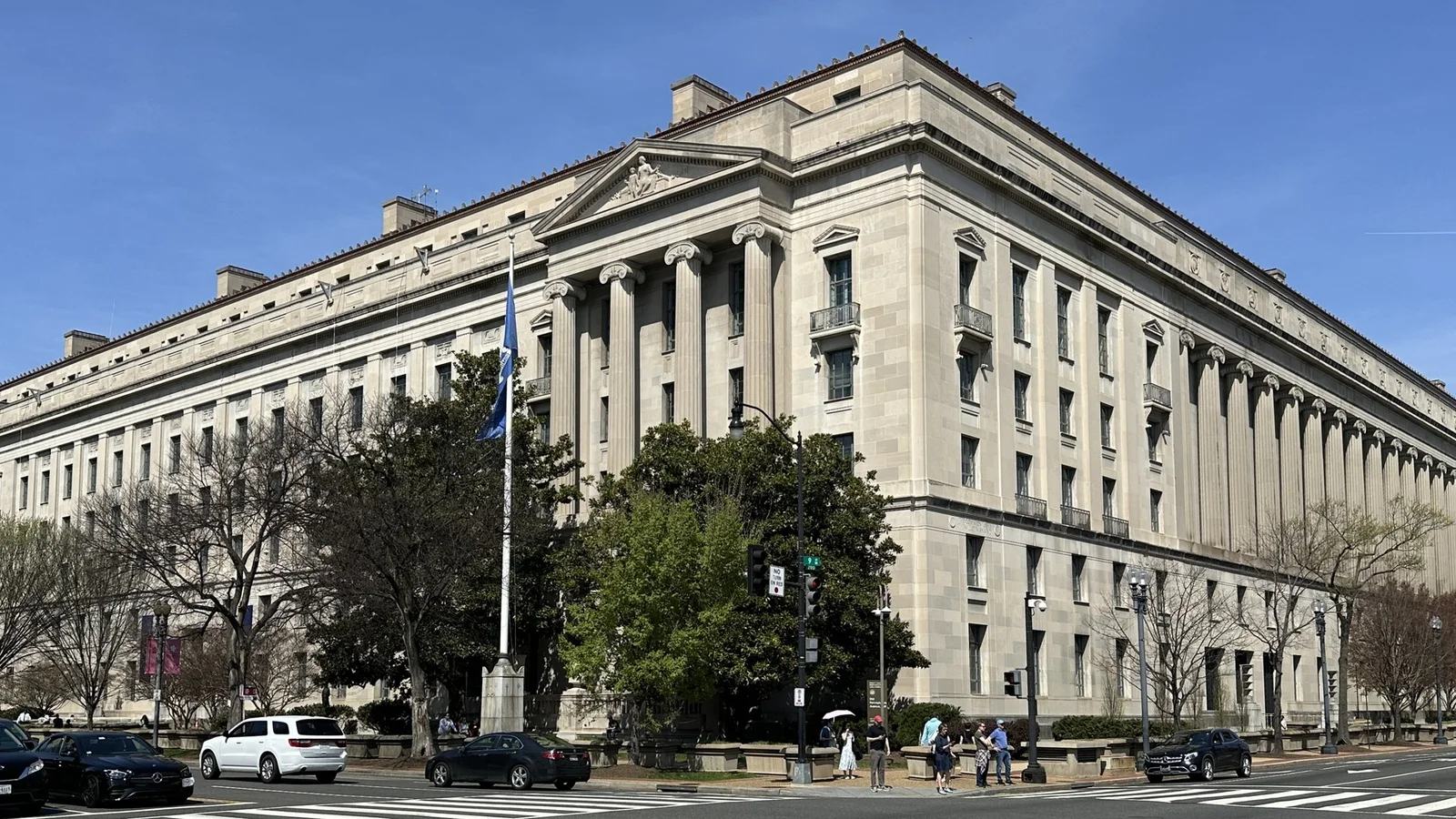
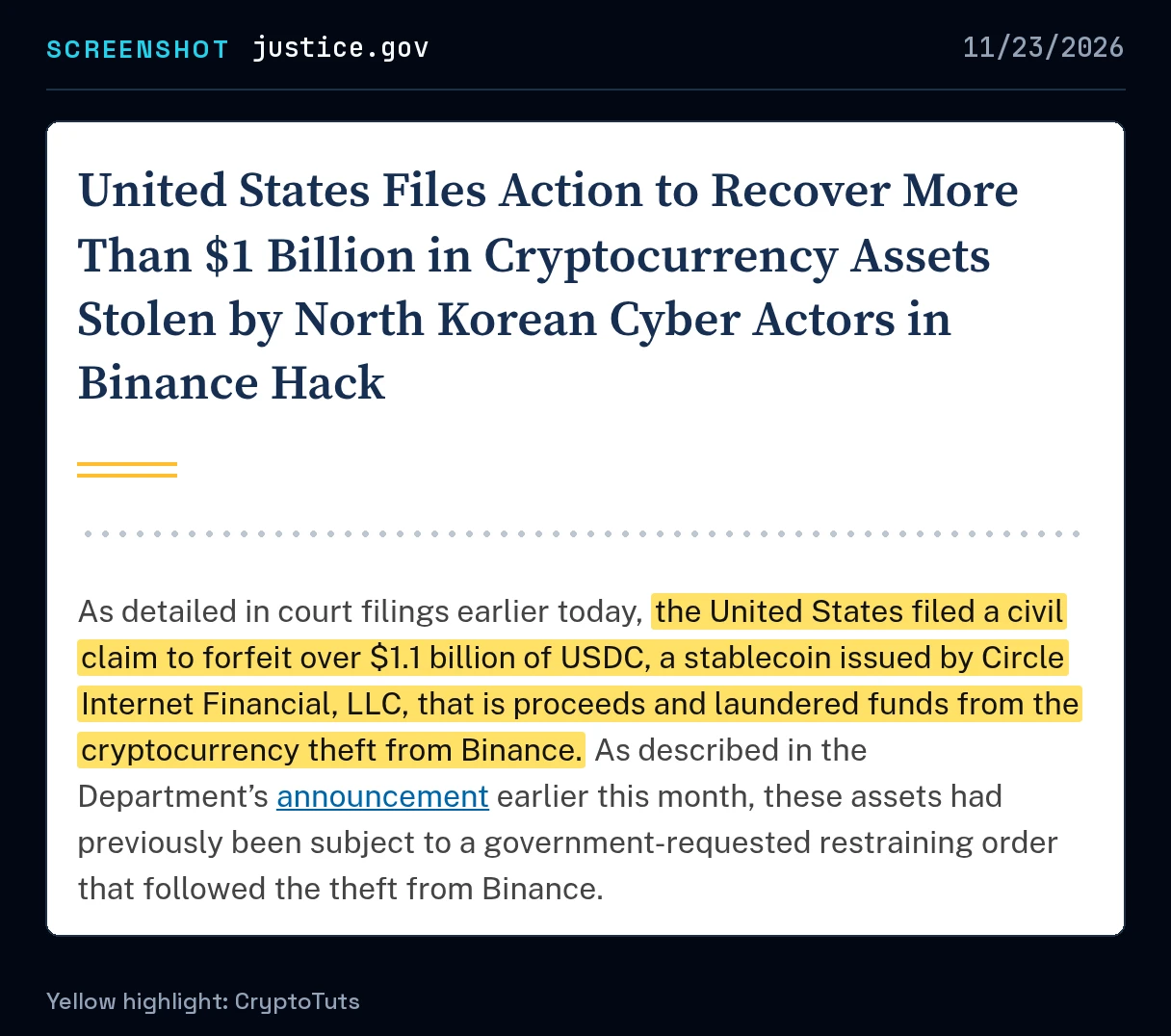
The United States filed Nov. 23, 2026, to forfeit more than $1.1 billion in USDC, a stablecoin issued by Circle. The Justice Department describes the coins as proceeds and laundered funds of the Binance theft. For Binance and its customers, the real question is who decides where that money goes. In a court forfeiture, the attorney general alone rules on remission petitions under the civil forfeiture statute (18 U.S.C. 981).
The verified complaint, filed in U.S. District Court for the District of Columbia, targets all USDC tied to 36 addresses on 18 blockchains. It is a civil forfeiture in rem: a lawsuit against the property itself, not a person, asking a court to transfer ownership to the government. The complaint calls the USDC proceeds of computer fraud, wire fraud and wire fraud conspiracy, and property involved in money laundering and money laundering conspiracy.
The outcome is still open. The filing asks that the USDC be forfeited to the United States. Any return to Binance would come later, through a remission or restoration decision by the attorney general rather than the court. A final forfeiture order in the case (Civ. No. 26-4150) settles the first step. A Justice Department ruling on a remission petition, or a restoration decision, settles the second.
The attorney general decides any return
After a final forfeiture order, the government asks that the U.S. Marshal dispose of the USDC according to law.
The first route to a victim is remission. Remission is a Justice Department procedure in which a victim asks for forfeited property back, decided outside court. Under the department's petition rule for court forfeitures, the petition is addressed to the attorney general and submitted to the U.S. attorney for the district. The chief of the Asset Forfeiture and Money Laundering Section rules on it without a hearing.
Restoration is the second route. The statute lets the attorney general transfer forfeited property to any victim of the offense behind the forfeiture. It also lets the attorney general keep the property.
Remission comes with a compensation test
The government's Nov. 23 motion for a restraining order says Binance has told the public it is self-insuring all losses. Binance currently appears to have enough holdings to meet that pledge, the motion adds.
The department's victim remission rule sets conditions and limits for any payout. Among them:
- No compensation for the loss from the perpetrator or others.
- No recourse reasonably available to other assets.
- A cap at the lost property's fair market value on the date of loss.
- A cap at the victim's share of net forfeiture proceeds, after allowable government expenses and valid third-party claims.
- Repayment to the Assets Forfeiture Fund if the victim is later compensated from another source.
The rule covers only property forfeited under statutes that explicitly authorize restoration or remission to victims. A petition can be considered until the forfeited property is disposed of.
The complaint also calls on anyone with an interest in the USDC to appear and respond. The government says it knows of no claimants so far. Its proposed order leaves the owners of the stolen property free to be heard later if the interests of justice require. Binance and Circle, through counsel, consented to the Nov. 12 order and its extension and waived being heard at this stage.
Circle's Oct. 29 freeze set up the case
According to the complaint, Circle blocked the USDC at Subject Addresses A through D on or about Oct. 29, 2026. It also blocked Binance smart contract and hot wallet addresses, E through JJ, that the attackers had compromised. The attackers had drained some, but not all, of the funds there before the block.
A blocklist is Circle's freeze on specific addresses: their USDC stays in place, while a seizure would change ownership. Circle lacks the technical ability to move the blocklisted USDC to the United States. It has agreed instead to voluntarily issue the same amount of new USDC, called substitute USDC. It would transfer that substitute USDC to the government once the court enters a forfeiture order.
The restraining-order motion says Circle indicated Nov. 6 that it would keep the funds blocked until the forfeiture proceeding ends or the court orders otherwise.
The court issued a temporary restraining order Nov. 12, 2026. It was served on Circle the same day.
The forfeiture covers a subset of the property under that order, because the victim will be able to get one address released when the order expires. The government is proceeding against all other addresses.
Each dollar figure measures something different
The department's Nov. 23 release gives the lead figure, more than $1.1 billion, as a minimum. The restraining-order motion, filed the same day, puts the funds in that application at approximately $1 billion.
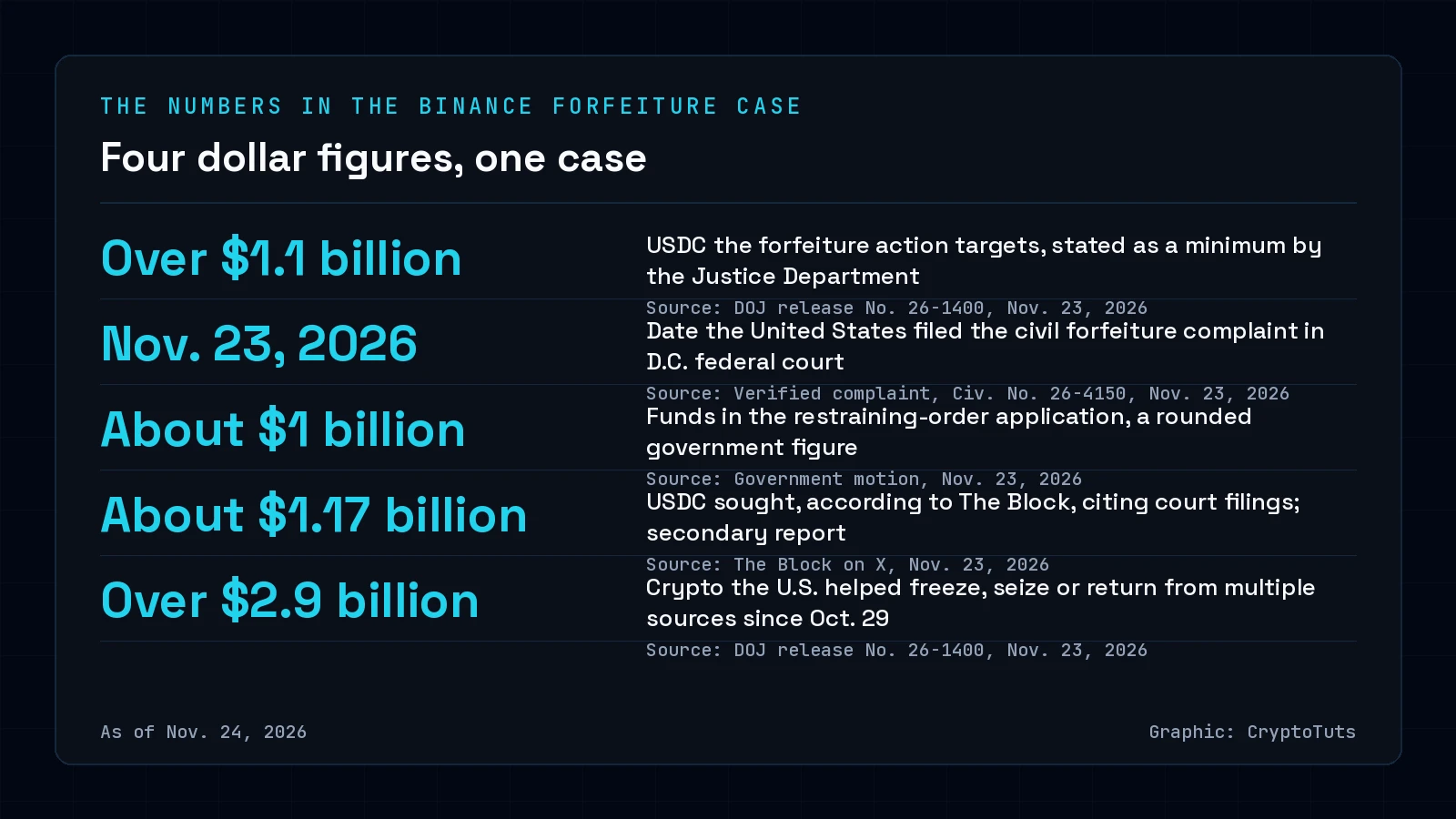
The Block put the USDC sought at about $1.17 billion, citing the court filings.
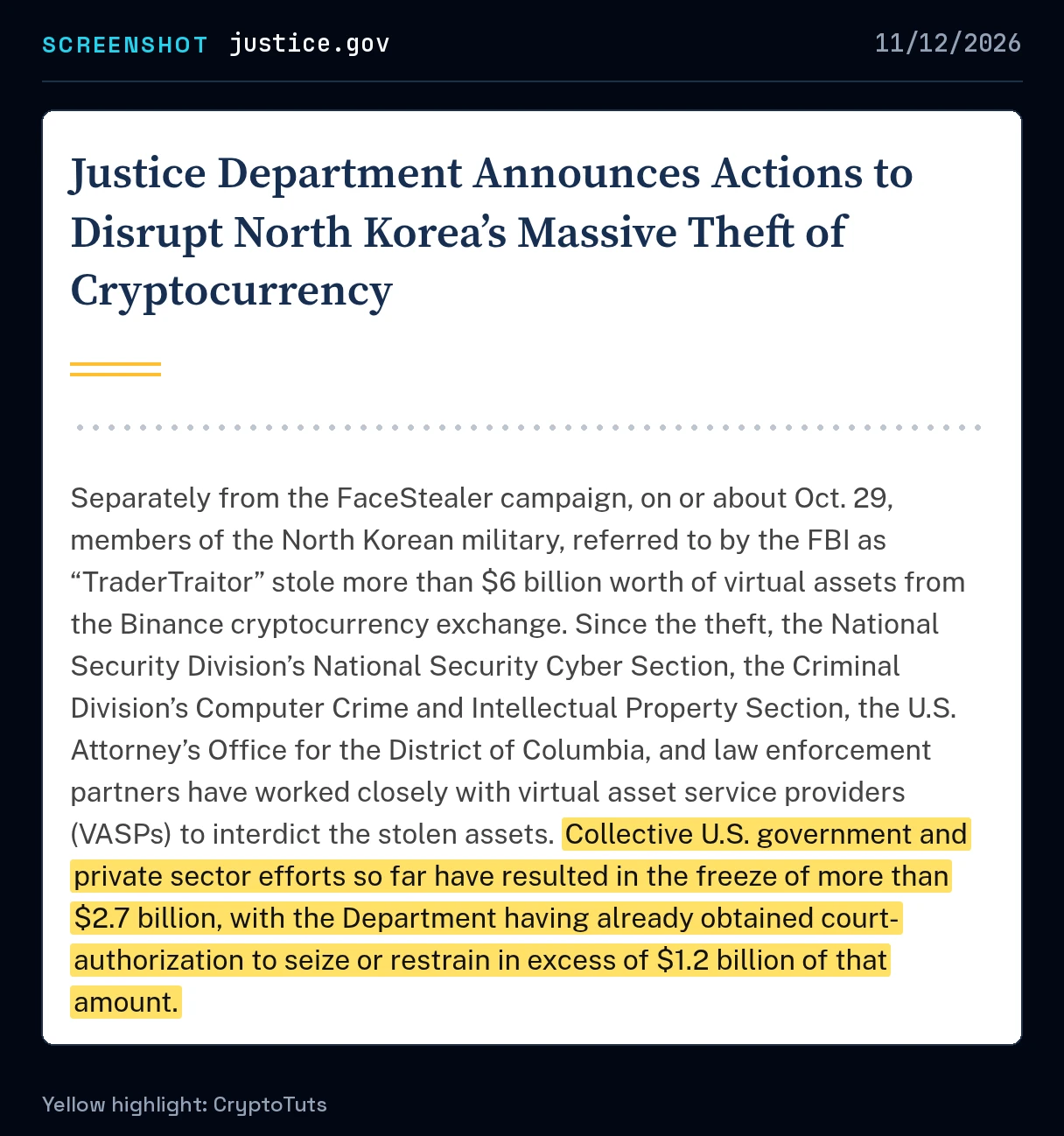
The broadest figure covers the whole recovery effort. The Nov. 23 release counts more than $2.9 billion worth of cryptocurrency from multiple sources. The United States has assisted in freezing, seizing or returning that amount since the theft on or about Oct. 29. On Nov. 12, the department's earlier release put the amount frozen by government and private-sector efforts at more than $2.7 billion. Court authorization covered seizing or restraining more than $1.2 billion of that.
Side by side, the figures cover three different things: the USDC in one case, the funds in one court application and the cryptocurrency the United States assisted in freezing, seizing and/or returning across the whole effort.
A ruling on Circle's blocklist comes next
The next step is a ruling on the government's Nov. 23 motion. It asks the court to order Circle to keep the addresses blocklisted until further order, for as long as the case runs. The motion's reason: it was not clear when or if the Nov. 12 order expired.
After that, watch Binance. A statement on how it is covering losses, or a claim or petition filed in the case, would be the first sign of whether it seeks the money back.
Sources
- Verified Complaint for Forfeiture In Rem, United States v. All USDC Associated With 36 Virtual Currency Addresses on 18 Different Blockchains (Civ. No. 26-4150) · U.S. Attorney's Office for the District of Columbia
- Motion for Restraining Order, USDC associated with 36 virtual currency addresses on 18 blockchains · U.S. Attorney's Office for the District of Columbia
- United States Files Action to Recover More Than $1 Billion in Cryptocurrency Assets Stolen by North Korean Cyber Actors in Binance Hack (Press Release No. 26-1400, Nov. 23, 2026) · U.S. Justice Department, Office of Public Affairs
- Justice Department Announces Actions to Disrupt North Korea's Massive Theft of Cryptocurrency (Press Release No. 26-1356, Nov. 12, 2026) · U.S. Justice Department, Office of Public Affairs
- 18 U.S.C. 981, Civil forfeiture · Legal Information Institute, Cornell Law School
- 28 CFR 9.8, Remission procedures for victims · Legal Information Institute, Cornell Law School
- 28 CFR 9.4, Petitions in judicial forfeiture cases · Legal Information Institute, Cornell Law School
- The Block on X: U.S. prosecutors seek to forfeit about $1.17 billion in USDC from the Binance hack · The Block
About the author

Phil
Founder & Editor-in-Chief · In crypto since 2017
Phil is the founder of CryptoTuts and has explored Bitcoin, cryptocurrencies and blockchain technology since 2017. He explains complex topics clearly, with data and without empty promises.
- XRP and the XRPL
- Bitcoin
- Crypto tax records
- Exchange comparisons
- On-chain analysis