Analysis · Regulation
CFTC staff letter reuses March haircuts for derivatives venues
The 20% minimum for bitcoin and ether and the 2% level for payment stablecoins first appeared March 20, 2026, as charges on futures brokers' own crypto. The new letter moves them to venues' operating costs.
By Phil5 min read

Discounts CFTC staff first accepted for futures brokers' own crypto on March 20, 2026, now reach the operating money of US derivatives venues. Staff Letter No. 26-31, dated Nov. 23, 2026, says futures exchanges, swap execution facilities and clearinghouses may count bitcoin, ether and payment stablecoins toward a year's operating costs. Bitcoin and ether count at least 20% below market value, payment stablecoins 2% below. Exchanges and clearinghouses must still hold six months of costs in cash or highly liquid securities, and clearinghouse default resources stay outside the letter.
Staff call such a discount a haircut: the share of market value knocked off before an asset counts. The levels themselves date to March, and what the letter adds is a new place for them. Under the existing rules, each venue's buffer has two parts: a floor in cash or highly liquid securities, and a remainder that crypto may fill at a discount.
Staff reused levels from March broker guidance
Two staff divisions issued the letter with a CFTC press release: the Division of Market Oversight (DMO) and the Division of Clearing and Risk (DCR). It applies to the financial resources rules for all three venue types (Regulations 37.1301, 38.1101(a) and 39.11(a)(2)). Duncan Hennes, acting director of DMO, and Richard Haynes, acting director of DCR, signed it.
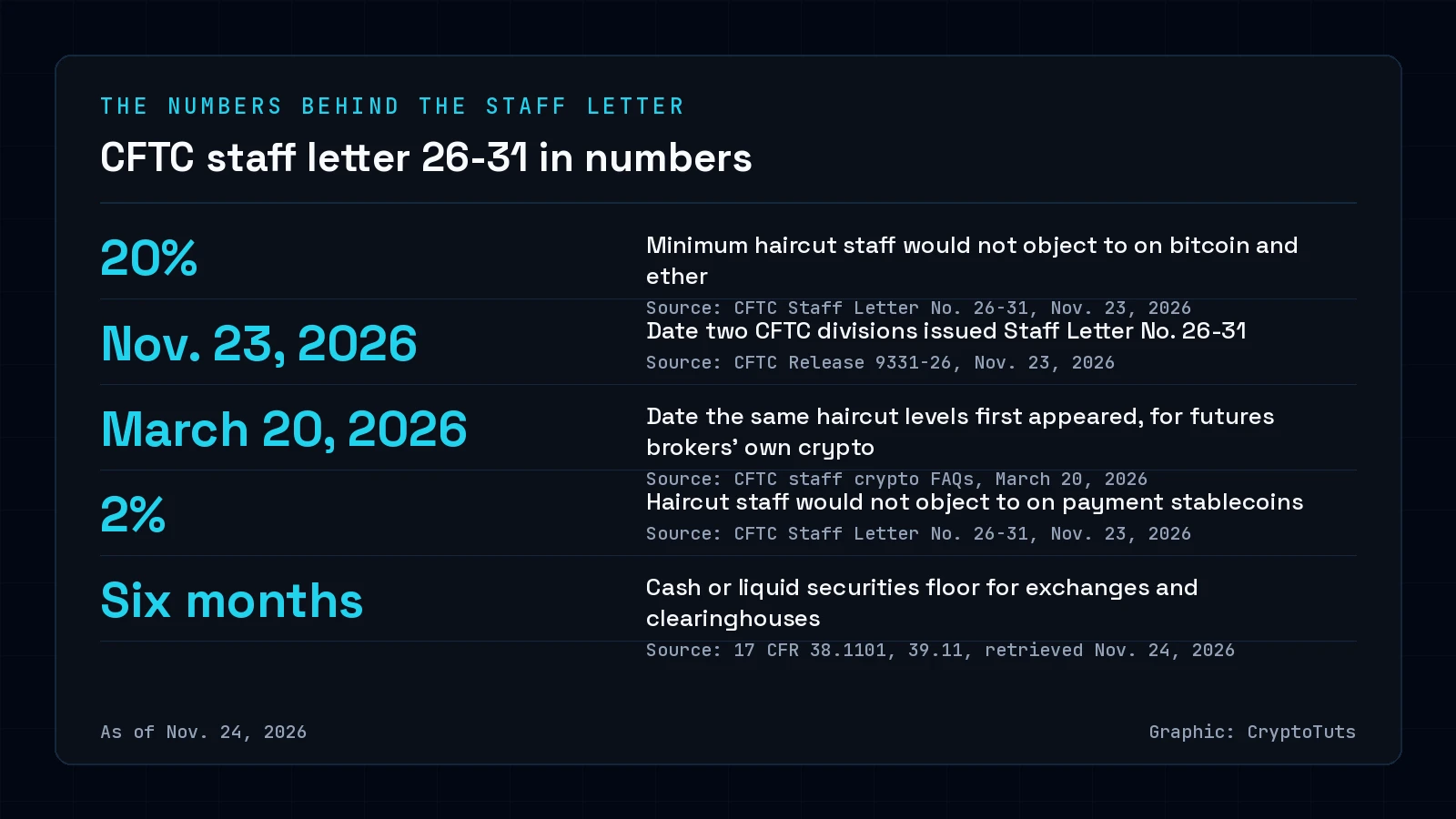
The levels first appeared in the staff crypto FAQs of March 20, 2026 (Q6), as capital charges on crypto that futures commission merchants hold for themselves. These are the brokers that carry customer futures accounts. The Sept. 24, 2026, reissue repeated the levels.
The letter is staff guidance and speaks for the two divisions only. It creates no binding rules, enforceable rights or no-action position. The Commission's own view may differ.
Crypto counts only above the cash floor
The exchange rule and the clearinghouse rule set the six-month floor, and the cash or securities in it must be unencumbered. The swap facility rule sets a floor of three months of projected operating costs or projected wind-down costs, whichever is greater. Bitcoin, ether and payment stablecoins count only toward the rest of the year.
Staff give two grounds for keeping crypto out of the floor. Under GAAP, the US accounting standard, crypto, payment stablecoins included, falls outside cash. As non-security assets, these tokens also fall outside highly liquid securities.
Each token counts at its current market value minus haircuts for market and credit risk. At clearinghouses, the haircuts also cover liquidity risk and must be evaluated monthly. A counted balance therefore moves with the price of bitcoin or ether.
For bitcoin and ether, 20% is a minimum, so a venue may apply a larger haircut. Payment stablecoins, as the letter defines them, carry 2%.
Exchanges and swap facilities that want to count another token should engage with DMO on compliance, and clearinghouses with DCR. A token that is neither readily marketable nor a payment stablecoin would generally take a 100% haircut and count for nothing. The letter covers crypto only.
"Up to half" is arithmetic, not a cap
Unchained's Nov. 24, 2026, headline had crypto filling "up to half" of a futures exchange's reserve. By its count, crypto after haircuts can fill at most half of the required year at an exchange or clearinghouse. At a swap facility on the three-month floor, the figure is nine months. Where a swap facility's wind-down costs exceed three months, its floor is higher and the crypto share smaller.
The count holds for a venue with exactly the required year and its floor met in cash or securities. Resources can run above that minimum, and the letter sets no ceiling on the crypto share. All three venue rules also let a venue short of liquid assets use a committed line of credit or similar facility toward the floor.
The haircut also changes the dollar math. At the 20% minimum, a venue needs at least $1.25 of bitcoin or ether at market value for every $1 it counts (1 divided by 0.80). At a 2% haircut, about $1.02 of payment stablecoins counts as $1 (1 divided by 0.98).
Take an exchange or clearinghouse that holds exactly the required year, with six months in cash or securities. Filling the other six months with bitcoin or ether takes at least 7.5 months of costs at market value, six times 1.25. That crypto half ties up at least a quarter more value than the same half held in cash.
The catch is losses and price drops together
Staff name the catch themselves. Each venue should weigh wrong-way risk when deciding whether to count crypto: operating losses and falling crypto prices could come together. The buffer would then shrink in market value just when the venue draws on it.
The letter responds to a number of registered swap facilities, exchanges and clearinghouses, as well as applicants, that hold crypto in their businesses. They had asked whether those assets could meet the requirements.
Two reactions relayed by Unchained welcome the letter. Katherine Kirkpatrick Bos, whom the outlet describes as head of legal at Chainlink Labs, called it significant. In her view, the cost of holding a lot of dollars is one impediment to these licenses, and the change will help. CFTC Chairman Michael Selig welcomed it on X as clarity around crypto assets in US derivatives markets.
The letter covers the venue's own money
For you as a trader, the letter concerns the venue's balance sheet: the operating-cost resources each swap facility, exchange and clearinghouse keeps to run for a year. By its own terms, it sets aside clearinghouse default resources (Regulation 39.11(a)(1)), the funds that cover a clearing member that fails.
The next step to watch is the first venue that discloses it counts crypto toward its resources.
Link disclosure: Sponsored module: Kalshi sponsors CryptoTuts, and we are compensated when readers sign up through the marked link (*). The reporting is independent of it. Read more
Sources
- CFTC Staff Letter No. 26-31: Staff advisory on using crypto assets to satisfy financial resources requirements · Commodity Futures Trading Commission
- CFTC Release 9331-26: CFTC Staff Issues Advisory Concerning the Use of Crypto Assets to Satisfy Financial Resources Requirements · Commodity Futures Trading Commission
- 17 CFR 37.1301, General requirements (SEF financial resources) · Cornell Law School Legal Information Institute
- 17 CFR 37.1303, Liquidity of financial resources (SEF) · Cornell Law School Legal Information Institute
- 17 CFR 38.1101, General requirements (DCM financial resources) · Cornell Law School Legal Information Institute
- 17 CFR 39.11, Financial resources (DCO) · Cornell Law School Legal Information Institute
- CFTC staff FAQs on crypto assets andblockchain technologies, updated Sept. 24, 2026 · Commodity Futures Trading Commission
- CFTC staff FAQs on crypto assets and blockchain technologies, original March 20, 2026, version · Commodity Futures Trading Commission
- Unchained: Crypto Can Fill Up to Half of a Futures Exchange's Reserve Under New CFTC Staff Advisory · Unchained
About the author

Phil
Founder & Editor-in-Chief · In crypto since 2017
Phil is the founder of CryptoTuts and has explored Bitcoin, cryptocurrencies and blockchain technology since 2017. He explains complex topics clearly, with data and without empty promises.
- XRP and the XRPL
- Bitcoin
- Crypto tax records
- Exchange comparisons
- On-chain analysis