Analysis · Regulation
Kalshi certifies 54 perpetual futures on stocks and funds
The Nov. 4 filing covers 51 single-company stocks plus Alibaba ADSs, SPY and QQQ, with a 0.02-share minimum trading unit. Kalshi self-certified them under CFTC Regulations 40.2(a) and 41.23(a).
By Phil6 min read
The Capital Markets Alliance sued the CFTC in the U.S. District Court for the Southern District of New York on Nov. 3, 2026. Its release says the suit seeks to vacate the agency's approval of perpetual futures on individual U.S. stocks. A perpetual future is a futures contract with no set expiry date, unlike a standard future that settles on a fixed day.
Kalshi certified 54 of these contracts in a Nov. 4 CFTC filing. If you hold them, Kalshi's Sept. 18 rule filing sets a short path to cash settlement. Its chief regulatory officer may declare accelerated final cash settlement upon any event that makes continued trading impracticable or inequitable. Settlement then ordinarily follows within three business days, with at least two business days' notice except in emergencies.
The CFTC's approval stands unless the court grants the alliance's request to bar the approval from taking effect while the case is pending. The timing of that decision will show up on the court's docket, in a scheduling order setting a hearing or in the order itself.
Kalshi said in its Nov. 4 filing that it intended to list the contracts on a continuous basis beginning Nov. 5. Unchained reported that Kalshi began offering them that day. Its account of the complaint puts Kalshi's earlier filing at 58 contracts and Bitnomial's at 10 stocks, including Alphabet and Microsoft. The Nov. 4 certification sets Kalshi's count at 54, and the gap of four is unexplained.
Bitnomial's Sept. 18 filing says its contracts will trade only after the CFTC approves its rules, including customer margin, and separate product applications. Coinbase Derivatives' rule change was still awaiting CFTC approval as of its own Sept. 18 filing.
Planned delistings come with longer notice
Kalshi's Rule 14.7 covers a slower case: the stock or fund behind a contract fails one of the exchange's maintenance standards. The underlying then gets a 90-day cure period. If that period runs out and the contract is delisted, Kalshi must give at least 30 calendar days' notice before final settlement.
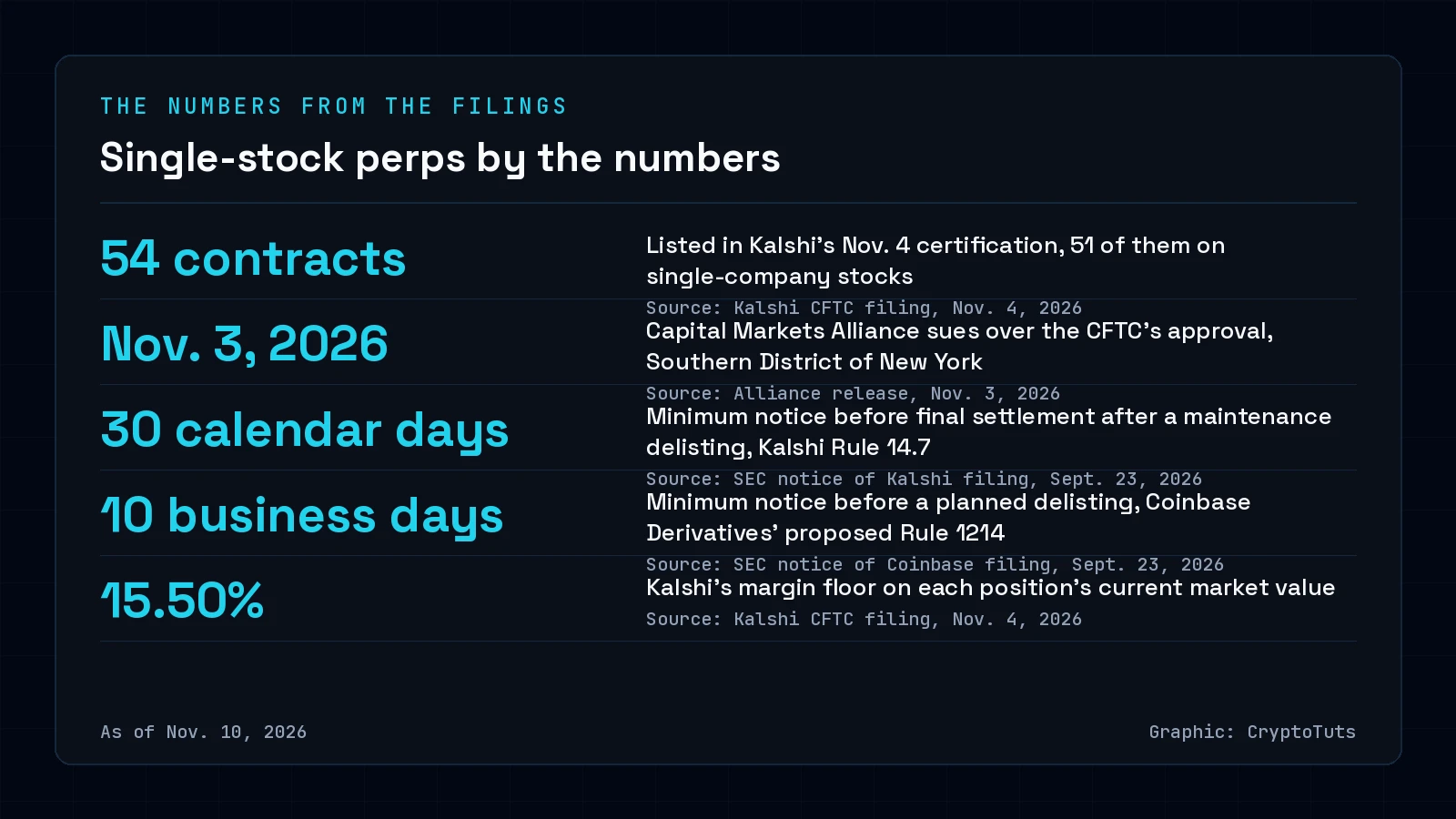
Coinbase Derivatives proposed a shorter window in its Sept. 18 filing. Its proposed Rule 1214 requires at least 10 business days' notice before a planned wind-down, termination or delisting. Shorter notice is allowed where it is necessary to protect investors or maintain fair and orderly markets.
Kalshi's floor is $1,550 on a $10,000 position
A margin floor is a minimum. It sets the least you must keep posted on a position, and losses on a leveraged position can exceed it.
Margin is not a loss cap
A margin floor does not limit what you can lose on a leveraged position, and the minimum is not necessarily the margin every customer pays.
Across the exchanges named in these filings, which you can line up in our exchange comparison, the floors sit within half a percentage point:
- Kalshi: 15.50% of each position's current market value, in its Nov. 4 terms
- Bitnomial: 15.25%, proposed in its Sept. 18 filing
- Coinbase Derivatives: 15%, proposed in its Sept. 18 filing
Kalshi's floor sits 0.5 percentage point above the 15% minimum set by joint SEC and CFTC rules. In dollars, a $10,000 position needs at least $1,550 in margin at Kalshi. The joint minimum would require $1,500, or $50 less.
The alliance says these are swaps for the SEC
The alliance's Nov. 3 release leads with jurisdiction. It argues the products are security-based swaps, which it says Congress placed under the SEC's exclusive jurisdiction. It asks the court to vacate the approvals, declare the products security-based swaps and bar the CFTC from giving the approvals effect while the case is pending.
A security-based swap is a swap tied to a single security or a narrow group of them, such as the single-stock swap Ripple Prime struck on SanDisk. A security futures product, by contrast, falls under joint CFTC and SEC oversight.
The alliance also argues the CFTC gave no explanation for its decision. In the alliance's view, the agency has long treated perpetual derivatives as swaps, and it did not acknowledge that history. It also faults the CFTC for failing to reasonably consider the impact on investors and the securities markets.
Cboe names itself, Citadel Securities and Healthy Markets Association among the alliance's members. The full member list is not public. In its Nov. 3 statement, Cboe says the CFTC broke with decades of precedent and its own prior determinations without clearly explaining the legal basis.
The CFTC and Kalshi call them security futures
CFTC Chairman Michael Selig said in a Nov. 3 statement that equity perpetual futures could begin trading that day on CFTC-registered exchanges. He framed the step as bringing perpetual products onshore, under both CFTC and SEC frameworks.
The equity perpetual futures were deemed approved by the CFTC under its Regulation 40.3 as security futures products. A deemed approval takes effect without a written order from the commission. Kalshi's Nov. 4 filing dates the approval of its Sept. 18 submissions to Nov. 2, 2026.
In the same filing, Kalshi self-certified the contracts under CFTC Regulations 40.2(a) and 41.23(a), a route in which the exchange itself certifies that a product meets the rules. Of the 54 contracts, 51 are on a single company's common stock and three on Alibaba American depositary shares and the SPY and QQQ funds. Kalshi says the terms match the Nov. 2 contracts except the minimum trading unit: 1/5,000 of a 100-share contract, or 0.02 shares.
Kalshi's filings make the statutory case in two steps. The definition of a security future, Kalshi argues, does not require delivery on a single, specified future date. That date is the feature a perpetual contract lacks. Its second point: the Commodity Exchange Act's swap definition expressly excludes security futures products, so the contracts are not security-based swaps.
An earlier challenge targets a crypto contract. CME sued the CFTC and its chairman in federal court in Washington on June 18, 2026 (Case No. 26-cv-02157). The suit targets the approval of Kalshi's bitcoin perpetual contract. Kalshi's Sept. 18 filing describes that case as still awaiting merits rulings.
The SEC holds a 60-day lever of its own
The SEC's notice on Coinbase Derivatives' filing sets out the window. Within 60 days after a rule change takes effect, the SEC may summarily abrogate it after consulting the CFTC. It can then require the change to be refiled. Bitnomial's filing states that its rule change takes effect upon CFTC approval (Section 19(b)(7)(B) of the Exchange Act).
Three steps will show where this goes next:
- Any SEC abrogation order within its 60-day window
- The next entry on the docket of CME's case in Washington
- CFTC approval of Bitnomial's rules and product applications
Link disclosure: Sponsored module: Kalshi sponsors CryptoTuts, and we are compensated when readers sign up through the marked link (*). The reporting is independent of it. Read more
Sources
- Capital Markets Alliance Files Suit Challenging CFTC Approval of Single-Stock Perpetual Derivatives (Nov. 3, 2026) · Capital Markets Alliance via Business Wire
- Cboe Joins Capital Markets Alliance Challenge to CFTC Approval of Single-Stock Perpetual Derivatives (Nov. 3, 2026) · Cboe Global Markets via PR Newswire
- Statement of Chairman Michael S. Selig on Equity Perpetual Futures (Nov. 3, 2026) · Commodity Futures Trading Commission
- KalshiEX LLC certification of security futures under CFTC Regulations 40.2(a) and 41.23(a) (Nov. 4, 2026) · KalshiEX LLC via Commodity Futures Trading Commission
- SEC Release No. 34-106422, KalshiEX LLC notice of filing, SR-KALSHIEX-2026-02 (Sept. 23, 2026) · U.S. Securities and Exchange Commission (Federal Register)
- SEC Release No. 34-106420, Coinbase Derivatives LLC notice of filing, SR-COIN-2026-002 (Sept. 23, 2026) · U.S. Securities and Exchange Commission (Federal Register)
- SEC Release No. 34-106421, Bitnomial Exchange LLC notice of filing, SR-BTNL-2026-001 (Sept. 23, 2026) · U.S. Securities and Exchange Commission (Federal Register)
- Coinbase, Kalshi and Jump Trading Urge Judge to Keep Single-Stock Perps Trading (Nov. 10, 2026) · Unchained
About the author

Phil
Founder & Editor-in-Chief · In crypto since 2017
Phil is the founder of CryptoTuts and has explored Bitcoin, cryptocurrencies and blockchain technology since 2017. He explains complex topics clearly, with data and without empty promises.
- XRP and the XRPL
- Bitcoin
- Crypto tax records
- Exchange comparisons
- On-chain analysis