Analysis · DeFi
Initia says MoveVM bug credited unbacked WETH, iUSD and USDC
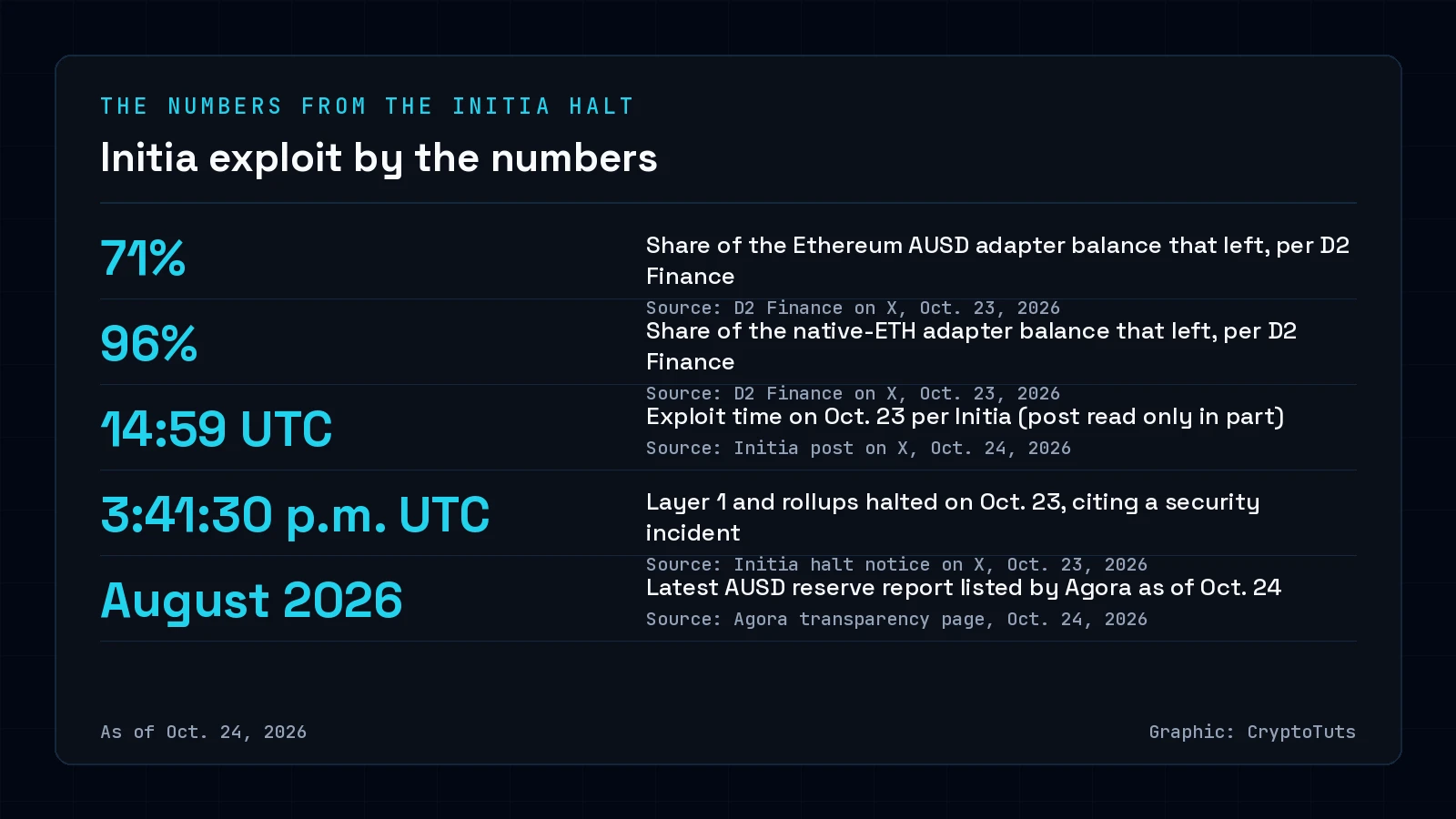
Initia's Oct. 24 post, read only in part, puts the exploit at 14:59 UTC on Oct. 23. It halted its layer 1 and rollups at 3:41:30 p.m. UTC and has set no restart date.
By Phil5 min read

Initia says a bug in MoveVM, the virtual machine that runs its smart contracts, let an attacker spoof the chain's record of balances on Oct. 23, 2026. The flaw sat in script caching, which keeps loaded code ready for reuse. The attacker credited their own account with unbacked WETH, a token version of ether, plus USDC and iUSD, which Initia's registry maps to the CoinGecko ID agora-dollar, like "AUSD on Initia."
D2 Finance's trace that day puts the outflows from the Ethereum bridge adapters for AUSD and ETH at about 71% and 96% of their balances, and Initia's halt notice set no restart time.
If you hold ETH, USDC or an AUSD-labeled token bridged to Initia, two questions are open: whether it is still backed and when you can move it. Initia's restart notice or full post-mortem, stating whether balances on its layer 1 chain and the rollups built on it are kept or rolled back, would settle both.
Initia and D2 describe the credit differently
Initia gave its account in an Oct. 24 post on X: the attacker struck at 2:59 p.m. UTC on Oct. 23, and the caching flaw let malicious code bypass security checks. The company halted its layer 1 and the rollups built on it at 3:41:30 p.m. UTC the same day, citing a security incident in its halt notice on X.
D2 Finance, which decoded the attack onchain, reads the credit as a mint: the attacker's own key called a single Move function, with no bridge message involved.
Your token's backing depends on its bridge
Initia's mainnet asset registry on GitHub shows that bridged tokens reach the chain by different routes. It lists ETH on Initia as an "ETH token via LayerZero," a protocol that passes messages between blockchains. USDC comes instead from the Noble chain over IBC, the Inter-Blockchain Communication standard of Cosmos-based networks.
Under LayerZero's OFT standard, short for Omnichain Fungible Token, a token is burned on the chain it leaves and minted on the chain it reaches. Where a token already lives on its home chain, as ETH does on Ethereum, an OFT Adapter takes that role. LayerZero's documentation describes the adapter as a lockbox: it locks tokens when they are sent out and unlocks them when they return, with only one lockbox per deployment.
In that model, the real tokens locked in the adapter stand behind the bridged version on the other chain. The CryptoTuts guide to DeFi security covers how bridge contracts like these get attacked.
D2 says the Ethereum adapters were largely emptied
D2 traced the exits in an Oct. 23 post on X. A LayerZero message 153 seconds after the mint released 1.4 million AUSD from the AUSD OFT adapter on Ethereum and left about 576,000 AUSD. Another 105 ETH left the native-ETH adapter, leaving 4.84 ETH.
Those figures put the adapters at about 1.98 million AUSD and 109.84 ETH before the outflow, so about 29% and 4% remained. For every 100 ETH the ETH adapter held before the attack, about four were left. The dollar totals do not reconcile without a price basis, and none was given. One counts $2.65 million back on Ethereum within 7 minutes, 21 seconds of the mint; the other values the 1,135.52 ETH sitting in a fresh wallet at the time of the post at about $2.73 million.
The USDC took a different exit: 1.08 million USDC reached the attacker's Ethereum address as fresh mints through CCTP. Circle's Cross-Chain Transfer Protocol retires USDC on one chain and issues new USDC on another.
In D2's reading, LayerZero's DVNs, the verifier networks that confirm cross-chain messages, then attested to burns that really took place. An adapter cannot check whether burned tokens were ever backed.
Agora says AUSD is unaffected
Agora, the issuer of AUSD, answered in a post on X at 2:26 p.m. ET on Oct. 23:
AUSD and Agora are unaffected. AUSD does not exist on Initia. AUSD deployments on all networks and Agora operations continue as normal. AUSD is fully backed.
The post quotes an earlier one in which Agora said it has no smart contracts on Initia. It pledged there to freeze AUSD held at hacker-linked addresses on chains where its contracts run. Unchained reported, citing onchain records, that Agora froze the attacker's Ethereum address at 12:31 p.m. ET on Oct. 23, when the address no longer held AUSD.
That statement stands against Initia's own registry label, "AUSD on Initia." If you hold AUSD on another chain, the distinction that matters is between a bridge lockbox and an issuer's reserves. An adapter holds tokens that users locked to bridge them; the issuer's reserves back the token itself.
Agora's transparency page lists monthly AUSD reserve reports by the accounting firm Grant Thornton LLP. As of Oct. 24, the latest listed report covers August 2026.
Initia is still mapping the impact
The halt notice describes the work under way: Initia's team is establishing the full scope of any impact with security teams, validators and exchanges. Validators are the node operators that produce Initia's blocks.
For INIT holders, co-founder Zon said the bug let the exploiter create additional tokens on the Initia L1 but does not apply to native INIT, according to Unchained. The halt, by contrast, covers the whole L1 and its rollups.
Three checks will show where your tokens stand:
- A restart notice from Initia, the next step to watch
- A fresh onchain reading of the two Ethereum adapters, showing what they hold today
- A September entry on Agora's transparency page, extending its report list past August
Sources
- Initia halt notice on X, Oct. 23, 2026 · Initia
- Initia post on X about the MoveVM exploit, Oct. 24, 2026 · Initia
- Initia registry: mainnet asset list · Initia (initia-labs on GitHub)
- LayerZero V2 documentation: OFT Adapter (EVM) · LayerZero
- D2 Finance post on X: decoded Initia exploit breakdown, Oct. 23, 2026 · D2 Finance
- Unchained: Initia has no restart date after attacker mints tokens and bridges out $2.7 million · Unchained
- Agora post on X: AUSD statement, Oct. 23, 2026 · Agora
- Agora transparency page: AUSD reserve reports · Agora Finance
About the author

Phil
Founder & Editor-in-Chief · In crypto since 2017
Phil is the founder of CryptoTuts and has explored Bitcoin, cryptocurrencies and blockchain technology since 2017. He explains complex topics clearly, with data and without empty promises.
- XRP and the XRPL
- Bitcoin
- Crypto tax records
- Exchange comparisons
- On-chain analysis