Analysis · DeFi
Solana Alpenglow is live: wallets and user fees stay the same
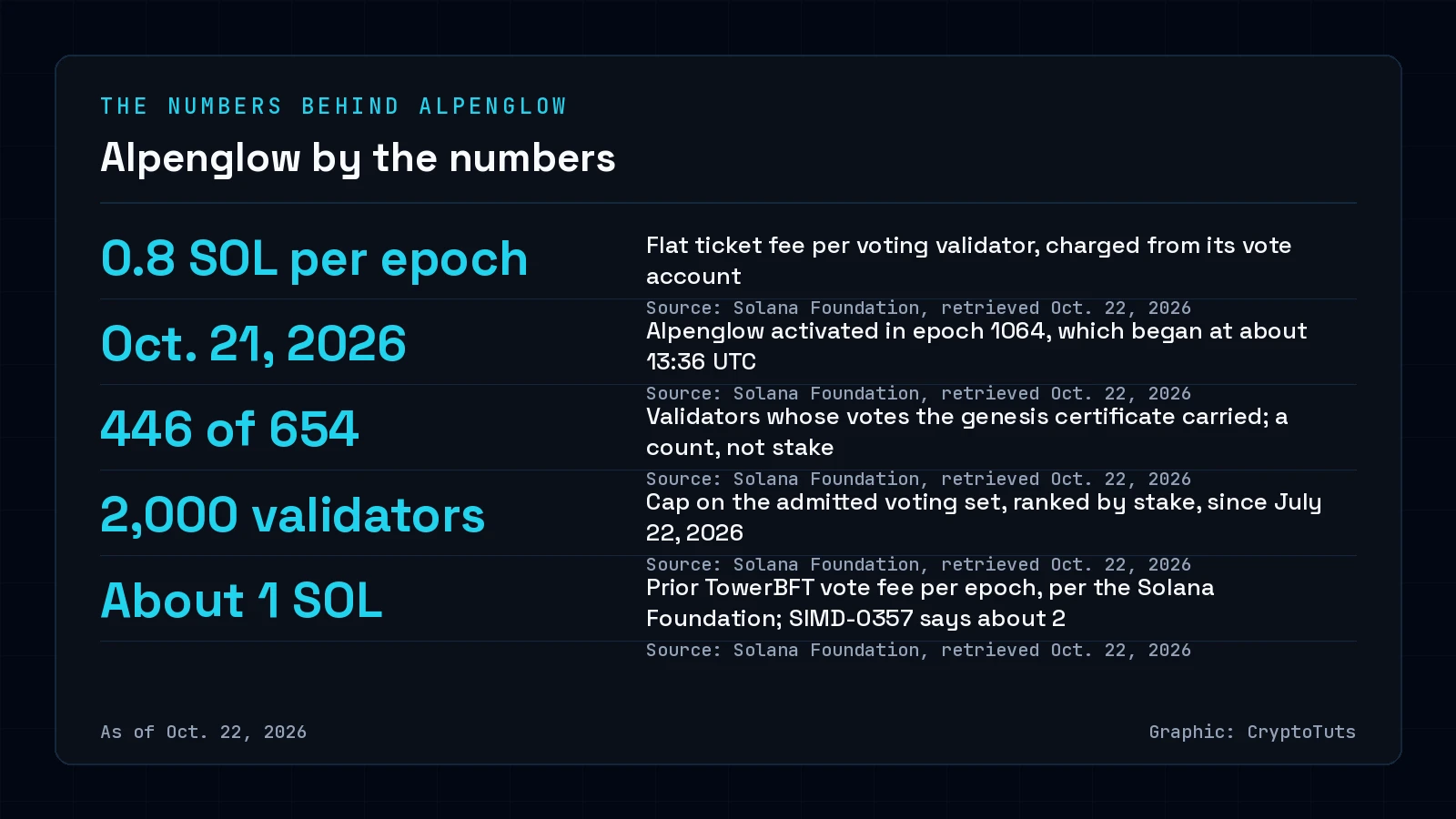
The Solana Foundation says wallets and user transaction fees work as before and calls the drop in reported transaction counts an accounting change. Validators had to upgrade and now pay 0.8 SOL per epoch to vote.
By Phil6 min read
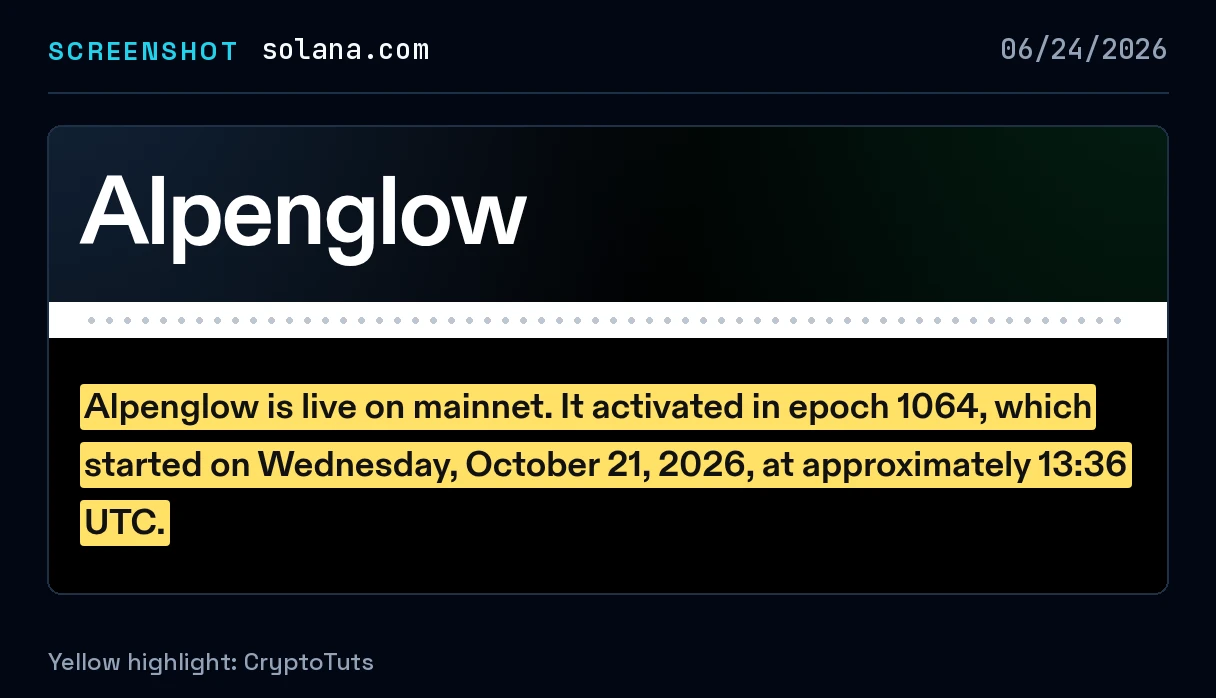
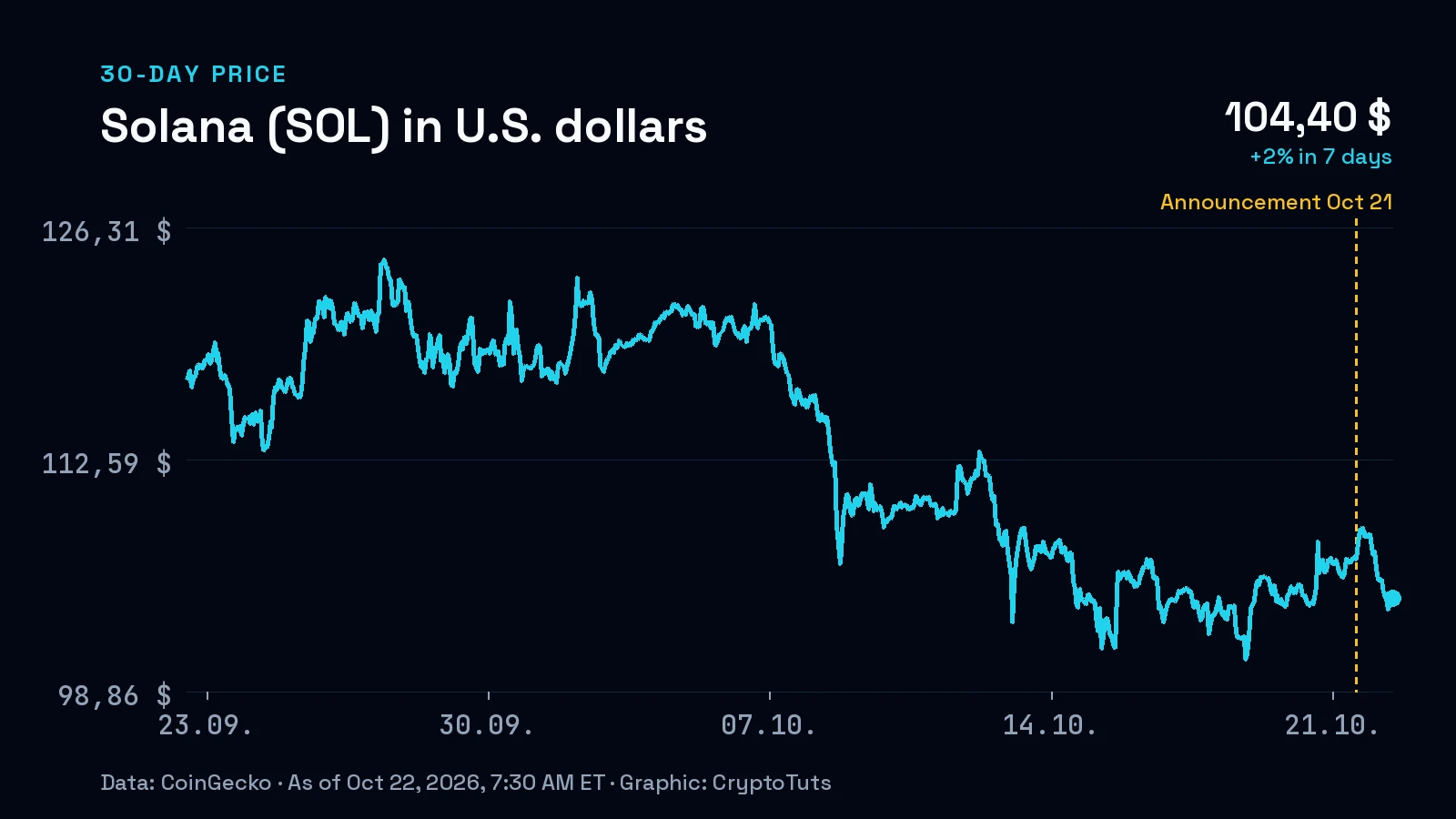
Solana's Alpenglow consensus upgrade went live on mainnet Oct. 21, 2026, in epoch 1064, one of the network's recurring periods for stake and rewards. If you hold SOL in a wallet, you have nothing to do. According to the Solana Foundation's Alpenglow page, wallets work as before and user transaction fees stayed the same.
The visible change sits in the charts, because validators, the operators who vote on and produce blocks, no longer record their votes as transactions in blocks. Reported transaction counts and transactions per second dropped sharply as a result. The Foundation calls this an accounting change, not a drop in activity. To compare activity across Oct. 21, use re-baselined counts from explorers and data providers once they publish them.
The work and the cost fell on validators. They had to install new client software, and each now pays a flat 0.8 SOL per epoch to stay in the voting set. If you stake SOL through a validator or an exchange, your provider's notice is where to confirm whether delegated stake needed any change after Oct. 21.
Wallets and apps kept working through the switch
The Solana Foundation's upgrade page lays out activation and the consensus switch as two separate steps. A slot is the short window in which one validator may produce a block. After epoch 1064 began at about 1:36 p.m. UTC, the network kept running TowerBFT, its old consensus method, for 5,000 slots, about 18 minutes.
Alpenglow took over from slot 459,653,000, around 2 p.m. UTC. By the Solana Foundation's figure, the handoff from TowerBFT to Alpenglow took about 900 milliseconds.
The parts you touch stayed put. Alpenglow left the Solana Virtual Machine, the transaction format and the account model unchanged. Signing, sending and approving transactions work as before. Apps that only send transactions and read account state have nothing to migrate.
The breaking change hit infrastructure that streams, indexes or counts block data, such as indexers, explorers and dashboards. Those tools are where the lower transaction counts show up.
Finality now takes one or two voting rounds
Finality is the point at which a transaction becomes irreversible. Under TowerBFT, a block became final after validator votes stacked up over 32 slots, so finality time scaled with slot length. Under Alpenglow, a block is final after one or two rounds of voting.
Votor is Alpenglow's voting component. It finalizes a block in one round at 80% of stake or in a second round at 60%. By design, it keeps reaching consensus with 20% of stake acting against the network and another 20% offline.
Block time moved on a separate track. Slot times were cut from 400 milliseconds to 200 milliseconds in four stages completed in October 2026.
The 150-millisecond figure tied to Alpenglow describes time to finality. Block time is set by the slots.
CoinDesk, writing before activation, put finality before the switch at roughly six seconds. Published finality measurements from mainnet are the check on how fast blocks become final now.
Developers get one practical change. Commitment levels are the labels apps use to say how settled a transaction is. Under Alpenglow, confirmed and finalized describe the same state. All three levels still worked at activation, and confirmed is set to be removed in a later, undated release.
Validators now pay 0.8 SOL each epoch
To keep voting and producing blocks, validators must run version 4.3.2 of one of three clients:
- Agave
- Jito-Solana
- Harmonic Salsa
The Agave v4.3.2 release is marked stable for mainnet.
The Validator Admission Ticket charges each admitted voting validator 0.8 SOL per epoch from its vote account, starting with epoch 1064. The fee is paid one epoch ahead and burned. It comes on top of the rent-exempt minimum, the balance an account must hold to stay open.
Missing a payment carries a direct cost. If a vote account lacks the funds for the ticket at the start of an epoch, the validator is left out of the next epoch. It sits out voting and block production and loses that epoch's rewards.
By the Foundation's figure, TowerBFT vote fees cost each voting validator about 1 SOL per epoch, paid from the identity account. Against that baseline, the ticket is about 20% cheaper. Over 10 epochs, a validator pays 8 SOL instead of about 10 SOL.
CoinDesk, writing before activation, started from about 2 SOL a day in vote fees. On that basis, it called the ticket roughly 60% cheaper.
SIMD-0357, the improvement proposal behind the ticket, is in Review status and dated Sept. 11, 2025. It specifies 1.6 SOL per epoch, replacing a voting fee of about 2 SOL per epoch. The 0.8 SOL charged on mainnet is half the proposal's figure.
The groundwork came in July. BLS is a signature scheme whose signatures can be combined into one. BLS pubkey registration activated on mainnet July 8, 2026, and the ticket's feature gate, the switch that turns on a protocol change, followed July 22.
Since July 22, consensus admits only validators with a registered BLS pubkey. The admitted voting set is capped at the top 2,000 validators by stake.
That cap sits well above the current network. The certificate that started Alpenglow consensus, over slot 459,652,999, carried votes from 446 of the 654 validators participating on Oct. 21, 2026. The 446 counts validators; their share of stake is a separate figure.
Bitwise counts fewer validators under cost pressure
The case for caution starts with Bitwise's Q4 2026 staking report, dated Oct. 20. Solana's validator count fell to 659 from 696 in the third quarter of 2026, roughly 30% below a year earlier. Bitwise attributes the decline to cost pressure.
That quarter closed before the 0.8 SOL ticket took effect. The 659 also comes from a different date than the 654 validators on Oct. 21.
Three clients carry Alpenglow consensus today
Client diversity is the second point. Firedancer and Frankendancer were not supported for the migration, so Alpenglow consensus runs on the three clients listed above. A Firedancer announcement on Alpenglow support would widen that set.
CoinDesk reported six test-network restarts
CoinDesk cited a Galaxy Digital post on the test phase. By that account, the Alpenglow test network was restarted six times since early May, and one migration attempt failed and was rolled back.
Planned releases include new block-producer turns
Leader rotation is the order in which validators take turns producing blocks. In its launch release, Anza lists a geographically aware version of it for later releases, along with Rotor and Quantumglow. The three have no committed date as of Oct. 21, 2026.
In the same release, CEO Brennan Watt called Alpenglow the largest, most ambitious blockchain upgrade since The Merge. The Merge was Ethereum's 2022 switch to proof of stake. Watt said Anza took Alpenglow from white paper to mainnet in under 18 months.
For holders, the answer from Oct. 21 holds: wallets and user fees are unchanged, and stakers still have their provider's notice as the place to check.
Link disclosure: Sponsored module: Kalshi sponsors CryptoTuts, and we are compensated when readers sign up through the marked link (*). The reporting is independent of it. Read more
Sources
- Solana Foundation: Alpenglow upgrade page · Solana Foundation
- Solana Foundation: BLS Pubkey and the Validator Admission Ticket · Solana Foundation
- Anza: Alpenglow is live on Solana (press release, Oct. 21, 2026) · Anza Technology, Inc. via PR Newswire
- Anza Agave v4.3.2 release · Anza (GitHub)
- SIMD-0357: Alpenglow Validator Admission Ticket · Solana Improvement Documents (GitHub)
- The Bitwise Staking Report, Q4 2026 · Bitwise
- CoinDesk: Solana's Alpenglow, its biggest network overhaul since 2020, goes live Wednesday · CoinDesk
About the author

Phil
Founder & Editor-in-Chief · In crypto since 2017
Phil is the founder of CryptoTuts and has explored Bitcoin, cryptocurrencies and blockchain technology since 2017. He explains complex topics clearly, with data and without empty promises.
- XRP and the XRPL
- Bitcoin
- Crypto tax records
- Exchange comparisons
- On-chain analysis