Analysis · Regulation
OCC drops stablecoin rewards presumption in final GENIUS Act rule
The Oct. 21, 2026, rule removes the proposal's presumption that certain affiliate or third-party arrangements break the yield ban. The OCC will test each program on its facts instead.
By Phil5 min read

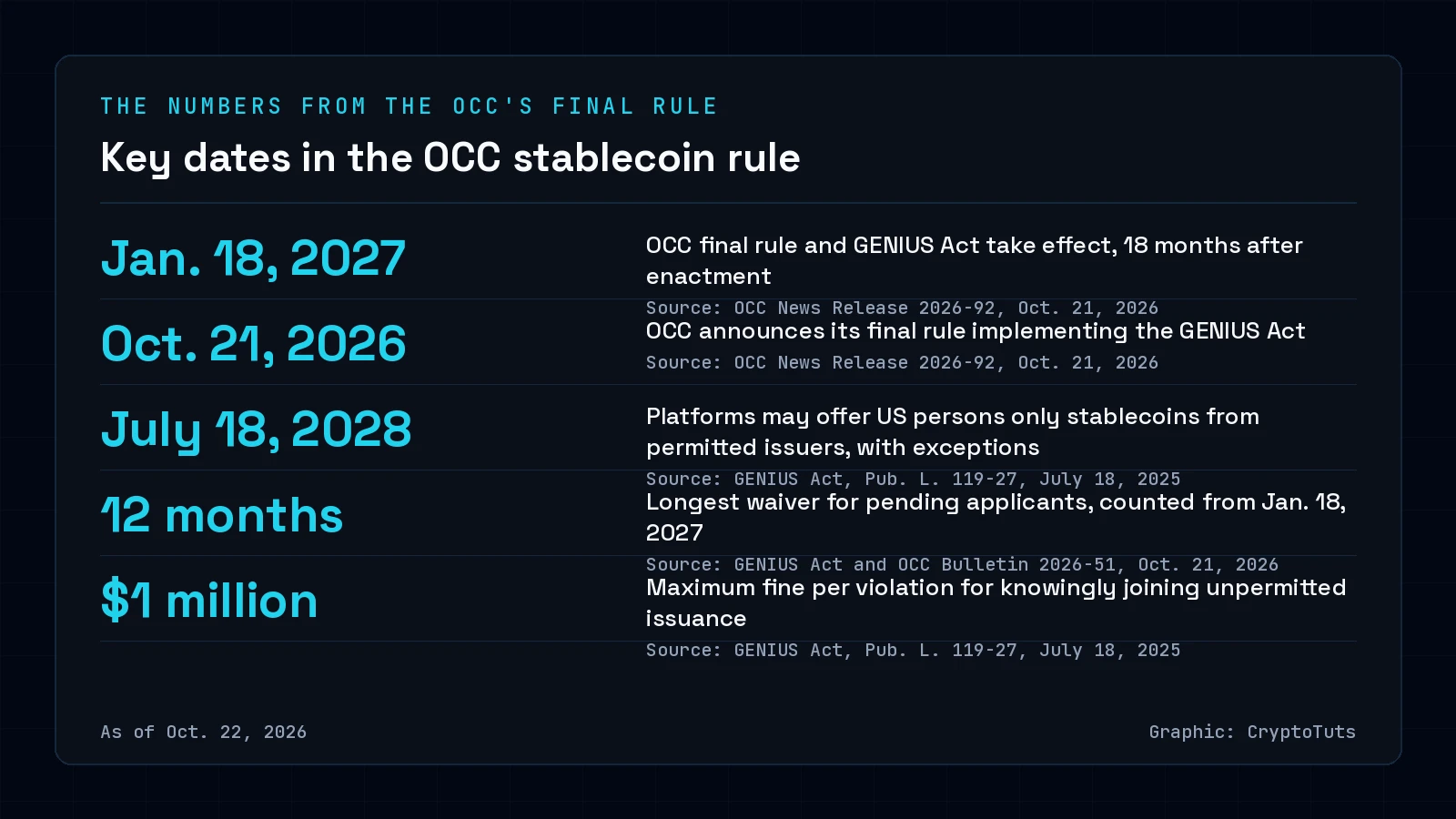
Stablecoin rewards on your platform will face case-by-case review by the Office of the Comptroller of the Currency (OCC). Its final GENIUS Act rule of Oct. 21, 2026, drops a planned rebuttable presumption that certain arrangements with affiliates or related third parties violate the law's yield ban. A second date decides which coins you can buy. Starting July 18, 2028, platforms may sell you only stablecoins from permitted issuers, with exceptions the statute sets.
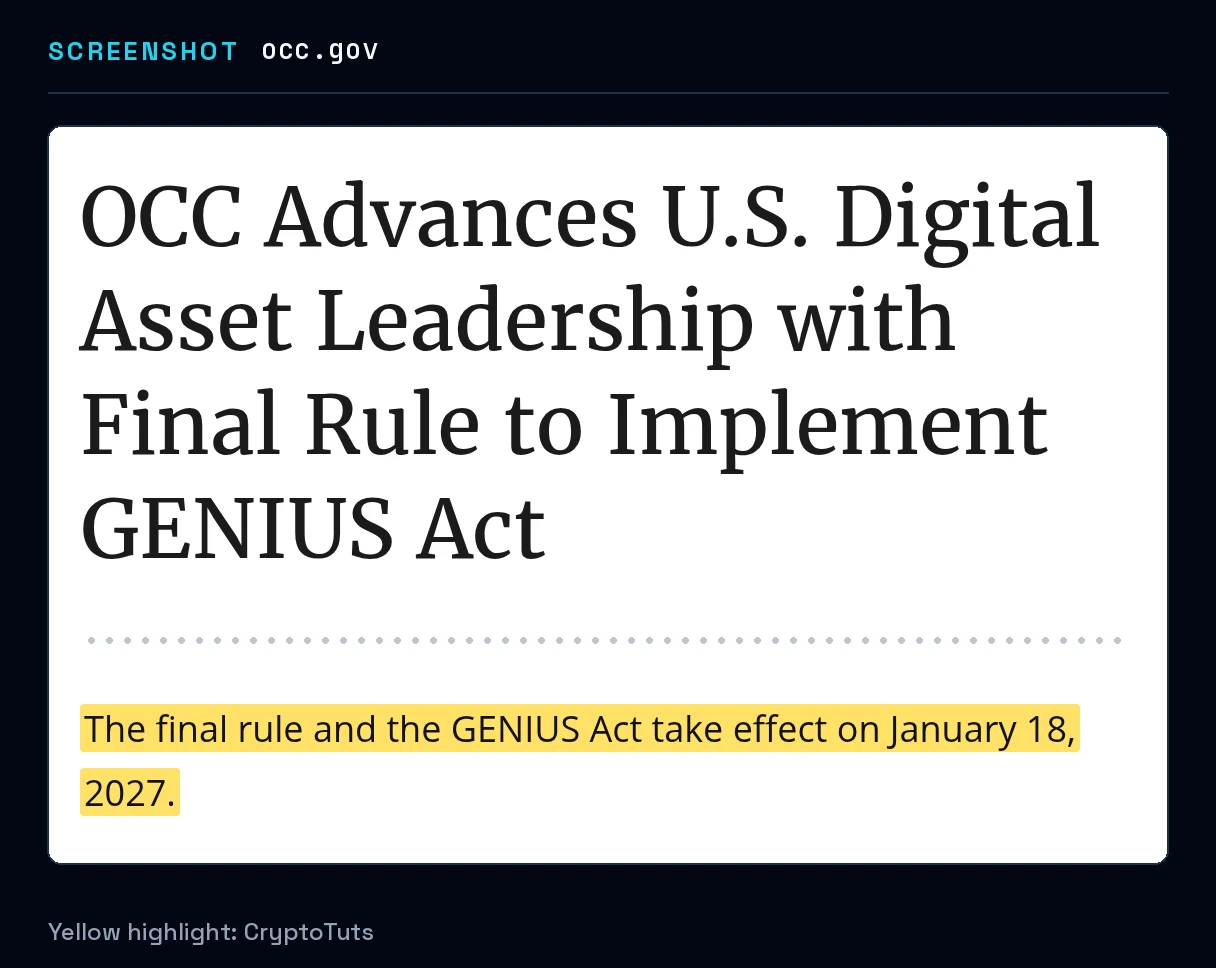
The OCC is the first primary federal payment stablecoin regulator to issue a final GENIUS Act rule. The 2025 law sets federal rules for payment stablecoins and their issuers. The rule and the law take effect Jan. 18, 2027, 18 months after enactment.
Can your platform keep paying you rewards after Jan. 18, 2027? Each program will be measured on its facts against the statute's ban on yield paid solely in connection with holding, using or retaining a stablecoin. An OCC official declined to tell reporters whether existing exchange programs comply, Crypto in America reported.
The word “solely” decides which rewards are banned
The yield ban sits in the GENIUS Act itself. It bars permitted and foreign payment stablecoin issuers from paying you interest or yield in any form, including cash and tokens. The ban covers payments made solely because you hold, use or keep the coin. The law names issuers as the payers.
The OCC's proposal of March 2, 2026, would have added a rebuttable presumption, a starting assumption that holds unless someone disproves it. Under it, certain reward arrangements with affiliates or related third parties would have counted as violations. The final rule removes that starting point. Each arrangement will be measured against the statute's own words, based on its facts.
CoinDesk reads the rule as giving “solely” real weight. On that reading, a reward paid at least partly for other reasons would fall outside the ban.
Programs that predate the law start on the same footing as new ones. The final rule declines to presume they comply. It will evaluate them the same as programs set up after the GENIUS Act.
Two bank groups object to the change
The Bank Policy Institute (BPI), a banking industry group, objected the same day. Executive Vice President Paige Pidano Paridon said omitting the presumption “replaces clarity with ambiguity” and puts the banking system and its customers at risk of deposit flight. Deposit flight means customers pulling money out of bank accounts.
The American Bankers Association went further, according to Cointelegraph. In its view, the rule removes safeguards on indirect arrangements, so issuers can offer economically equivalent yield while staying technically outside the ban.
The OCC ties its approach to the text Congress passed. In the final rule, it says it will apply the yield ban as enacted. That holds until Congress amends the GENIUS Act or passes a law that clearly addresses it.
Your stablecoin's issuer needs approval or a waiver
From Jan. 18, 2027, issuers under the OCC need its approval to issue, a step the agency calls the prior approval requirement. In its waiver guidance (Bulletin 2026-51), the OCC generally expects to grant waivers to existing US issuers with a substantially complete application filed before that date. A review can still turn up more compelling reasons to deny.
Applications and waiver requests open once the Office of Management and Budget, the White House office that clears federal forms, gives final approval to the application forms. As of Oct. 22, 2026, the OCC had yet to start accepting them (OCC GENIUS Act page). It will announce the start in a press release.
The waiver matters on day one. An existing issuer that applied on time but has no waiver could still violate the prior approval requirement on Jan. 18, 2027, if it keeps issuing.
The guidance finds no compelling, generally applicable reason to waive any other requirement. Issuers have had 18 months since the law passed to prepare. The same goes for issuers not yet operating or issuing in the US, which the OCC generally expects to start only after approval.
Issuing a payment stablecoin in the US without permitted status carries criminal penalties under the statute. Anyone who knowingly takes part in issuance by someone other than a permitted issuer can be fined up to $1 million per violation. The law also allows up to five years in prison, or both. Both figures are statutory maximums.
A permitted issuer must also back its coins with reserve assets on at least a 1-to-1 basis at all times, under the final rule. For background on a bank holding a dollar stablecoin, see our report on RLUSD custody at Standard Chartered's DIFC branch.
The longest waiver ends six months before the cutoff
Once intake opens, the OCC commits in Bulletin 2026-51 to act on each application within 120 days of finding it substantially complete. That clock starts no earlier than Jan. 18, 2027.
Waivers for pending applicants can last no more than 12 months from Jan. 18, 2027. The OCC expects to limit each one to the time needed to address the reasons for granting it.
Set those dates beside the platform deadline. The longest possible waiver ends Jan. 18, 2028. That is six months before July 18, 2028, when platforms must stop selling you stablecoins from issuers without permitted status, subject to exceptions the statute sets. A shorter waiver ends earlier and widens the gap.
Watch first for the OCC press release that opens intake; the budget office approval it depends on carries no date yet. Then come the first waiver decisions, which show whether issuers can keep issuing after Jan. 18, 2027, while their applications are pending.
Link disclosure: Sponsored module: Kalshi sponsors CryptoTuts, and we are compensated when readers sign up through the marked link (*). The reporting is independent of it. Read more
Sources
- OCC News Release 2026-92: Final rule to implement the GENIUS Act · Office of the Comptroller of the Currency
- OCC final rule implementing the GENIUS Act (PDF) · Office of the Comptroller of the Currency
- OCC Bulletin 2026-51: GENIUS Act waivers and application submission guidance · Office of the Comptroller of the Currency
- OCC GENIUS Act page · Office of the Comptroller of the Currency
- GENIUS Act, Public Law 119-27 · U.S. Government Publishing Office (GovInfo)
- OCC proposed rule implementing the GENIUS Act, 91 FR 10202 (March 2, 2026) · U.S. Government Publishing Office (GovInfo)
- Bank Policy Institute: OCC GENIUS Act rule leaves room for ambiguity on yield · Bank Policy Institute
- OCC Bulletin 2026-50: GENIUS Act regulations, final rule · Office of the Comptroller of the Currency
- OCC Bulletin 2026-52: Revised reporting forms for permitted payment stablecoin issuers · Office of the Comptroller of the Currency
- Crypto in America: OCC finalizes GENIUS Act rules, backs off stablecoin rewards restrictions · Crypto in America
- CoinDesk: OCC's final rule to start fresh in weighing stablecoin rewards against GENIUS Act ban · CoinDesk
- Cointelegraph: American Bankers Association on OCC GENIUS Act rules · Cointelegraph
About the author

Phil
Founder & Editor-in-Chief · In crypto since 2017
Phil is the founder of CryptoTuts and has explored Bitcoin, cryptocurrencies and blockchain technology since 2017. He explains complex topics clearly, with data and without empty promises.
- XRP and the XRPL
- Bitcoin
- Crypto tax records
- Exchange comparisons
- On-chain analysis