Analysis · Regulation
Missouri prediction markets: license fees could hit $500,000
Missouri's letters to Novig and Crypto.com say the initial fee and the five-year renewal could each reach that cap, plus a 10% tax. The letters are demands, not a ban.
By Phil4 min read
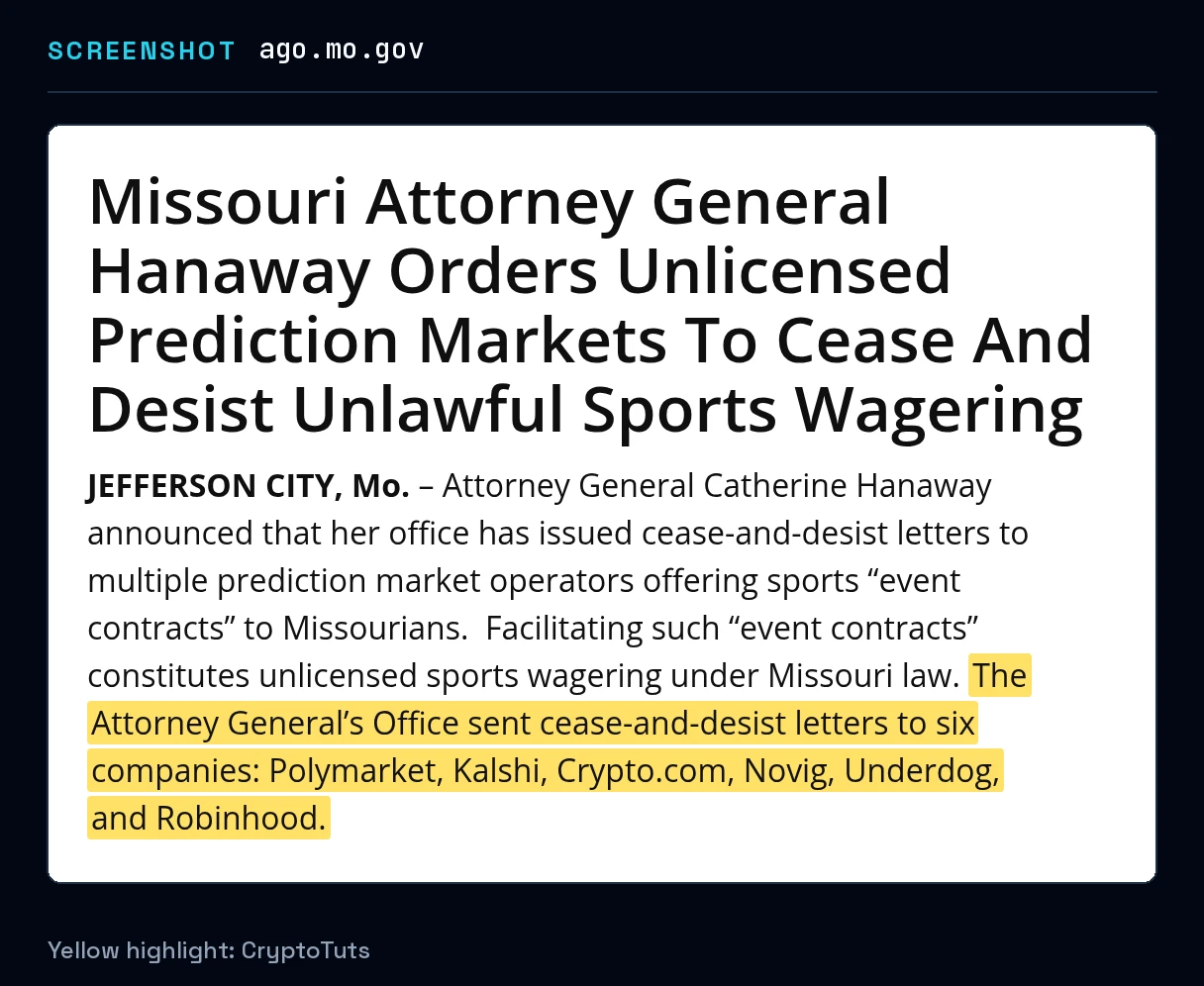
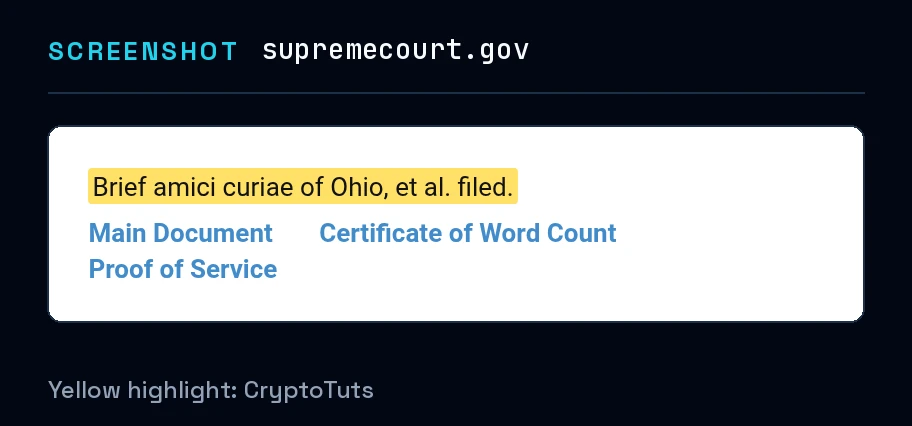
On Oct. 7, 2026, Ohio, 38 other states and the District of Columbia filed an amicus brief at the U.S. Supreme Court. The case, Flaherty v. KalshiEX, is a petition from New Jersey gaming officials; an amicus brief is a friend-of-the-court filing. In September 2026, the Missouri attorney general's office sent cease-and-desist letters to six prediction market companies, Novig and Crypto.com among them. Those letters are demands on the companies, not a court order or an enforcement action.
Missouri's attorney general argues that federal law does not preempt Missouri gambling law for sports event contracts and that such contracts are not swaps under the Commodity Exchange Act. Preemption means federal law overrides conflicting state law; swaps are derivatives under federal oversight. The Ninth and Sixth Circuits, whose rulings the letters cite, sided with the states, Covers reports, while the Third Circuit sided with prediction markets. The Eighth Circuit, which covers Missouri, has yet to rule in a prediction market case.
The Crypto.com letter and the Novig letter each give the company two options: stop offering sports wagering in Missouri, or get a Missouri Gaming Commission license and pay the associated taxes and fees. The office warns that failure to comply will result in enforcement action by the State of Missouri. As of Unchained's report after the Oct. 16 filings, none against either exchange had been announced.
License fees could reach $500,000 each
Missouri has had a legal path for sports betting since 2024, when voters approved Amendment 2 and put it under the Missouri Gaming Commission. The regulated market, online and in person, launched Dec. 1, 2025.
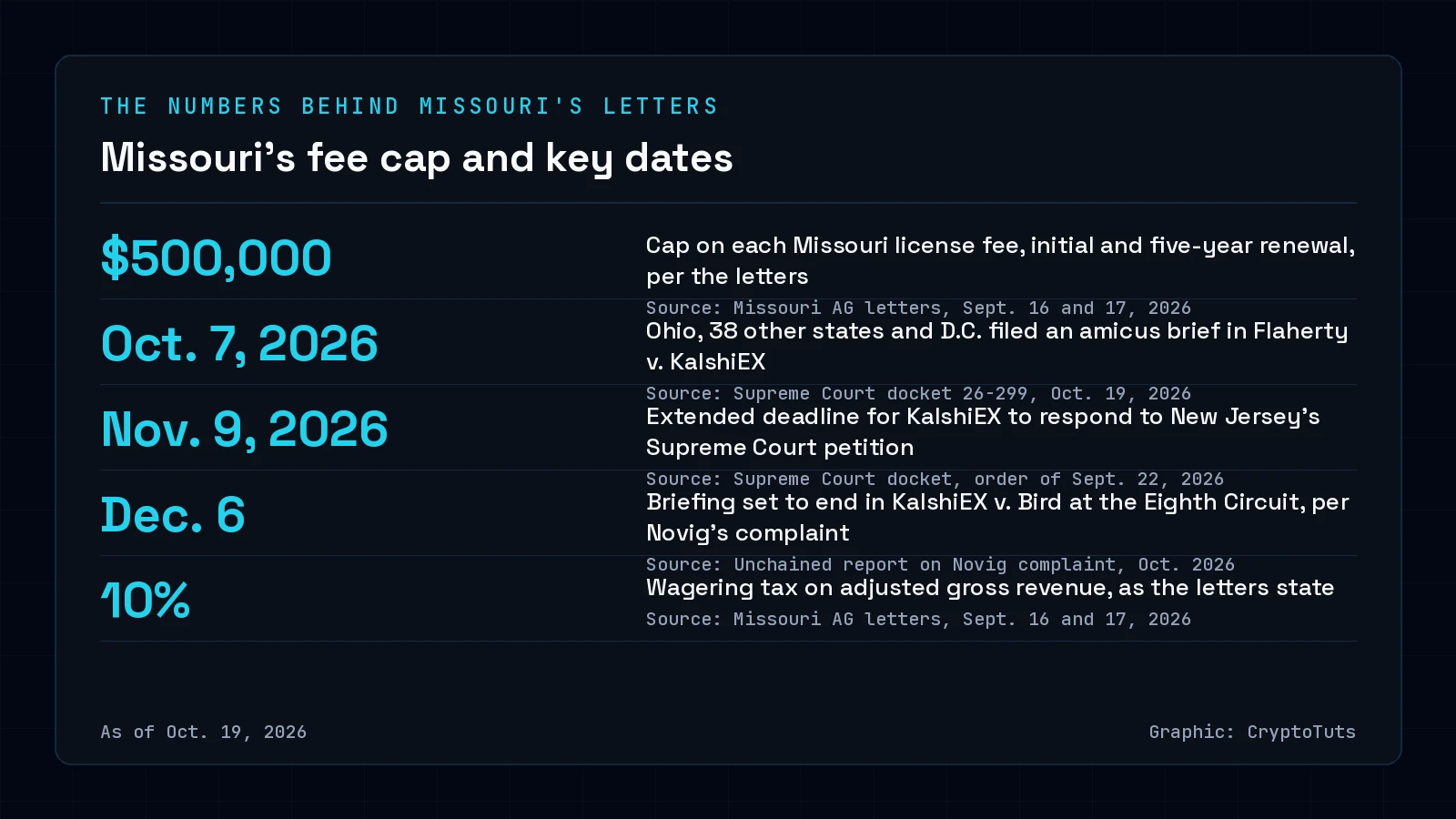
The Crypto.com letter and the Novig letter put a price on that path. The initial license fee for an online sports wagering platform and the renewal fee due every five years could each be as much as $500,000. The letters also say Missouri imposes a 10% wagering tax on adjusted gross revenue, the platform's revenue from in-state sports wagering.
Take a platform that holds a license for 10 years. It would pay the initial fee and one renewal, up to $1 million in fees, plus the 10% tax. Your own winnings are a separate matter, covered in our guide to crypto gambling and taxes.
Each letter asked for confirmation of compliance or cessation within 30 days of its date. The Crypto.com letter is dated Sept. 16, 2026, so its window ran through Oct. 16. The Novig letter is dated Sept. 17, so its window ran through Oct. 17.
Missouri says Crypto.com's age limit is too low
The Crypto.com letter sets the company's age rule against Missouri's. In the letter's account, Crypto.com's U.S. exchange terms allow users 18 and older, while Missouri rules impose an affirmative duty to prevent wagers by anyone under 21. Its license option adds a third condition: stop offering sports wagering to people in Missouri under 21.
The office's release widens the charge, with Attorney General Hanaway writing that companies “cannot repackage sports bets as ‘event contracts’ to avoid Missouri law.” It accuses Polymarket, Kalshi, Crypto.com, Underdog and Robinhood, every recipient except Novig, of permitting users under 21 or lacking adequate safeguards to keep them out.
Both exchanges have a record with the CFTC
Novig's complaint states that the Commodity Futures Trading Commission designated its exchange as a contract market in June. A designated contract market is an exchange the CFTC has approved to list derivatives.
On Jan. 14, 2025, the CFTC told North American Derivatives Exchange, doing business as Crypto.com, that it would review two self-certified sports contracts. It asked the exchange to suspend listing and trading of them during the review. Self-certification lets an exchange list a new contract on its own filing, subject to CFTC review.
Missouri addressed its Crypto.com letter to a different entity, Foris DAX, Inc., which the letter calls “Crypto.com.” A footnote in North American Derivatives Exchange's complaint calls the letter incorrectly addressed.
Nov. 9 and Dec. 6 are the dates to watch
New Jersey gaming officials petitioned the Supreme Court on Sept. 2, 2026, to review a Third Circuit decision dated April 6, 2026. The court docketed the case Sept. 8 (No. 26-299). On Sept. 22, KalshiEX's deadline to respond was extended to Nov. 9, 2026, from Oct. 8.
Closer to home, Novig's complaint points to Kalshi's pending appeal in KalshiEX v. Bird at the Eighth Circuit, with briefing set to end Dec. 6.
Nov. 9 comes first: once KalshiEX responds, the justices can decide whether to take the case. Dec. 6 follows, and from then on a ruling in KalshiEX v. Bird rests with the Eighth Circuit on its own schedule.
Sources
- Missouri Attorney General Hanaway Orders Unlicensed Prediction Markets To Cease And Desist Unlawful Sports Wagering · Missouri Attorney General's Office
- Cease-and-desist letter to Crypto.com (Sept. 16, 2026) · Missouri Attorney General's Office
- Cease-and-desist letter to Novig (Sept. 17, 2026) · Missouri Attorney General's Office
- CFTC Release 9033-25: CFTC's Review of Nadex Sports Contract Submissions · U.S. Commodity Futures Trading Commission
- Docket No. 26-299, Flaherty v. KalshiEX, LLC · Supreme Court of the United States
- Novig and Crypto.com's Exchange Ask Federal Courts to Shield Them From Missouri Enforcement · Unchained
- Novig, Crypto.com Sue Missouri After Cease-and-Desist Order · Covers
About the author

Phil
Founder & Editor-in-Chief · In crypto since 2017
Phil is the founder of CryptoTuts and has explored Bitcoin, cryptocurrencies and blockchain technology since 2017. He explains complex topics clearly, with data and without empty promises.
- XRP and the XRPL
- Bitcoin
- Crypto tax records
- Exchange comparisons
- On-chain analysis