Analysis · Regulation
Swiss bitcoin ETF holdings must generally sit at a Swiss bank
FINMA's January 2026 guidance sets the rule, with narrow exceptions. It guards custody, not price, and FINMA did not name the fund's custodian or issuer.
By Phil5 min read

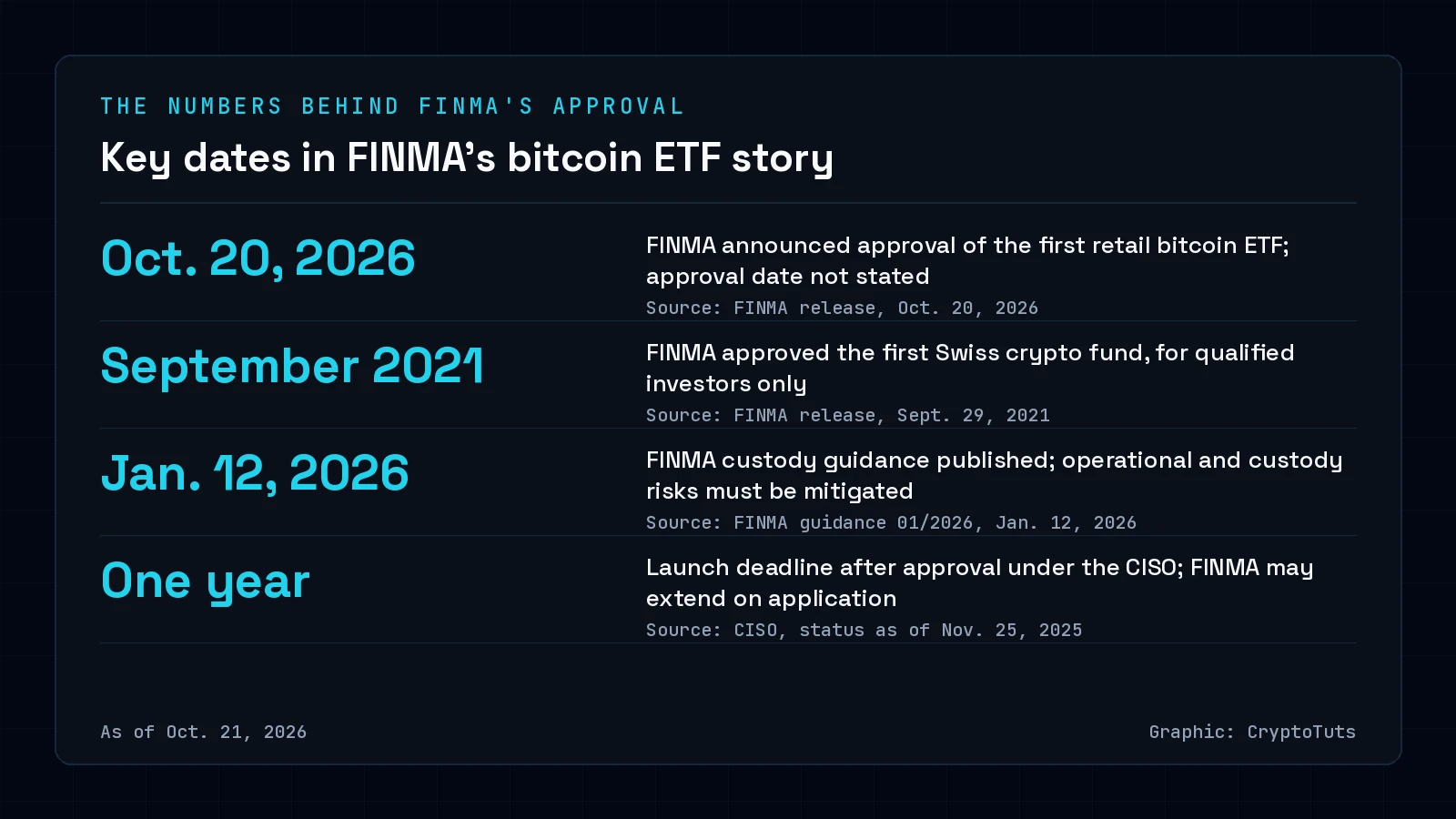
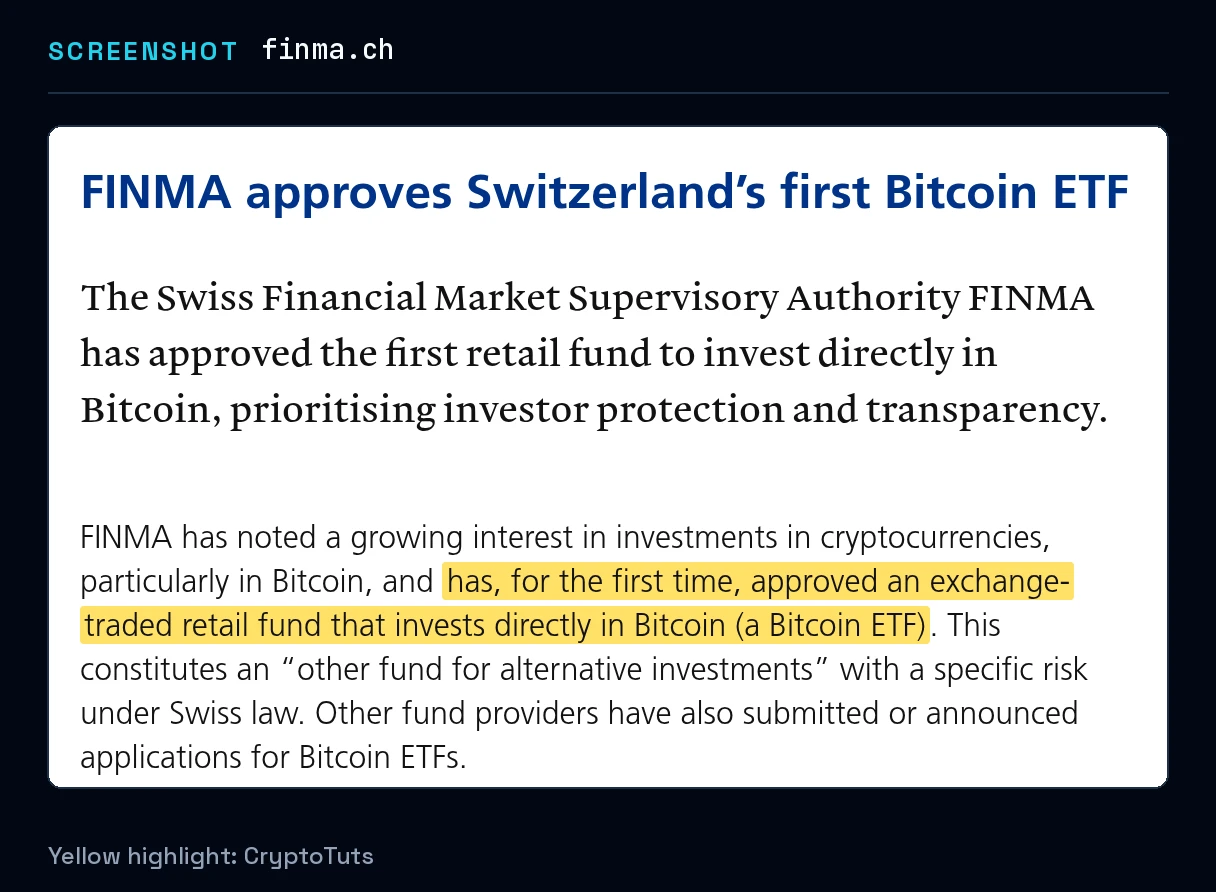
FINMA, Switzerland's financial regulator, announced on Oct. 20, 2026, that it approved the country's first exchange-traded fund for retail investors that invests directly in bitcoin. For this one fund, it waived the risk diversification rules that normally cap how much of a fund can sit in one asset or with one issuer. Five years earlier, on Sept. 29, 2021, FINMA announced Switzerland's first crypto fund, whose distribution is restricted to qualified investors rather than the general public.
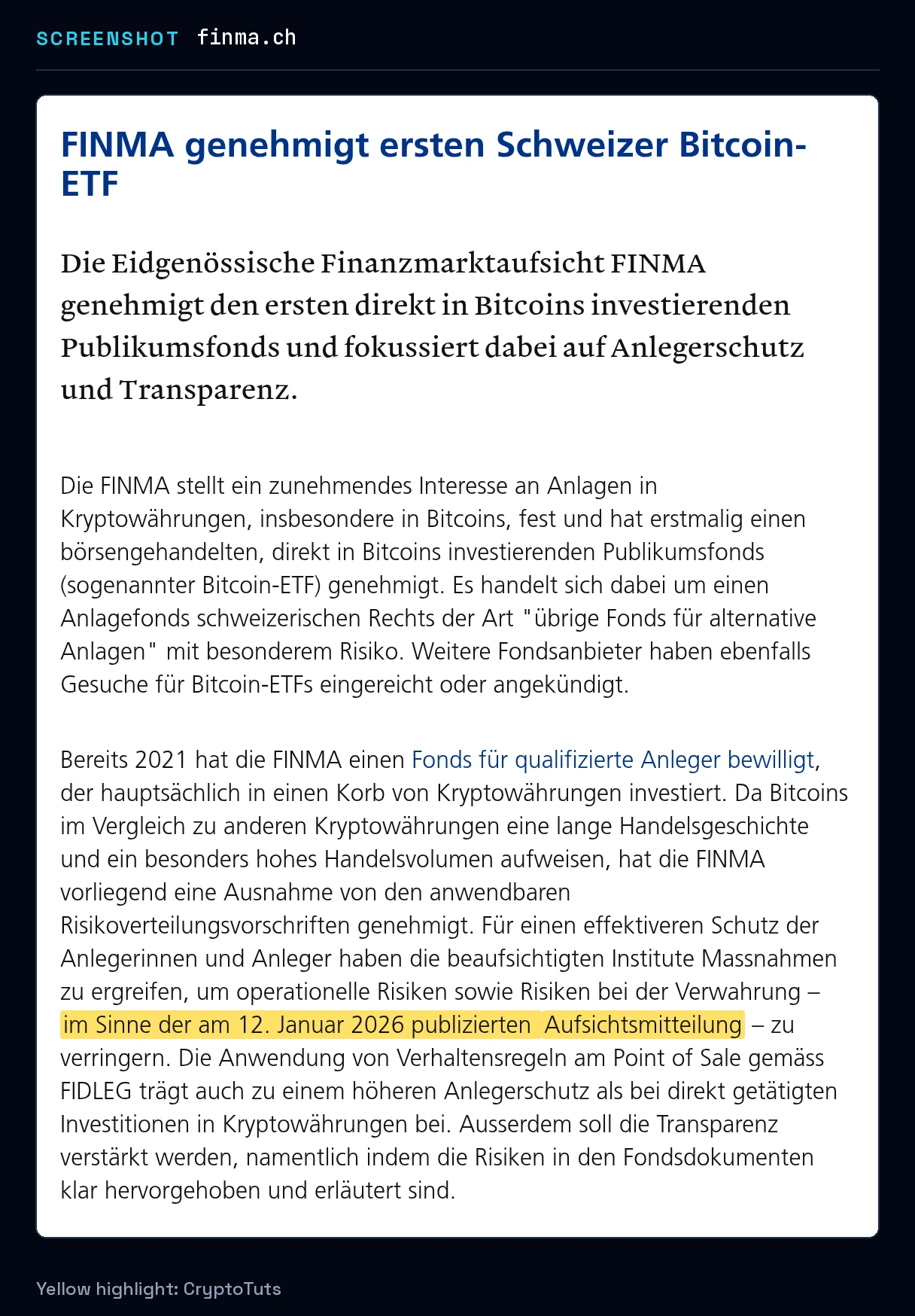
Under FINMA's guidance of Jan. 12, 2026, the direct crypto investments of a Swiss fund must generally be held at a Swiss custodian bank, the bank that keeps a fund's assets in safekeeping. That rule guards custody, not price.
FINMA grounded the waiver in bitcoin's long trading history and its particularly high trading volume compared with other cryptocurrencies. Supervised institutions must also curb custody and operational risks as the January guidance sets out.
Responsibility stays put when custody is outsourced
The guidance allows one route around the Swiss bank. Another custodian may hold the crypto only if it is supervised for soundness to an equivalent standard and equivalent rules protect crypto assets if it goes bankrupt.
If an authorized financial institution hands crypto custody to a third-party provider, in Switzerland or abroad, responsibility stays with the institution.
The guidance cites FINMA's own supervisory findings. Supervised institutions, as a group, at times fell short in taking custody risks into account in the past.
The 2021 fund came with asset conditions
FINMA classifies the new fund under Swiss law as an “other fund for alternative investments” with a specific risk. The 2021 fund, the Crypto Market Index Fund, belongs to the same category and invests primarily in crypto assets.
FINMA tied that approval to conditions on what the fund could buy. It could invest only in established crypto assets with sufficiently large trading volume. Its counterparties and platforms had to be established, bound by anti-money laundering rules and based in member countries of the Financial Action Task Force, the global money laundering watchdog. Trading volume appears in both decisions: as a condition on the assets in 2021 and as the ground for the waiver in 2026.
Bitcoin exchange-traded products such as the iShares product on SIX Swiss Exchange need no FINMA approval and fall under SIX Exchange Regulation, a FINMA spokesperson told Cointelegraph.
Other fund providers have also submitted or announced applications for bitcoin ETFs, FINMA said in its Oct. 20 release.
The risk warning goes on page one
Swiss fund law sets what a buyer sees before investing. The Collective Investment Schemes Act requires funds for alternative investments to flag their special risks in the fund name, the prospectus, the key information document and advertising material.
The Collective Investment Schemes Ordinance adds a step: the warning clause on those risks needs FINMA's approval. In that approved form, it must stand on the first page of the fund regulations, the prospectus and the key information document. For this fund, the Oct. 20 release also calls for clearer disclosure, chiefly by highlighting and explaining the risks in the fund documents.
Sales rules apply on top. FINMA reminded all supervised entities to follow the conduct rules of FinSA, Switzerland's Financial Services Act, strictly whenever they offer crypto-based instruments. That includes clear risk warnings and particular attention to suitability checks, which test whether a product fits a client.
Approval leaves the price risk with you
FINMA presents the fund as a gain for investor protection. In its view, applying FinSA point-of-sale conduct rules will help give buyers more protection than investing in cryptocurrencies directly.
Protection at the point of sale is a different thing from protection against losses. Bitcoin investments remain highly risky even through an approved ETF, FINMA warns. Because cryptocurrencies are highly volatile, invested capital may lose a significant amount of its value.
The January guidance makes the same point about custody. Crypto assets are not per se safe investments, even when held in custody in line with FINMA's rules. They are often risky and highly speculative, and high losses are possible.
The law also sets the scope of FINMA's review. Swiss fund law tasks the regulator with checking compliance with legal, contractual and regulatory provisions. Whether a licensee's business decisions are expedient lies outside that review.
The fund needs a Swiss listing to trade
To carry the ETF label, the fund needs a permanent listing on a Swiss stock exchange. Under the ordinance, at least one market maker must also keep the traded units close to their indicative net asset value. That value is a running estimate of what the fund's holdings are worth per unit.
A deadline frames the launch. FINMA's German release calls the product an investment fund, or Anlagefonds, and under the ordinance such a fund must be issued for subscription within one year of FINMA approval. FINMA can extend that limit on application. The clock starts with the approval decision itself; Oct. 20 is the day FINMA announced it.
FINMA's release does not name the fund, its issuer, its listing venue or a launch date.
Link disclosure: Sponsored module: Kalshi sponsors CryptoTuts, and we are compensated when readers sign up through the marked link (*). The reporting is independent of it. Read more
Sources
- FINMA approves Switzerland's first Bitcoin ETF (press release, Oct. 20, 2026) · FINMA
- FINMA genehmigt ersten Schweizer Bitcoin-ETF (German version of the Oct. 20, 2026, release) · FINMA
- FINMA publishes guidance on risks associated with the custody of cryptobased assets (press release, Jan. 12, 2026) · FINMA
- FINMA Guidance 01/2026: Custody of cryptobased assets (Jan. 12, 2026) · FINMA
- Federal Act on Collective Investment Schemes (CISA), SR 951.31, status as of March 1, 2024 · Swiss Confederation (Fedlex)
- Collective Investment Schemes Ordinance (CISO), SR 951.311, status as of Nov. 25, 2025 · Swiss Confederation (Fedlex)
- Approval of first Swiss crypto fund (press release, Sept. 29, 2021) · FINMA
- FINMA approves Switzerland's first Bitcoin ETF for retail investors · Cointelegraph
- Switzerland's FINMA Lets Retail Investors Into a Bitcoin-Only Fund for the First Time · Unchained
About the author

Phil
Founder & Editor-in-Chief · In crypto since 2017
Phil is the founder of CryptoTuts and has explored Bitcoin, cryptocurrencies and blockchain technology since 2017. He explains complex topics clearly, with data and without empty promises.
- XRP and the XRPL
- Bitcoin
- Crypto tax records
- Exchange comparisons
- On-chain analysis