Analysis · Bitcoin
Franklin Templeton bitcoin ETFs may have to limit reinvestment
The Oct. 22, 2026, prospectus warns that tax distribution rules may force FBEQ and FIBT to limit reinvesting dividends into bitcoin or to sell other holdings for cash.
By Phil5 min read

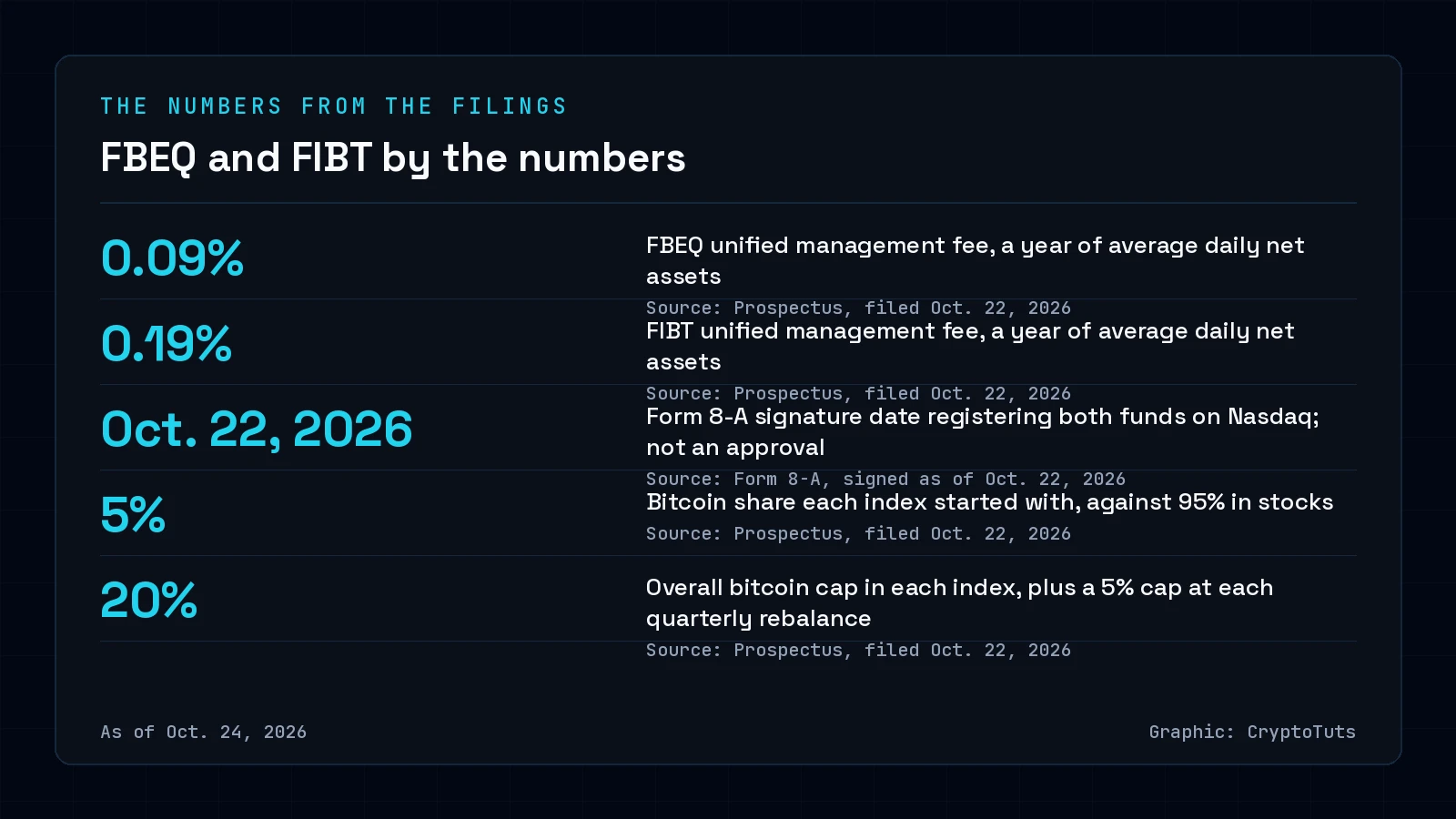
Franklin Templeton ETF Trust's new stock ETFs, FBEQ and FIBT, track indexes that started at 5% bitcoin and 95% stocks and reinvest every dividend into bitcoin. The prospectus filed Oct. 22, 2026, sets FBEQ's unified management fee at 0.09% a year and FIBT's at 0.19%. It also warns that tax distribution rules may force each fund to limit that reinvestment or sell other holdings for cash. Limiting reinvestment slows the bitcoin buildup, and either step may hurt how closely a fund tracks its index.
So how much bitcoin do you get? Each index caps bitcoin at 20% overall and at 5% at each quarterly rebalance. The funds reach that exposure through bitcoin ETPs, futures, options and depositary receipts. Each fund's daily holdings file will show what it actually holds.
Dividends buy bitcoin up to a 20% cap
The prospectus ties each fund to an index that VettaFi LLC maintains and calculates. FBEQ, the Franklin US Equity Bitcoin DRIP Index ETF, seeks to track the VettaFi US Large-Cap 500 Bitcoin DRIP Index. FIBT, the Franklin US Innovation Bitcoin DRIP Index ETF, seeks to track the VettaFi US Innovation 100 Bitcoin DRIP Index.
Each index builds its stock portion from a parent index and measures it on a price return basis. That basis counts share-price moves only. The dividends feed the bitcoin side instead.
Regular and special dividends both go into bitcoin at the market open on the day after each ex-dividend date. That date is the cutoff that decides who receives a dividend. As a result, the bitcoin share of the index grows over time.
The caps keep bitcoin a secondary allocation. CoinLaw, TokenPost and MyToken report how the reset works. At a quarterly rebalance, a bitcoin weight above 5% is cut to 4.5%. A weight above 20% between rebalances goes back to 4.5% at the close of the second business day after the breach.
The 95% stock and 5% bitcoin split is therefore the index's starting point rather than a fixed mix inside the funds. As dividends arrive, the bitcoin weight can climb between rebalances. For another bitcoin fund whose structure shapes what you keep, see how the iShares bitcoin buffer ETF compares with IBIT after tax.
Your bitcoin comes through ETPs and derivatives
Each fund seeks its bitcoin exposure through bitcoin ETPs, including ones sponsored by affiliates of its manager, Franklin Advisory Services, LLC. An ETP, or exchange-traded product, is a listed vehicle that holds or tracks an asset. The funds can also use bitcoin options and futures and depositary receipts representing bitcoin. Some of these positions may sit in a wholly owned Cayman Islands subsidiary.
Under normal market conditions, each fund invests at least 80% of net assets in two buckets together. One is its index's stocks; the other is bitcoin-related investments meant to match the index's bitcoin allocation. The bitcoin share within that minimum follows the index.
The subsidiary has its own ceiling. Each fund intends to hold no more than 25% of total assets there at each fiscal quarter-end. The limit serves tax diversification rules for regulated investment companies, the tax status most U.S. funds use. It governs where positions sit, while the bitcoin share still follows the index.
If a fund uses bitcoin futures, tracking error may grow when futures and spot prices diverge, the prospectus warns. Rolling contracts in contango creates a cost that could produce negative returns. Contango is a market where later-dated futures cost more than near-dated ones.
FBEQ and FIBT file under the Investment Company Act of 1940, the main U.S. law for investment funds. The spot bitcoin ETPs they may buy sit outside that act and lack its regulatory protections and governance standards.
Trading costs come on top of the fee
Here is what the two fees mean in dollars. On $10,000 of average net assets held for a year, FBEQ's 0.09% fee comes to $9. FIBT's 0.19% fee comes to $19. The gap is 0.10 percentage point, or $10 a year on that amount, before any waiver and before trading costs.
Under the management agreement, Franklin Advisory Services pays each fund's ordinary operating expenses. It also pays the sub-adviser, Franklin Templeton Institutional, LLC, which serves under agreements dated Sept. 22, 2026. And it reimburses all acquired fund fees and expenses, such as those of a Franklin Templeton money fund, plus all subsidiary-related expenses.
Brokerage, taxes, interest, litigation, extraordinary expenses and any 12b-1 payments stay outside the fee. Your own commission and the bid-ask spread come on top when you trade. The prospectus also warns that investing through underlying ETPs may duplicate advisory fees, with one fee at the fund level and another inside the ETP.
The holdings file shows the real bitcoin share
Once trading starts, you can check the bitcoin share yourself. Rule 6c-11, the SEC's ETF rule, requires a fund relying on it to post specified information on each holding every business day. The posting comes before regular trading opens on its primary listing exchange, and each fund says it will post before the Nasdaq open. Flows across bitcoin ETFs are in the CryptoTuts ETF flows tracker.
The Form 8-A, signed as of Oct. 22, 2026, registers shares of both funds on The Nasdaq Stock Market LLC, their primary listing exchange. A registration is not an approval; a Nasdaq listing notice or a Franklin Templeton launch release would name the first trading day. For an earlier case, see how the Winklevoss Zcash ETF's Nasdaq filing played out.
The $9 or $19 a year per $10,000 buys a fund whose index caps bitcoin at 5% at each quarterly rebalance and at 20% overall. In the holdings file, add up the bitcoin ETPs, futures, options and depositary receipts, then set the total against those caps. A futures position is where roll costs can arise. Near each fiscal quarter-end, the subsidiary's share of total assets shows how close a fund runs to its 25% ceiling.
Link disclosure: Sponsored module: Kalshi sponsors CryptoTuts, and we are compensated when readers sign up through the marked link (*). The reporting is independent of it. Read more
Sources
- Franklin Templeton ETF Trust, Form 485BPOS (Post-Effective Amendment No. 172), prospectus for FBEQ and FIBT, filed Oct. 22, 2026 · U.S. Securities and Exchange Commission (EDGAR)
- Franklin Templeton ETF Trust, Form 8-A12B for FBEQ and FIBT, signed as of Oct. 22, 2026 · U.S. Securities and Exchange Commission (EDGAR)
- Franklin Templeton ETF Trust, Form 485APOS (initial filing for the two Bitcoin DRIP Index ETFs), June 18, 2026 · U.S. Securities and Exchange Commission (EDGAR)
- SEC final rule, Exchange-Traded Funds (Rule 6c-11), 84 FR 57162, Oct. 24, 2019 · Federal Register (GovInfo)
- 17 CFR 270.6c-11, Exchange-traded funds (rule text) · Legal Information Institute, Cornell Law School
- SEC order approving Nasdaq Rule 5704 (Exchange Traded Fund Shares), April 3, 2020 · Federal Register (GovInfo)
- Bitcoin ETFs From $1.8 Trillion Giant Franklin Templeton Get Nasdaq Nod · U.Today
- Franklin Templeton Bitcoin DRIP ETFs Set to List on Nasdaq · CoinLaw
- Franklin Templeton Trust Files to Register Two Bitcoin Dividend ETFs, Naming Nasdaq · TokenPost
- Franklin Templeton Registers Bitcoin DRIP ETFs That Reinvest Stock Dividends Into BTC · MyToken
About the author

Phil
Founder & Editor-in-Chief · In crypto since 2017
Phil is the founder of CryptoTuts and has explored Bitcoin, cryptocurrencies and blockchain technology since 2017. He explains complex topics clearly, with data and without empty promises.
- XRP and the XRPL
- Bitcoin
- Crypto tax records
- Exchange comparisons
- On-chain analysis