Analysis · Bitcoin
iShares bitcoin buffer ETF could leave you less after tax than IBIT
PBIT would cap gains to hold each tranche's initial loss to about 10% before fees. The filing warns that straddle rules could lower your after-tax return versus holding IBIT directly.
By Phil5 min read

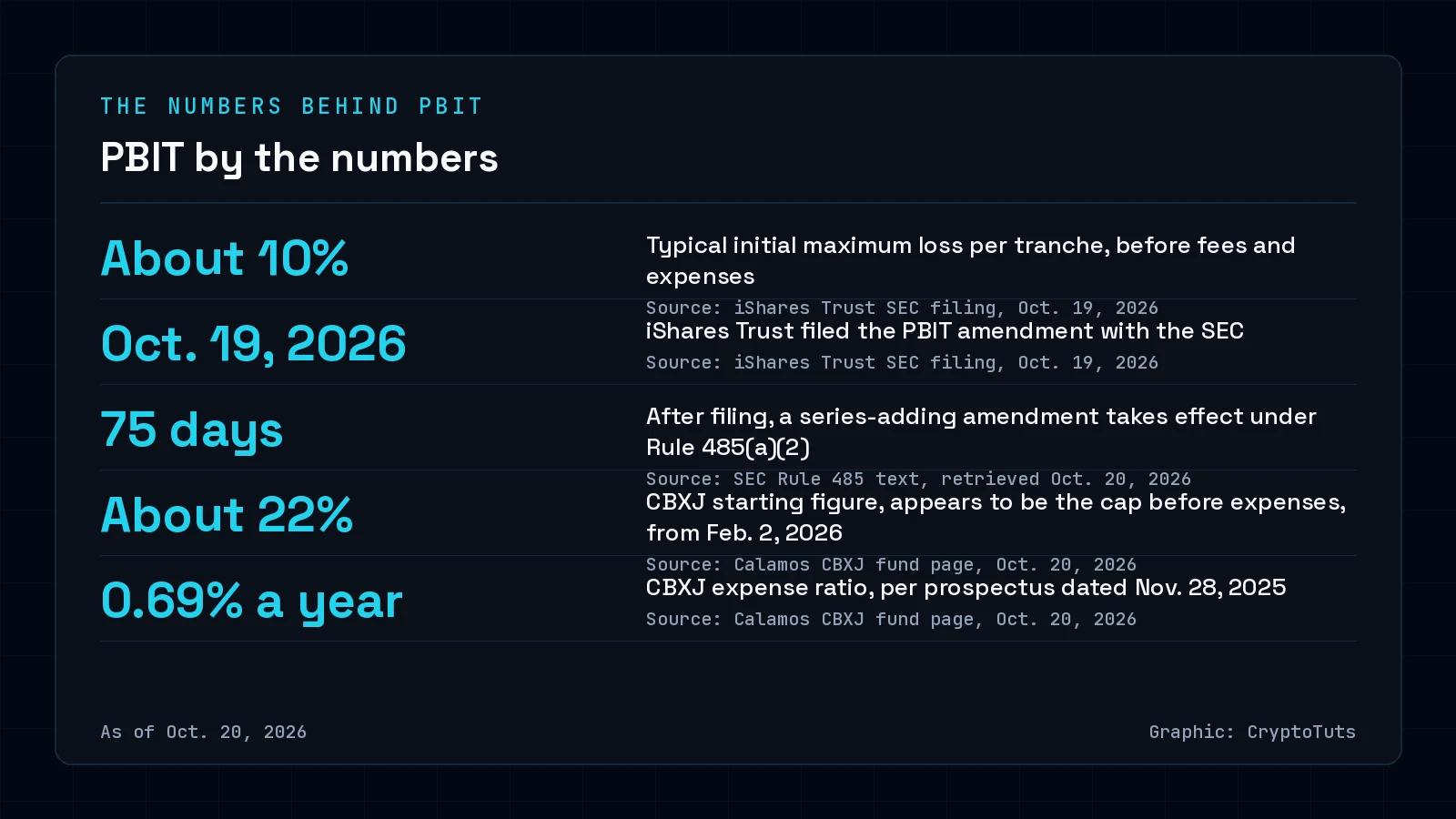
On Oct. 19, 2026, iShares Trust filed an SEC amendment for a bitcoin ETF that would cap your gains to hold each tranche's initial loss to about 10% before fees. The iShares Bitcoin Managed Protection ETF, proposed ticker PBIT, would hold options on IBIT, the iShares Bitcoin Trust ETF, or similar bitcoin exposure. A tranche is one package of those options; the fund generally holds three, typically started a month apart. Its filing also warns that you could keep less after tax than by holding IBIT directly.
For an IBIT holder, that is the trade: less upside, and possibly more tax, for a partial cushion. Each tranche's protection typically starts at about 90% of the reference asset's value when its options are bought. The filing calls that roughly 10% drop the Floor. Each tranche is a call spread: the fund buys a call option and sells one at a higher strike price, and the sold call sets where your gain stops.
Caps and fees shape what you keep
Calamos's bitcoin buffer ETFs show what such a cushion costs in upside. Calamos designs CBXJ to limit the maximum loss to 10% and CBOJ to protect against 100% of losses, each over a one-year period before fees. For the period that began Feb. 2, 2026, CBXJ listed a starting figure of about 22% (22.24%), which appears to be the cap before expenses, about 2.7 times CBOJ's roughly 8% (8.36%). Both charge 0.69% a year as of prospectuses dated Nov. 28, 2025.
For PBIT, the cushion carries three costs:
- Gains above the cap. Each tranche's cap is set from market conditions when it starts, so caps can vary over time. The fund will not fully participate in gains above that cap and may trail its reference asset significantly, while you still carry losses that can be large.
- Fees that shrink the buffer. Floors and caps are stated before fees and expenses, including the management fee, so those costs cut your upside and add to your possible losses.
- A possible tax drag. BlackRock Fund Advisors (BFA), the fund's adviser, expects its options to be Section 1256 contracts under current law, treated as sold at each year end. New guidance could change that, and straddle rules may raise short-term gains taxed as ordinary income.
PBIT's management fee was blank at filing, Decrypt reports. The filing names no trading date, while CoinDesk said in a post on X that the fund is "targeting early January 2027." Once the fund runs, iShares.com is to post its tranche caps, protection start values, weights and holdings.
Three rolling tranches mean your floor moves
PBIT would get its bitcoin exposure through options rather than by holding bitcoin, so it carries bitcoin's risks. Alongside its call spreads, it holds fixed-income investments.
Each month one tranche typically expires and a new one replaces it, though the fund can hold more or fewer tranches and vary expirations. It generally expects to use FLEX Options, exchange-listed contracts with customized terms, and may also use standardized listed options. The FLEX contracts are expected to be European style, exercisable only at expiration, with the Options Clearing Corp. as guarantor.
The fund can raise or lower each tranche's protection start level at any time. If IBIT rises after a tranche starts, your possible loss from the higher price is larger than the Floor.
The floor is no guarantee
The strategy may not work as intended, you may lose some or all of your money, and extreme volatility may shrink both the upside and the protection.
Because tranches overlap, the fund has no fixed start value, floor or cap. Your result can differ from that of any single tranche held for its full period.
Cash and short-term debt round out the portfolio: money market funds, short-term government obligations and short-term investment-grade securities. Their income is meant to help cover the cost of the options and may partly offset losses.
Calamos's figures apply to one-year holds
Buffered bitcoin ETFs already exist. Calamos runs several, and Decrypt reports that First Trust and Innovator offer such funds too.
The paired values on Calamos's fund pages, 22.24% and 21.55% for CBXJ and 8.36% and 7.67% for CBOJ, appear to be the caps before and after fund expenses.
PBIT's management fee is the figure to set beside Calamos's 0.69%. Under the advisory agreement, BFA pays the fund's other operating expenses, apart from interest, taxes, transaction costs such as brokerage commissions, distribution fees and litigation or extraordinary expenses. Calamos's caps describe one-year funds, while PBIT would typically add a new tranche each month.
PBIT could also feed IBIT and its adviser
The filing discloses a potential conflict. PBIT's options on IBIT may bring IBIT additional assets and, indirectly, higher fees for BFA and its affiliates. That tells you who else could gain when you buy.
New funds face a 75-day SEC clock
The filing is a post-effective amendment, an update to iShares Trust's existing registration, and it has yet to take effect. For an amendment that adds a fund series, the SEC's Rule 485 (paragraph (a)(2)) sets effectiveness on the 75th day after filing. The registrant may designate a later date, up to 95 days after filing, and the SEC can accelerate or suspend effectiveness.
Effectiveness is neither an SEC judgment on the fund's merits nor a trading date.
Link disclosure: Sponsored module: Kalshi sponsors CryptoTuts, and we are compensated when readers sign up through the marked link (*). The reporting is independent of it. Read more
Sources
- iShares Trust Form 485APOS, Post-Effective Amendment No. 2,895 (iShares Bitcoin Managed Protection ETF) · U.S. Securities and Exchange Commission (EDGAR)
- 17 CFR 230.485, Securities Act Rule 485 · Cornell Law School Legal Information Institute
- Calamos Bitcoin 90 Series Structured Alt Protection ETF - January (CBXJ), fund page · Calamos Investments
- Calamos Bitcoin Structured Alt Protection ETF - January (CBOJ), fund page · Calamos Investments
- BlackRock files for buffer bitcoin ETF · Decrypt
- CoinDesk post on X about PBIT · CoinDesk
About the author

Phil
Founder & Editor-in-Chief · In crypto since 2017
Phil is the founder of CryptoTuts and has explored Bitcoin, cryptocurrencies and blockchain technology since 2017. He explains complex topics clearly, with data and without empty promises.
- XRP and the XRPL
- Bitcoin
- Crypto tax records
- Exchange comparisons
- On-chain analysis