Analysis · Taxes
Mesh Visa crypto payments would be sales for the IRS
Mesh says the Visa credential works without selling first. Treasury and the IRS say a payment with digital assets is a sale or exchange, so any gain or loss goes on your return.
By Phil5 min read

Mesh announced a partnership with Visa on Oct. 19, 2026, designed to let you spend crypto and stablecoin balances at Visa merchants. In the preamble to the broker rules Treasury and the IRS published July 9, 2024, a payment with digital assets is a sale or exchange. You report any gain or loss on your federal return, while paying cash is not a taxable transaction.
Whether a purchase also lands on a Form 1099-DA, the information return brokers file for digital asset sales, turns on custody. The question is whether a party in the Mesh flow takes possession of your coins and reports as a payment processor or other broker.
You skip the sell step, not the sale
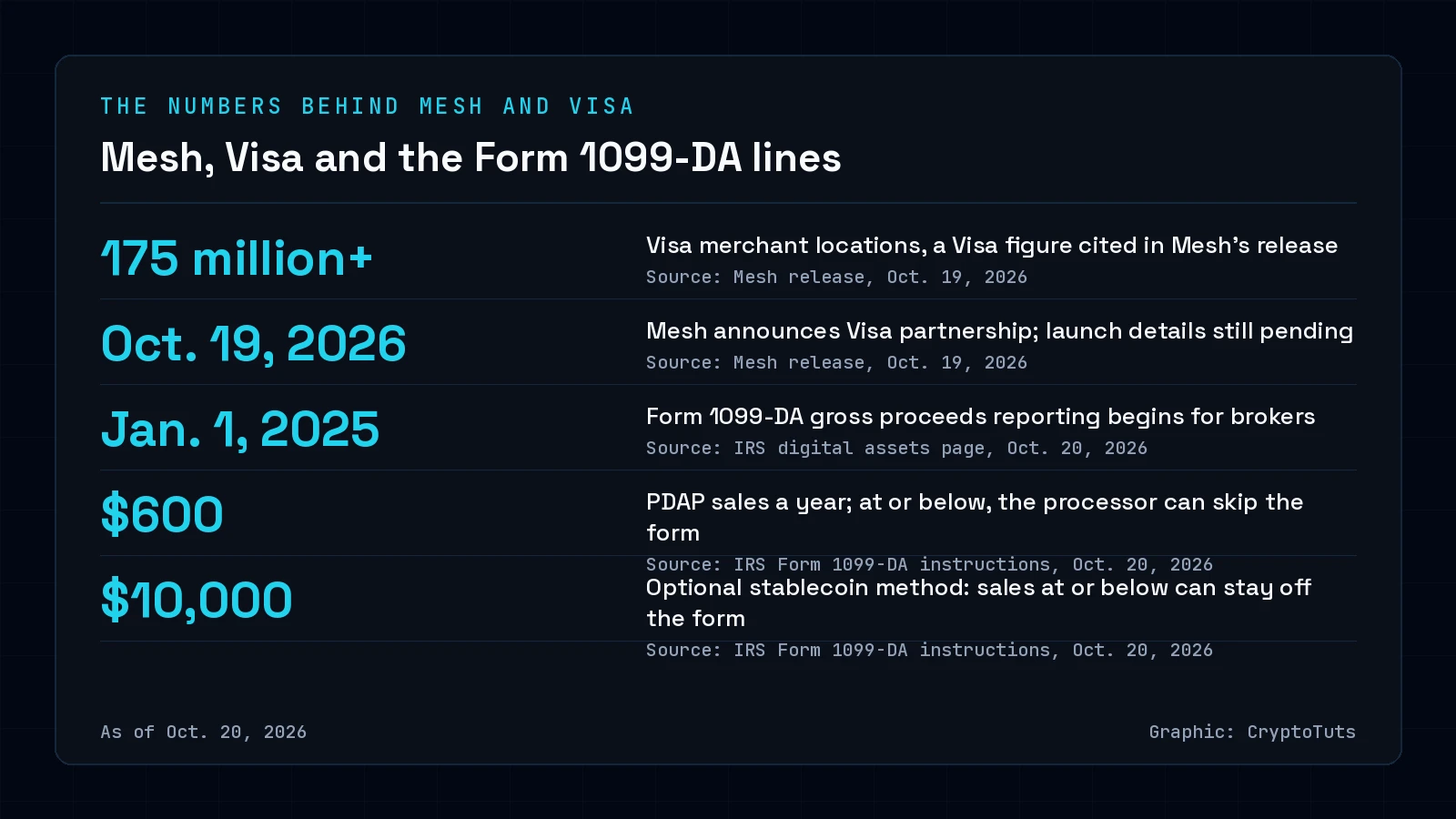
Visa's network spans upwards of 175 million merchant locations in more than 200 countries and territories, a Visa figure cited in Mesh's release. In Mesh's planned setup, a Visa credential is provisioned behind the scenes. You tap at a contactless terminal or check out online without first selling, transferring or preloading funds.

Mesh orchestrates how each transaction is funded and converted across supported balances, including crypto, stablecoins and fiat. Bam Azizi, Mesh's CEO and co-founder, said Mesh handles the funding and conversion so a balance "becomes purchasing power at the moment of payment."
For U.S. tax purposes, the IRS treats digital assets, stablecoins included, as property, not currency. Under the IRS FAQs for transactions before Jan. 1, 2025, using crypto held as a capital asset to buy goods is an exchange that produces a capital gain or loss. The gain or loss is the fair market value of what you receive minus your adjusted basis.
If what you receive is worth more than your adjusted basis in the coins, those FAQs put a gain on the purchase. If it is worth less, the result is a loss.
Who holds your coins decides the Form 1099-DA
The final broker rules apply to brokers that take possession of the digital assets their customers sell, including certain processors of digital asset payments, or PDAPs. Decentralized or non-custodial brokers that never hold your assets fall outside their reporting requirements. That is the line between an app that holds your coins and a self-custody wallet you control yourself.
Under those rules, paying a stablecoin or other digital asset to a PDAP that then pays the merchant in digital assets or cash is a PDAP sale. You count as the PDAP's customer only to the extent it has an agreement with you for payment services. That agreement must let it verify your identity or otherwise meet anti-money-laundering program requirements.
The instructions for Form 1099-DA draw a $600 line for PDAPs. Say your PDAP sales at one processor total exactly $600 for the year: the processor can leave them off the form. One more purchase that lifts the total past $600 puts all of them on it, not just the excess. The line covers PDAP sales only; a transaction a custodial broker effects as an ordinary sale is reported under the general rules.
Stablecoins can fall under a second, higher line. A broker can opt into the qualifying stablecoin method. Your designated stablecoin sales at that broker can then stay off the form while their gross proceeds, net of allocable transaction costs, total $10,000 or less for the year.
Form 1099-DA reporting of gross proceeds began with transactions on or after Jan. 1, 2025. Basis reporting for certain transactions followed on or after Jan. 1, 2026.
Stablecoin spending differs from spending appreciated crypto
In the preamble to the broker rules, Treasury and the IRS expected that many stablecoin purchases through payment processors might go unreported under the optional $10,000 threshold. They judged that gains below that line are likely to be small.
Under the pre-2025 IRS FAQs, appreciated crypto held as a capital asset yields a gain equal to the fair market value of what you receive minus your adjusted basis. A Form 1099-DA from a PDAP would show your proceeds alone, because PDAPs are spared from reporting cost basis. You supply the basis from your own records. You also report every digital asset transaction on your return, with or without a gain or loss and with or without a Form 1099-DA.
Rollout details are the next step to watch
As of Oct. 19, 2026, Mesh was to announce initial availability, supported devices and participating platforms as rollout details are finalized. Mesh acts as program manager, handling user onboarding and KYC, the know-your-customer identity checks. Because the rules tie PDAP customer status to that kind of identity agreement, the program terms are where to look for which party holds it with you.
Until then, keep records of the adjusted basis of every coin you might spend; the pre-2025 IRS FAQs figure gain or loss on capital assets from it. Mesh has yet to name the bank that issues the Visa credential, the assets it supports or the fees and exchange rates it charges.
Link disclosure: Sponsored module: Kalshi sponsors CryptoTuts, and we are compensated when readers sign up through the marked link (*). The reporting is independent of it. Read more
Sources
- Mesh and Visa Partner to Make Stablecoin and Crypto Balances Spendable Across 175 Million Merchants · PR Newswire
- Mesh and Visa Make Stablecoin and Crypto Balances Spendable Across 175 Million Merchants · Mesh
- Digital assets · Internal Revenue Service
- T.D. 10000: Gross Proceeds and Basis Reporting by Brokers and Determination of Amount Realized and Basis for Digital Asset Transactions (89 FR 56480) · Federal Register
- Instructions for Form 1099-DA (2026) · Internal Revenue Service
- Frequently asked questions on virtual currency transactions · Internal Revenue Service
- Mesh on X: Money20/20 stage payment over the Visa network · X (@meshpay)
About the author

Phil
Founder & Editor-in-Chief · In crypto since 2017
Phil is the founder of CryptoTuts and has explored Bitcoin, cryptocurrencies and blockchain technology since 2017. He explains complex topics clearly, with data and without empty promises.
- XRP and the XRPL
- Bitcoin
- Crypto tax records
- Exchange comparisons
- On-chain analysis