Analysis · Regulation
Coinbase trust bank needs at least $60 million in tier 1 capital
The OCC's April 2 decision sets the floor for the first three years, plus 180 days of wind-down expenses in liquid assets. A minimum is not the bank's actual capital.
By Phil5 min read

Coinbase plans to move its entire custody business into a new federal trust bank. The move from New York-chartered Coinbase Custody Trust Company runs over the bank's three-year de novo period, its start-up years. The bank, Coinbase National Trust Company, received a charter effective Nov. 6, 2026. Its services are limited to custody customers, mainly institutions, and the OCC's April 2 decision requires at least $60 million in tier 1 capital during its first three years.
The change is about custody, not deposits. A national trust bank is a federally chartered fiduciary: it holds assets under a legal duty to act in its clients' interest. The Coinbase bank will not be an FDIC-insured depository institution, which is why the Community Reinvestment Act does not apply to it. It must keep to trust company operations and stay outside the Bank Holding Company Act's definition of a bank, which turns on taking demand deposits and making commercial loans.
The bank's transactional services, accepting, holding and transferring custodied fiat and digital assets, reach only custody customers and their custodied assets. Whether Coinbase app accounts become custody customers of the bank is the open part; a Coinbase customer notice would settle it.
Custody comes in segregated or pooled wallets
Coinbase's application to the OCC names mainly business and commercial entities across the United States as the bank's intended market and describes two custody setups. Prime Vault keeps each client's assets in segregated storage, with onchain wallet addresses unique to that client. Prime Custody holds client fiat and digital assets in an omnibus wallet, one pooled account for many clients.
In the application, the bank acts as a qualified custodian in a fiduciary capacity. A qualified custodian is the kind of firm SEC custody rules require investment advisers to use for client assets.
Client cash goes to other banks. A footnote in the OCC decision places custodied fiat in for-benefit-of accounts at third-party banks, held in the custodian's name on behalf of its clients.
The business slated to move is large. Coinbase put its assets under custody at $245.7 billion as of June 30, 2025, which it called about 7% of the total market value of all crypto assets that day.
The bank stays a custodian. Staking, Prime Trading and Prime Financing remain with Coinbase affiliates, and the bank may act as a finder that connects custody clients to them for custodied assets. Coinbase said in April 2026 that it was not becoming a commercial bank and would not take retail deposits or engage in fractional reserve banking, Decrypt reported.
The OCC posed no objection to Rick Schonberg serving as the bank's director and chief executive officer. In a release quoted by American Banker, Schonberg said the approval lets Coinbase expand its custody capabilities within a consistent federal regulatory framework.
The OCC set a $60 million tier 1 capital floor
The OCC's April 2 decision requires the bank to hold at least $60 million in tier 1 capital during its first three years of operation. Tier 1 capital is a bank's core capital, mainly shareholder equity. The greater of 50% of that capital or $30 million must sit in Eligible Liquid Assets, holdings the OCC accepts as liquid.
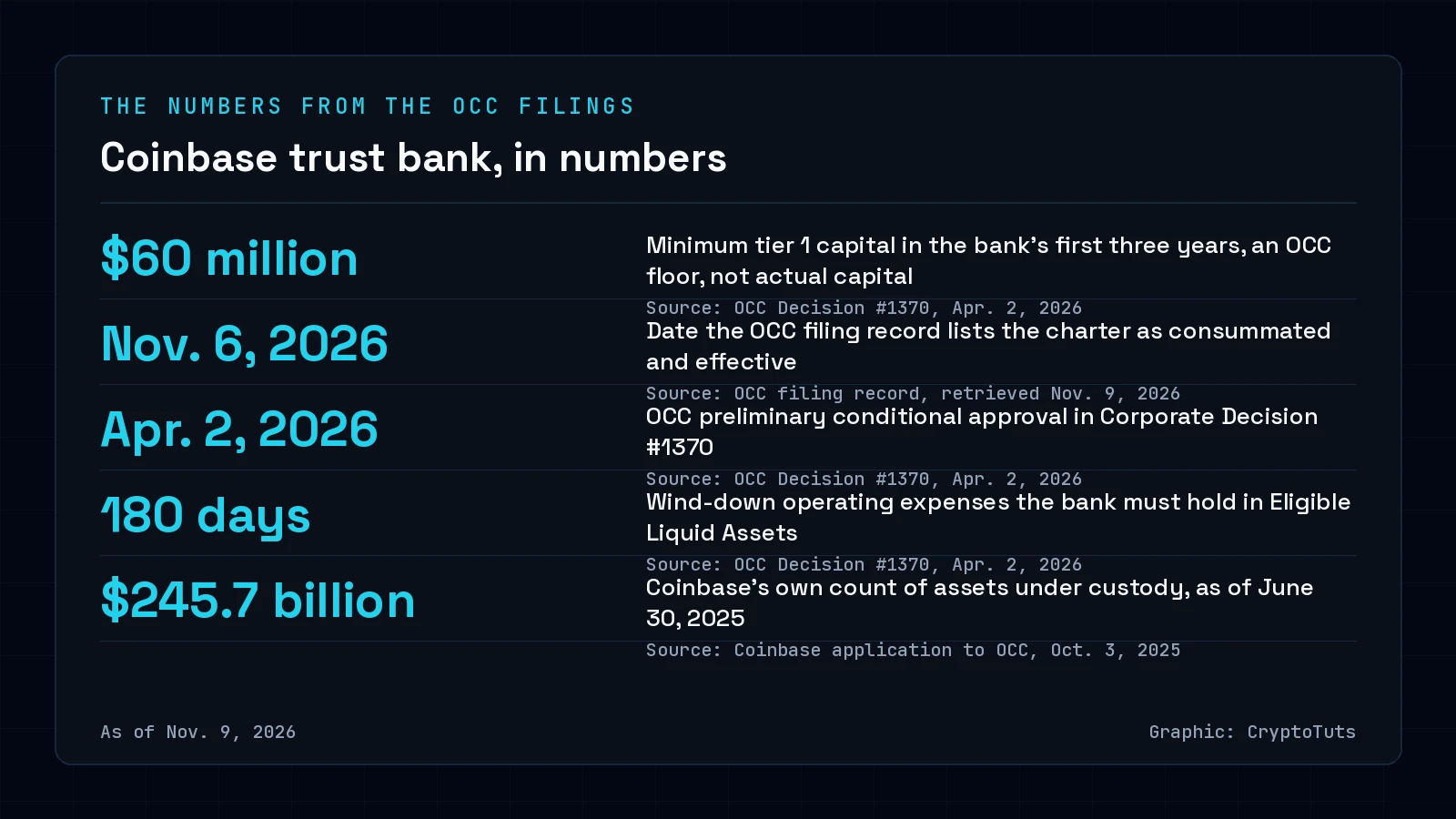
At the floor, both tests give the same number: half of $60 million is $30 million. Above $60 million, every added dollar of tier 1 capital raises the liquid requirement, because 50% then exceeds $30 million.
The bank must also hold 180 days of operating expenses in Eligible Liquid Assets over the same three years, counted separately from the capital rule. Those expenses are measured for a distressed wind-down, the cost of shutting the business down under stress.
Stablecoins are a Coinbase plan, not a bank permission
The OCC decision states that the bank does not propose to issue stablecoins. American Banker reports that Coinbase's immediate focus is custody and that it eventually plans to move into stablecoin issuance, servicing, white-label stablecoin arrangements for other companies and payments. White-label means a coin another company sells under its own brand.
Coinbase's application, filed Oct. 3, 2025, lists digital asset payments products and custody products that let clients interact with select smart contracts onchain as ideas the bank will explore.
The bank must give the OCC at least 60 days' written notice of any significant change to its business plan or operations and obtain a written no-objection first. That rule runs through its organization period and first three years. Like the capital rules, it is a condition from the April 2 decision; the Nov. 6 filing record lists the charter's effective date, not its terms.
The bank must also conform its activities to the GENIUS Act, the federal stablecoin law, along with its implementing rules and future applicable laws where the OCC finds that necessary.
Bank groups and Warren say the OCC overstepped
The objections began in the OCC's own file. The agency received five public comments on Coinbase's application, two from bank trade groups and three from community groups. Four questioned the OCC's authority to charter the bank. In April, the OCC rejected those arguments and found the proposed activities permissible.
Decrypt reports that the Independent Community Bankers of America has sued the OCC to stop crypto firms from entering banking through what it calls a side door. Sen. Elizabeth Warren, D-Mass., has argued that the OCC's crypto charter approvals, including Coinbase's, are illegal, Decrypt adds.
Coinbase's approval came after Ripple's
For XRP holders, the closest comparison is Ripple. The OCC's Dec. 12, 2025, release announced conditional approvals for five national trust banks: First National Digital Currency Bank and Ripple National Trust Bank as new charters, and BitGo, Fidelity Digital Assets and Paxos as conversions. Coinbase's preliminary conditional approval followed on April 2, 2026, and its charter took effect about seven months later.
For anyone with assets in Coinbase custody, the change comes in stages. Coinbase plans to complete the move out of its New York trust company within the bank's three-year de novo period, and its updates on shifting assets will show whether that plan holds.
Link disclosure: Sponsored module: Kalshi sponsors CryptoTuts, and we are compensated when readers sign up through the marked link (*). The reporting is independent of it. Read more
Sources
- OCC Corporate Applications Search: Coinbase National Trust Company, filing 2025-Charter-343449 · Office of the Comptroller of the Currency
- OCC Corporate Decision #1370: preliminary conditional approval of Coinbase National Trust Company · Office of the Comptroller of the Currency
- Coinbase application to the OCC to organize Coinbase National Trust Company (public portion) · Coinbase (filed with the OCC)
- OCC News Release 2025-125: Conditional approvals for five national trust bank charter applications · Office of the Comptroller of the Currency
- American Banker: Coinbase gets final OCC charter approval · American Banker
- Decrypt: Coinbase Joins Circle, Ripple With Final OCC Approval for Federal Trust Bank Charter · Decrypt
About the author

Phil
Founder & Editor-in-Chief · In crypto since 2017
Phil is the founder of CryptoTuts and has explored Bitcoin, cryptocurrencies and blockchain technology since 2017. He explains complex topics clearly, with data and without empty promises.
- XRP and the XRPL
- Bitcoin
- Crypto tax records
- Exchange comparisons
- On-chain analysis