Analysis · Regulation
CLARITY Act sits at the Senate's first step after two cloture motions
The Congressional Record Index lists the motions at pages dated Aug. 7 and Sept. 15, 2026. It does not show whether cloture was invoked, and the Democratic wins are AP projections.
By Phil4 min read
The CLARITY Act is the bill that would set SEC and CFTC rules for selling digital commodities. The 2026 Congressional Record Index lists cloture motions on the motion to proceed to H.R. 3633 at Record pages dated Aug. 7 and Sept. 15, 2026. Democrats won both chambers in Associated Press race calls late Nov. 3 and early Nov. 4, 2026, Eastern time, projections ahead of certified results.
The motion to proceed brings a bill to the floor before debate on the bill itself. Cloture is the vote that ends debate so the chamber can move on.
Whether the Senate can still pass the bill before the new Congress is seated is open. A Senate procedural vote on the bill failed in September 2026, according to the advocacy group Stand With Crypto. The lame-duck session is the sitting Senate's remaining floor time before then. Its floor schedule and the congress.gov action history for H.R. 3633 will show whether the bill comes back up.
The Senate's version goes beyond market rules
The House passed the bill in July 2025, as Cointelegraph noted in its election coverage. In the Senate, Sen. Tim Scott of South Carolina reported it with an amendment. That Senate-reported version shows a last action date of June 1, 2026, on Govinfo.
Its full title covers more than market rules. It also prohibits use of a central bank digital currency, a digital form of a country's money issued by its central bank, for monetary policy. And it bars Federal Reserve banks from offering certain products or services directly to individuals.
The new majorities are still taking shape. Cointelegraph's live tally after the election showed Democrats with 54 Senate seats to 44 for Republicans and 228 House seats to 139. Races were still uncalled at that point.
Ethics terms and bank deposits held it up
Senate Democrats had refused to advance the bill without stronger ethics language, Unchained reported. They wanted it to bar Trump, his family and administration officials from profiting from crypto ventures. Sen. Mark Warner cited the need for such safeguards when he voted against advancing it in September.
Republicans objected too. Sen. Susan Collins of Maine opposed advancing the bill in September, citing concerns about bank deposits. Cointelegraph counts four Republican opponents in all. Collins lost her seat to Democrat Troy Jackson in an AP race call early Nov. 4, 2026.
Leadership of the Senate Banking Committee is also in play. Politico's reporting, relayed by Unchained, says Sen. Elizabeth Warren "appears poised" to chair it in the next Congress. Senate Democrats' committee assignments, still to come, will name the chair.
Most of Fairshake's payouts went to affiliated committees
Fairshake's FEC filings show where its money went. From Jan. 1, 2025, through Oct. 14, 2026, the committee's disbursements totaled $169.5 million. Transfers to affiliated committees made up $139 million of that, or 82%. Its own independent expenditures came to $19.4 million, about 11%, and operating expenditures to $11.1 million.
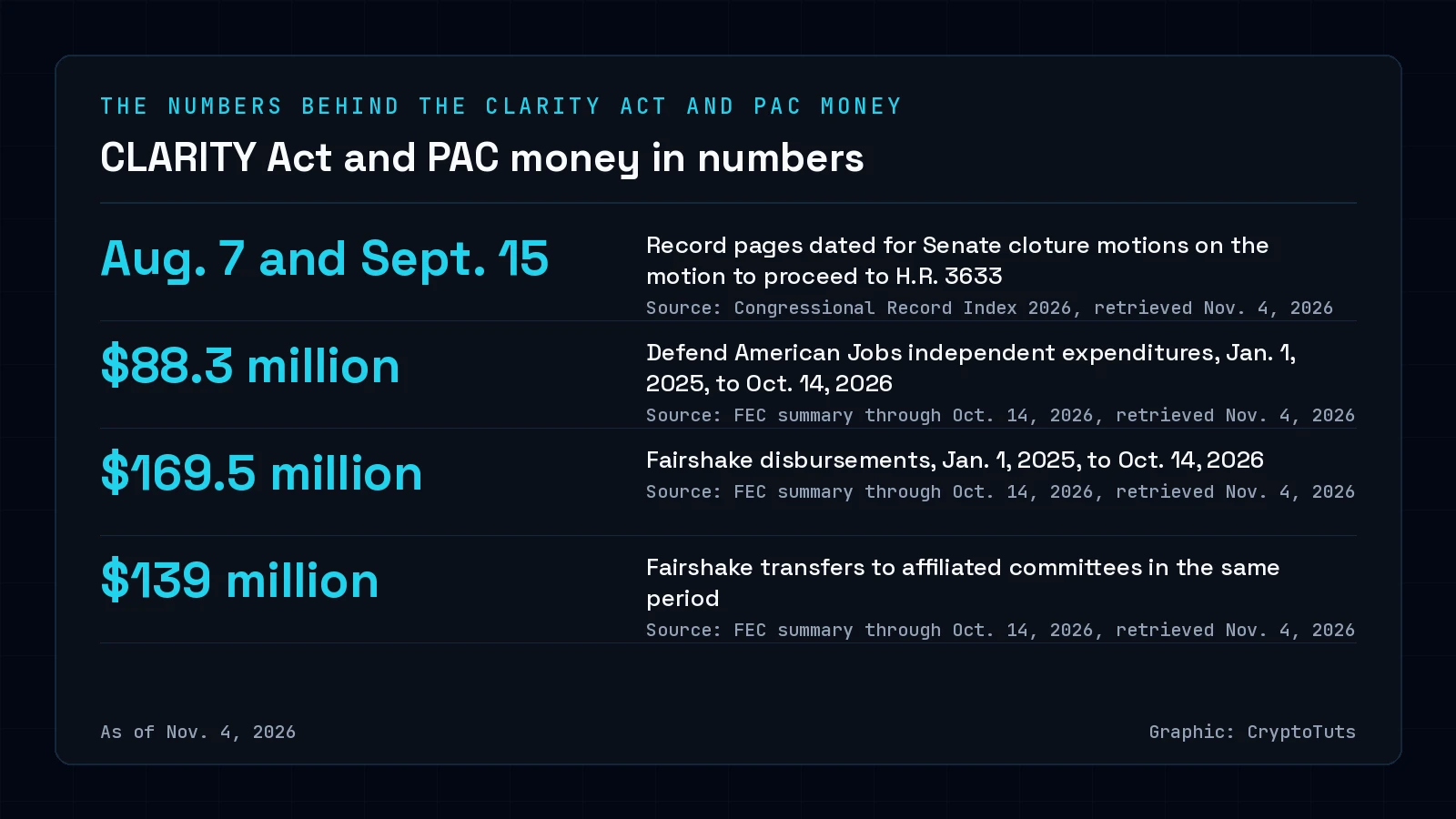
A transfer to an affiliated committee is money moved to an allied committee. An independent expenditure, by contrast, is spending for or against a candidate without coordinating with the campaign. Put simply, about $8 of every $10 Fairshake paid out through Oct. 14 went to affiliated committees. About $1 of every $10 went to candidate spending under its own name.
Defend American Jobs filed $88.3 million in independent expenditures across all races over the same period, a floor for its 2026 cycle spending. Adding its figures to Fairshake's would count money moving between affiliated committees twice.
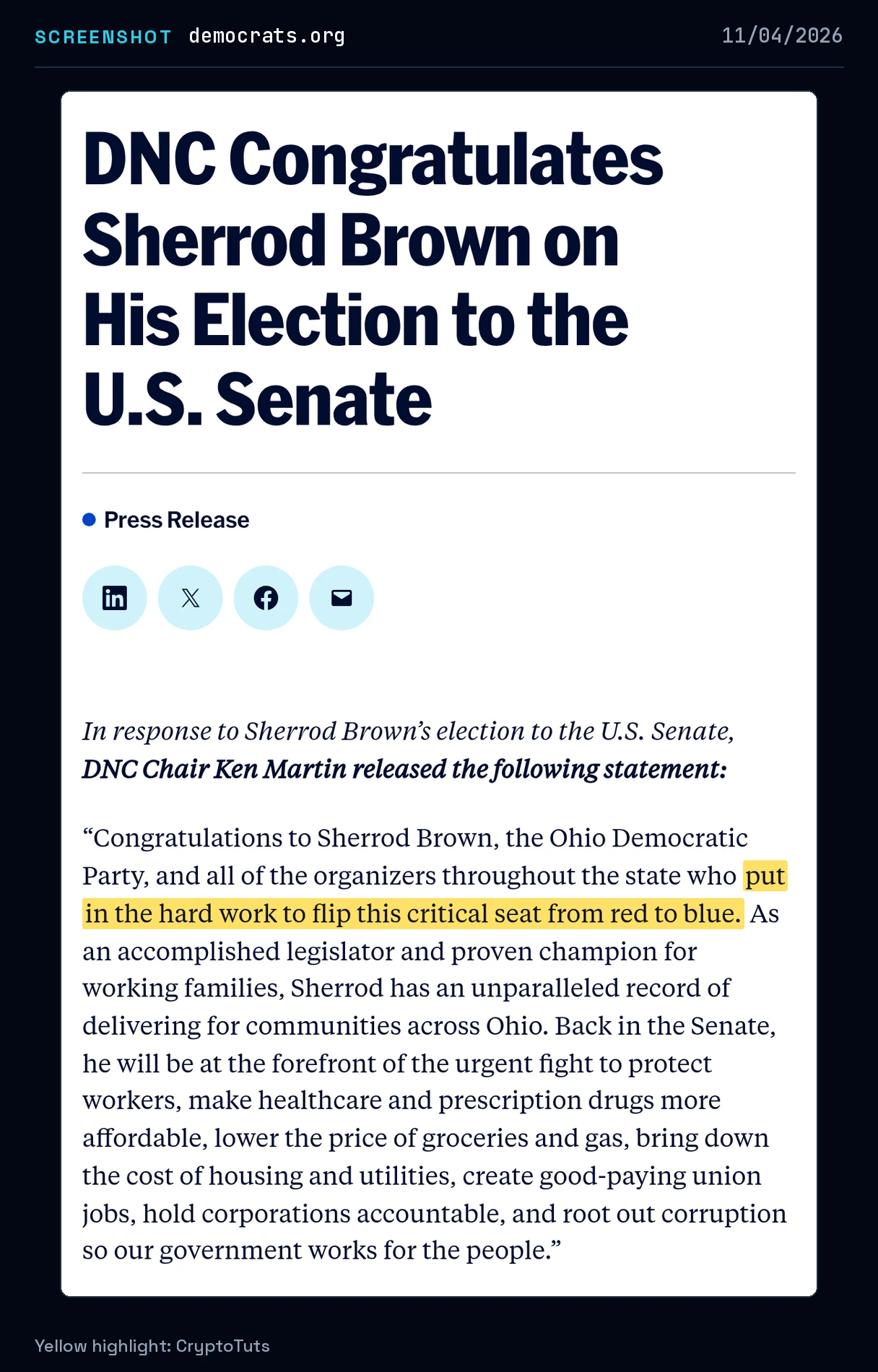
In AP-based calls, Democrat Sherrod Brown ousted Republican Sen. Jon Husted in Ohio, and Republican Sen. Pete Ricketts held off independent Dan Osborn in Nebraska. Estimates of crypto industry spending in Ohio diverge: more than $55 million from Politico and more than $68 million from Reuters before the vote, both relayed by Unchained. In Nebraska, Bankrolled's compilation of FEC data as of Nov. 3, 2026, puts Defend American Jobs' spending against Osborn at about $13.5 million.
Analysts split on what the flip means
Grayscale Head of Research Zach Pandl argued before the vote that a flip in Congress would not materially change crypto's prospects. His reason: the industry is bipartisan, global and institutional.
JPMorgan analysts saw a different risk. They told Reuters, as relayed by Unchained, that crypto rules written under Trump could be undone by a later administration.
Maylea Ma, deputy general counsel at 1inch, expects the SEC, CFTC and Treasury, rather than Congress, to drive "real movement" in U.S. digital-asset regulation over the next few years. She still sees a durable statute as the long-term goal.
Link disclosure: Sponsored module: Kalshi sponsors CryptoTuts, and we are compensated when readers sign up through the marked link (*). The reporting is independent of it. Read more
Sources
- US midterm elections 2026 as it happened · Cointelegraph
- Democrats Sweep Congress as Sherrod Brown Survives Crypto's Ohio Spending Push · Unchained
- Congressional Record Index 2026: Digital Asset Market Clarity (CLARITY) Act · U.S. Government Publishing Office (govinfo)
- H.R. 3633 (RS), Digital Asset Market Clarity Act, reported in Senate · U.S. Government Publishing Office (govinfo)
- FEC committee page: Defend American Jobs (C00836221) · Federal Election Commission
- FEC committee page: Fairshake (C00835959) · Federal Election Commission
- AP post on Democratic control of the House and Senate · The Associated Press
- WSJ post relaying the AP Senate call · The Wall Street Journal
About the author

Phil
Founder & Editor-in-Chief · In crypto since 2017
Phil is the founder of CryptoTuts and has explored Bitcoin, cryptocurrencies and blockchain technology since 2017. He explains complex topics clearly, with data and without empty promises.
- XRP and the XRPL
- Bitcoin
- Crypto tax records
- Exchange comparisons
- On-chain analysis