Analysis · Regulation
SEC exam priorities put tokenization under clearing agency exams
Clearing agency exams and exams under Regulation SCI now name tokenization, and neither section did in fiscal 2026. The report is a staff document with no legal force.
By Phil5 min read

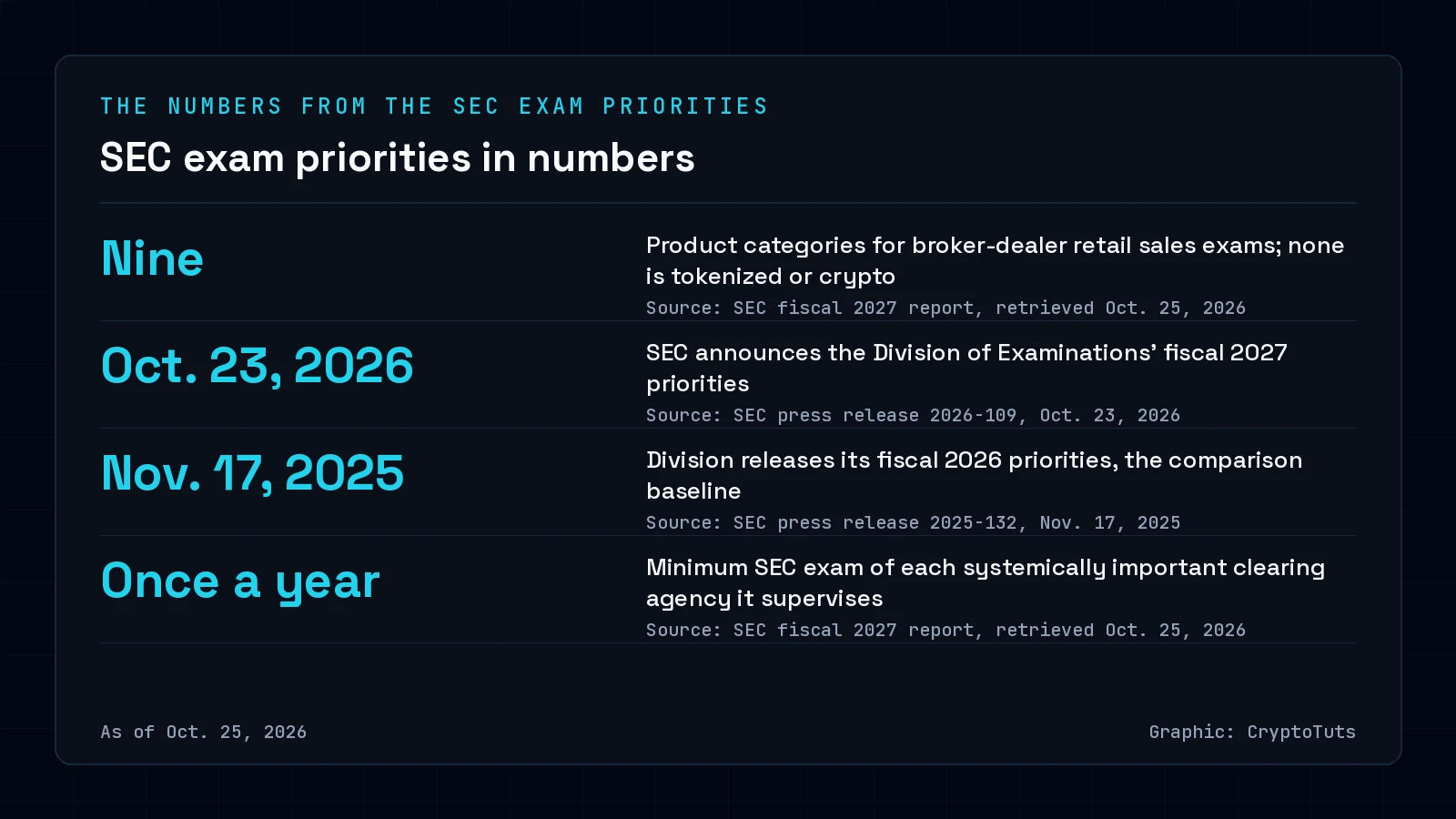
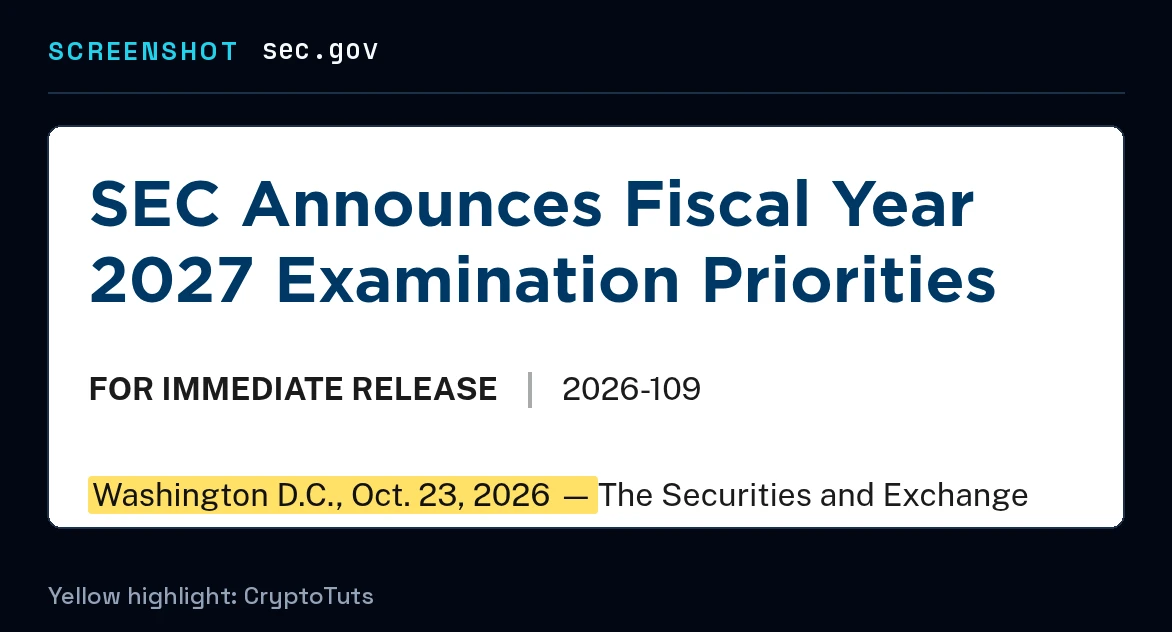
The SEC announced the Division of Examinations' fiscal 2027 priorities on Oct. 23, 2026, and its full report names tokenization for two kinds of exams. Tokenization means recording a security, such as a share or a bond, as a digital token. The first kind covers clearing agencies, the firms that stand between buyer and seller so that a trade settles. The second covers exams under Regulation SCI, which in fiscal 2026 centered on incident response policies and third-party vendor risk.
Your broker's side of the agenda reads differently. The fiscal 2027 report flags nine product categories for broker-dealer retail sales exams, which check what brokers sell to customers like you. None of the nine is a tokenized or crypto product.
Both tokenization entries are new since the fiscal 2026 report. For now, the agenda ties tokenization to market infrastructure, while broker-dealer and adviser exams cover new investment products and new asset classes in general terms.
Your broker's sales exams target nine named products
The fiscal 2027 report gives broker-dealer retail sales exams a product list of its own. Its nine categories include:
- ETFs or other products that invest in illiquid assets
- zero-days-to-expiration options, which are options traded on the day they expire
- structured products
The SEC's press release lists tokenization among its key focus areas for fiscal 2027. That item covers risks from evolving market infrastructure, including Treasury clearing reforms, tokenization and related developments. Tokenization thus has a place among the release's key focus areas and none among the report's nine broker sales products.
Two exam sections are new since fiscal 2026
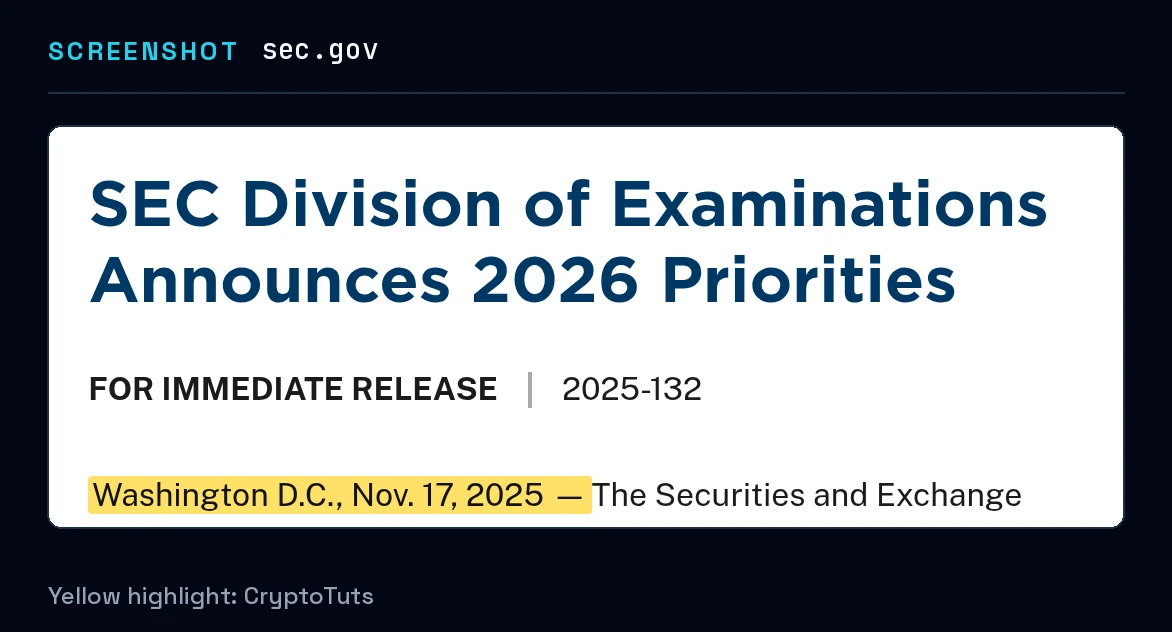
The Division released its fiscal 2026 priorities on Nov. 17, 2025. Against that fiscal 2026 report, the fiscal 2027 clearing agency list adds tokenization and securities lending. Its high-risk areas now include risk management of defaults, recovery and wind-down, securities lending, operations and tokenization.
For fiscal 2027, Regulation SCI exams will focus on emerging trends including super intelligence, tokenization of securities, extended trading hours and quantum computing. Tokenization of securities is new to that section since the fiscal 2026 report. Across these two sections, the count of tokenization entries went from zero in the fiscal 2026 report to two in the fiscal 2027 report.
Tech items name super intelligence, not crypto
The fiscal 2026 report's emerging financial technology section named AI technologies among the products and services in focus. The 2027 report prioritizes exams of policies and procedures for monitoring super intelligence. The uses in focus are fraud prevention and detection, back-office operations, anti-money laundering and Reg BI compliance, and trading. Reg BI, short for Regulation Best Interest, is the SEC's conduct standard for brokers advising retail customers.
The fiscal 2026 report's table of contents has no crypto asset section. Unchained reports that neither the 2027 nor the 2026 report uses the words crypto, digital asset, blockchain or stablecoin. By its account, the fiscal 2025 priorities still carried a standalone Crypto Assets section for registrants offering crypto asset-related services.
Examiners start with the plumbing behind tokenized assets
For some clearing agencies, exams come on a fixed schedule, as the fiscal 2027 report recalls. Title VIII of the Dodd-Frank Act sets that floor. Each clearing agency designated as systemically important, with the SEC as its supervisory agency, must be examined by the SEC at least once a year. That floor applies within the same registrant type whose exams now list tokenization.
The Division will also prioritize clearing agency exams for compliance with new rules. They include rules on expanded Treasury clearing, clearing agency governance, recovery and orderly wind-down plans, and straight-through processing by central matching service providers. Straight-through processing means a trade moves from execution to settlement without manual steps. These new rules form a track separate from the tokenization entry.
The report also cites an enhanced memorandum of understanding between the SEC and the Commodity Futures Trading Commission, which oversees futures and other derivatives markets. It covers coordinated exam planning and opportunities for joint or aligned exams.
Decrypt reads more into the tokenization line
Decrypt reads the tokenization line more broadly. In its view, brokers, investment advisers and transfer agents building tokenized products now face examiner attention on their compliance programs, beyond policy attention. The report names tokenization only in its clearing agency and Regulation SCI sections.
The report's broker and adviser sections speak in general terms. Adviser exams will look at compliance practices when advisers change business models, take on new client types, or begin advising on new asset classes or providing new services. Broker-dealer supervision exams will cover systems and controls for new business activities and investment products. Transfer agents stay under exam for their use of emerging technology to perform their functions, an item also in the fiscal 2026 priorities.
The priorities are not an exhaustive list of what examiners will review in fiscal 2027, and the Division may adjust its focus areas during the year.
The fiscal 2027 report represents the views of Division staff. It is not a rule or a Commission statement, has no legal force or effect and creates no new or additional obligations. For the legislative side, see our CLARITY Act coverage.
Link disclosure: Sponsored module: Kalshi sponsors CryptoTuts, and we are compensated when readers sign up through the marked link (*). The reporting is independent of it. Read more
Sources
- SEC Announces Fiscal Year 2027 Examination Priorities (press release 2026-109) · U.S. Securities and Exchange Commission
- Division of Examinations, Fiscal Year 2027 Examination Priorities (full report, PDF) · U.S. Securities and Exchange Commission
- Division of Examinations, Fiscal Year 2026 Examination Priorities (full report, PDF) · U.S. Securities and Exchange Commission
- SEC Division of Examinations Announces 2026 Priorities (press release 2025-132) · U.S. Securities and Exchange Commission
- SEC adds AI, super intelligence and tokenization to 2027 exam list · Decrypt
- SEC Examiners Set Sights on Tokenization at Clearing Agencies for Fiscal 2027 · Unchained
About the author

Phil
Founder & Editor-in-Chief · In crypto since 2017
Phil is the founder of CryptoTuts and has explored Bitcoin, cryptocurrencies and blockchain technology since 2017. He explains complex topics clearly, with data and without empty promises.
- XRP and the XRPL
- Bitcoin
- Crypto tax records
- Exchange comparisons
- On-chain analysis