Analysis · Regulation
SEC staff calls Canton Coin a digital commodity but skips “not itself a security”
Digital Asset's Oct. 30 request asked staff to confirm that phrase. The Nov. 3 response gives the commodity view only and states no legal conclusion on the issues presented.
By Phil5 min read

SEC staff said Nov. 3, 2026, that it will not recommend enforcement over Canton Coin minted programmatically as Digital Asset described. It called the token a “digital commodity,” which the Commission's March 2026 interpretation counts as not itself a security, though it can be sold subject to an investment contract.
Digital Asset's Oct. 30 request had also sought the words “therefore is not itself a ‘security,’” and the response leaves them out. Staff's view rests on the company's representations, which describe 13 voting operators as of Sept. 30, 2026, at least nine of whom must approve parameter changes.
That leaves minters with a narrow promise and holders with a staff label. The letter names three roles whose minting it covers: Super Validators, Validators and application providers. The promise covers their minting without registration under the Securities Act or the Exchange Act (Sections 5 and 12(g)). It relies on counsel's opinion.
A no-action letter is a staff statement that it will not recommend enforcement over a described activity. This one states the division's enforcement position only and expresses no legal conclusion on the issues presented. Different facts or conditions might lead staff to different conclusions.
The answer stops at “digital commodity”
Jeffrey T. Dinwoodie submitted the request on behalf of Digital Asset Holdings LLC, which describes itself as creator of the Canton blockchain protocol. The staff response came four days later from the Office of Chief Counsel in the SEC Division of Corporation Finance. Deputy Chief Counsel Jonathan A. Ingram signed it.
The request repeats the “not itself a security” phrase in its analysis and again in its conclusion. Ingram's answer takes the commodity step alone.
The commodity label comes from the Commission's taxonomy, which also covers digital collectibles and digital tools. Staff's view places Canton Coin in the first group.
Two representations carry the commodity view
The relief for Super Validators, Validators and application providers covers minting in the manner and under the circumstances Digital Asset described. For its digital-commodity view, staff particularly noted two of the company's representations. One is that Canton Coin draws its value from the network's programmatic operation and from supply and demand, rather than from the essential managerial efforts of others. The other is that the network has no “central party” as the interpretation defines it.
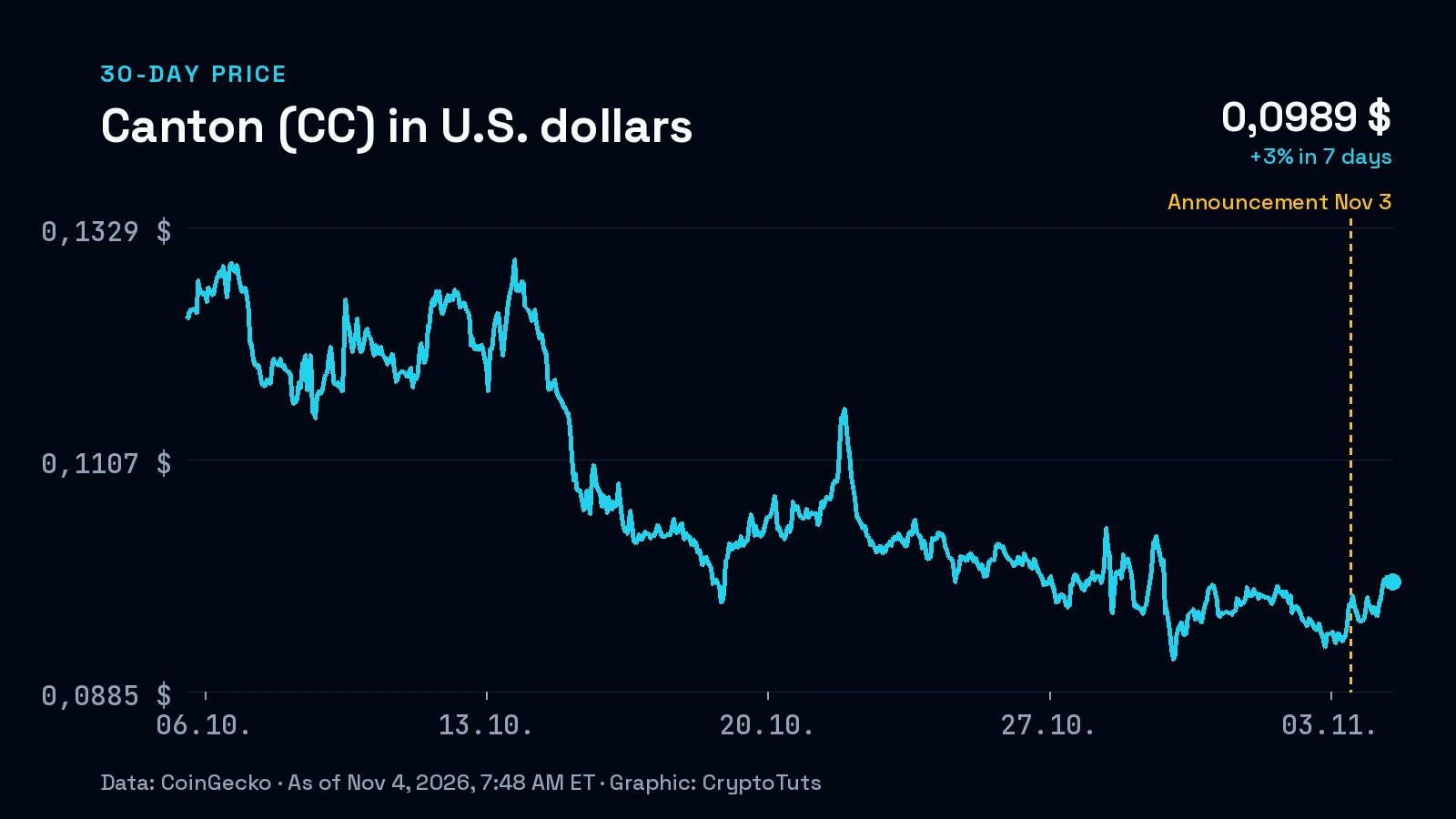
Digital Asset says Canton Coin had no initial coin offering, pre-mine or pre-launch sale or allocation. Network participants have minted it programmatically since the network launched in June 2024.
One change came in February 2026. Since then, 5% of the Canton Coin available for minting has gone to a Development Fund. The share comes pro rata out of the Super Validator, Validator and application provider allocations. Grants follow frameworks that Super Validator Node Operators approve.
Thirteen operators vote on Canton's rules
Staff's crypto FAQs describe what a central party looks like. Answers added Nov. 2, 2026, one day before the response, say a central party oversees participation when it can control access at any level. Generally, none does where operation runs automatically under rules-based code, or where discretion runs solely through a broad-based governance system whose participants are not themselves a central party. Such participants generally form no “group” if they are unaffiliated and have no agreement, arrangement or understanding to act in concert.
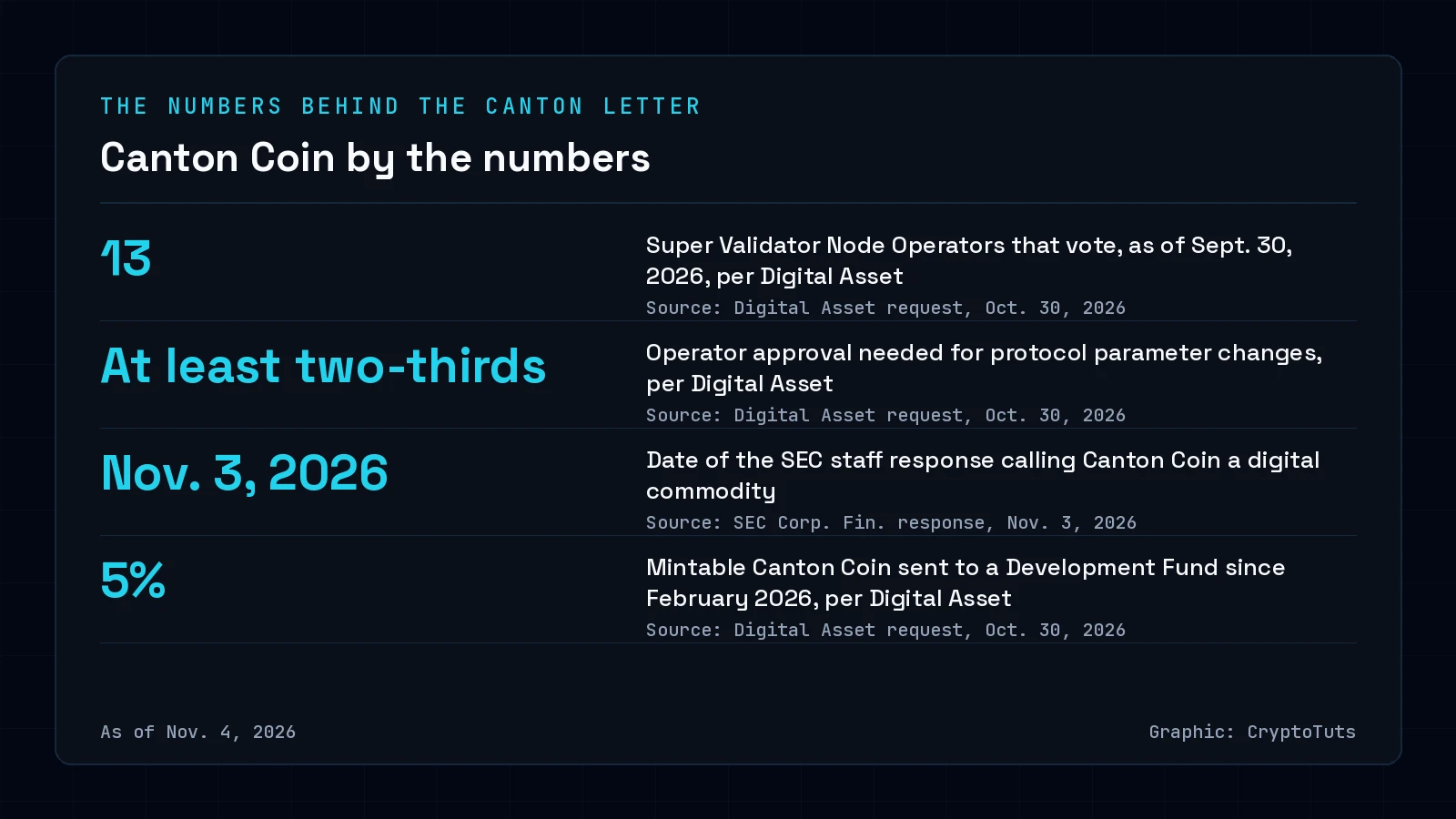
Digital Asset's request describes who votes on Canton. As of Sept. 30, 2026, there were 13 Super Validator Node Operators, and under the current framework only they vote on Global Synchronizer governance. Each has one vote, however many Super Validators it hosts and however much Canton Coin it holds.
Changes to protocol parameters, economic ones included, need approval from at least two-thirds of the operators. With 13 operators, that means at least nine votes. Digital Asset runs two of the 13 Super Validator Nodes, or about 15%. Whether those two nodes carry one vote or two is open; a Canton Foundation governance disclosure or a published voting record would settle it.
On the same date, DTCC and Euroclear co-chaired the Canton Foundation, which a 22-member board governed. Digital Asset held one seat.
Digital Asset is also active in the token's market. It has earned Canton Coin through minting since launch and has bought and sold it on the secondary market for operational and treasury purposes. It says it does not undertake to support or influence the price.
Staff guidance carries no legal force
The division's crypto FAQs, updated Nov. 2, 2026, are staff views. They are no Commission rule or statement. Like all staff guidance, they have no legal force or effect.
The Commission set the frame staff works in. It said it and its staff will administer the federal securities laws consistent with the March interpretation, including in enforcement actions. The release keeps the Howey test in place as binding legal precedent. Howey is the Supreme Court standard for what counts as an investment contract.
One basis in Digital Asset's request is still a proposal. For development work after launch, the company relies on a staff FAQ answer. That answer cites a view in Regulation Crypto Assets, dated Aug. 18, 2026 (Release No. 33-11434). The FAQs call it a proposing release.
Jennings reads a wider pathway than staff drew
The broadest reading comes from Miles Jennings of a16z. CryptoSlate reported that he wrote on X that the March framework and later guidance had created a clear pathway out of securities laws. He argued that network tokens should be treated as digital commodities.
The a16z crypto fund also led a $355 million financing round for Digital Asset in June, according to the same report. BNP Paribas, HSBC and Citadel Securities joined the round.
Staff drew a narrower line, tied to Canton's facts as Digital Asset presented them. For an issuer of another token, the letter is a reference point rather than cover. The division's crypto page lists earlier no-action letters to DoubleZero (Sept. 29, 2025), Fuse Crypto Limited (Nov. 29, 2025) and MegPrime Holding LLC (Jan. 15, 2026).
Link disclosure: Sponsored module: Kalshi sponsors CryptoTuts, and we are compensated when readers sign up through the marked link (*). The reporting is independent of it. Read more
Sources
- No-action response: Canton Coin (Nov. 3, 2026) · U.S. Securities and Exchange Commission, Division of Corporation Finance
- Incoming request letter on Canton Coin (Oct. 30, 2026) · U.S. Securities and Exchange Commission
- Release Nos. 33-11412; 34-105020, Application of the Federal Securities Laws to Certain Types of Crypto Assets (March 17, 2026) · U.S. Securities and Exchange Commission
- Press release 2026-30: SEC Clarifies the Application of Federal Securities Laws to Crypto Assets · U.S. Securities and Exchange Commission
- FAQs on the Application of the Federal Securities Laws to Certain Types of Crypto Assets (updated Nov. 2, 2026) · U.S. Securities and Exchange Commission, Division of Corporation Finance
- CorpFin Crypto Assets · U.S. Securities and Exchange Commission, Division of Corporation Finance
- SEC ruling lifts Canton Coin 6% as a16z sees pathway out of securities laws · CryptoSlate
About the author

Phil
Founder & Editor-in-Chief · In crypto since 2017
Phil is the founder of CryptoTuts and has explored Bitcoin, cryptocurrencies and blockchain technology since 2017. He explains complex topics clearly, with data and without empty promises.
- XRP and the XRPL
- Bitcoin
- Crypto tax records
- Exchange comparisons
- On-chain analysis