Analysis · Regulation
Exempt reporting adviser filing is no SEC registration: how to check
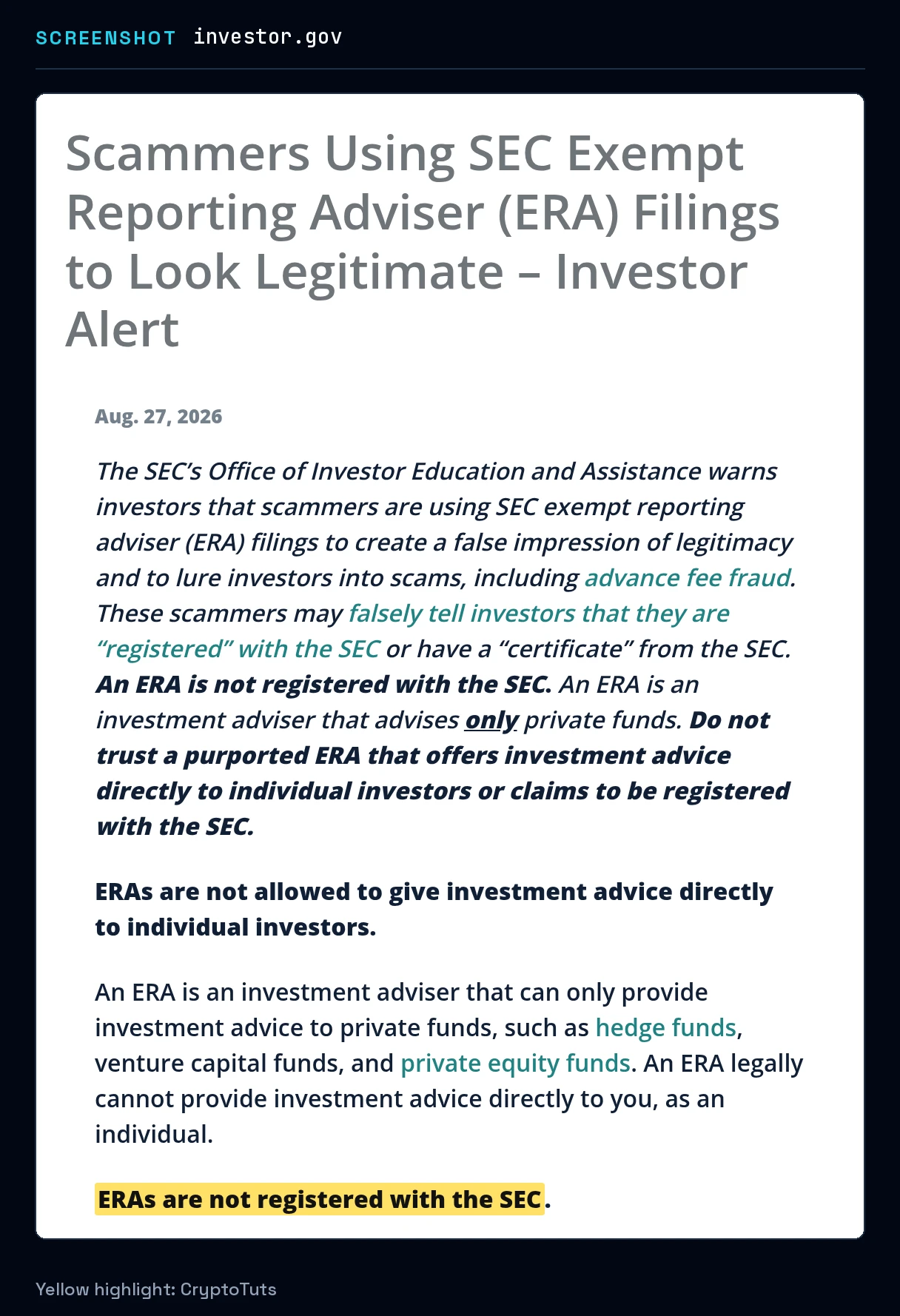
An exempt reporting adviser legally can't advise you directly, and the Investor.gov lookup lists ERA filings too. Check the listing type before you send funds.
By Phil6 min read

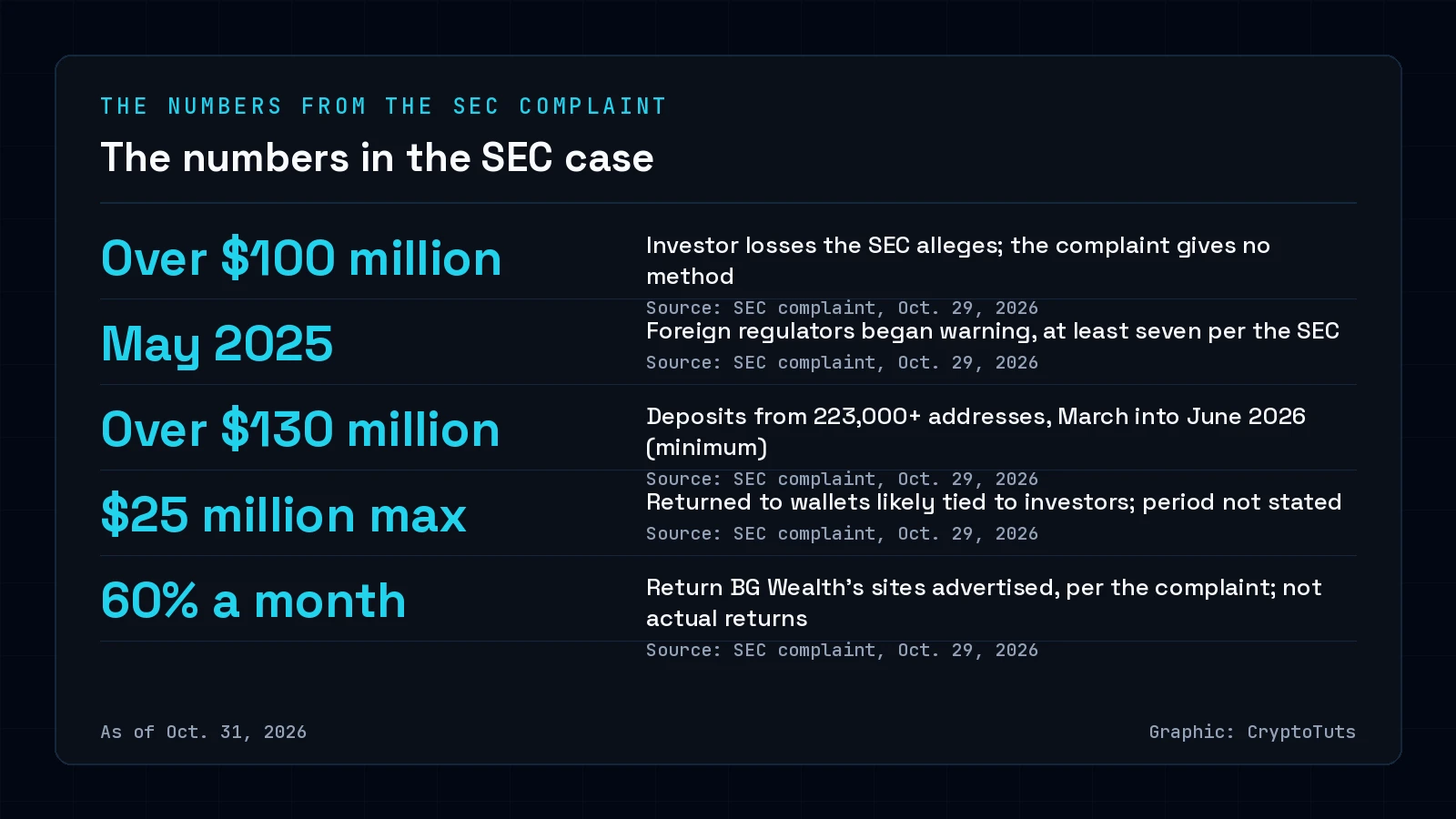
An exempt reporting adviser, or ERA, advises only private funds and legally cannot give investment advice directly to you, per an SEC investor alert. On Oct. 29, 2026, the SEC charged two Colorado corporations, BG Wealth Sharing Ltd and DSJ Exchange Pty Ltd. Its complaint alleges they pointed investors to their own SEC filings as proof of registration. It puts investor losses above $100 million.
BG Wealth filed its Form ADV, the disclosure form investment advisers file with the SEC, as an ERA. ERAs are not registered with the SEC, so that filing is no proof of registration. If a platform cites an ERA Form ADV or a Form D as proof of SEC registration, this case shows that the filing is not that proof.
Check the listing type on Investor.gov first
A Form D is the short notice a company files when it sells securities under an exemption from registration. SEC staff takes no action on Form D filings, according to a second Investor.gov alert. The SEC also issues no certificates of any type to ERAs or registered advisers. The check that counts is a firm's listing type in the Check Out Your Investment Professional tool on Investor.gov, which lists ERA filings too.
An ERA filing or a Form D is a lawful tool in itself. The alerts are staff guidance rather than rules, and they target how a firm uses its filing. An ERA's filing comes with no SEC review of its abilities or qualifications.
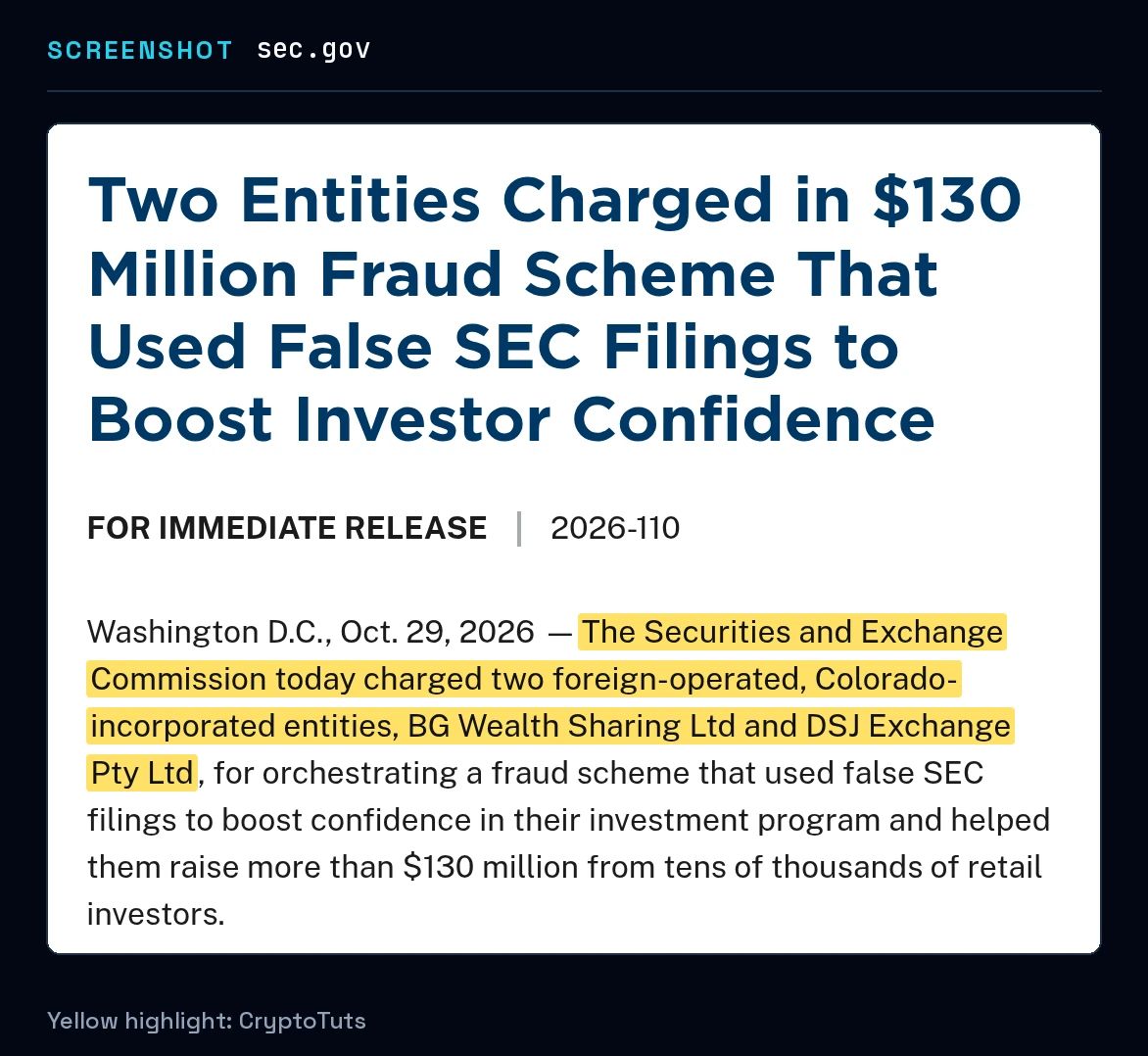
The SEC's press release on the case encourages you to run the Investor.gov lookup on anyone who offers or sells you an investment. Search the firm by name before you send funds, and read an ERA listing as a firm limited to private funds. If a firm points to a Form ADV or Form D as evidence of SEC registration, SEC staff advises sending it no money or crypto. For what SEC oversight of registered firms involves, see our report on the SEC's exam priorities for tokenization.
The firms filed the paperwork themselves
Neither BG Wealth nor DSJ Exchange has ever been registered with the SEC, though both claimed SEC licenses. According to the complaint, they built a paper trail instead.
DSJ Exchange filed a Form D on July 11, 2025, claiming revenue of over $100 million. It also claimed a $100 million exempt offering of pooled investment fund interests (Rule 506(c) of Regulation D). That $100 million is the offering size DSJ claimed.
BG Wealth followed on Aug. 16, 2025, with its Form ADV. It named Indicator Global as the independent public accounting firm auditing BG Wealth's private funds. Indicator Global appears in no public registry of federal or state accounting firms. Both filings contained false statements, DSJ's among them a false business address and contact details.
Promoters then pointed investors to BG Wealth's Form ADV on the SEC's public IAPD site and to DSJ Exchange's Form D on EDGAR. The firms had submitted both documents themselves.
BG Wealth's website also displayed purported SEC registration certificates for both firms. Each bore the SEC's seal. They carried the CRD number from BG Wealth's Form ADV and the CIK number from DSJ Exchange's Form D. SEC systems assign these identifiers to filers. Here the real numbers sat on certificates the defendants fabricated.
The SEC has since removed both filings from its website. On Sept. 29, 2026, DSJ Exchange renamed itself on EDGAR as Horizon Crest Capital Inc. Horizon Crest purports to be a New York corporation. It filed a Form D for a purported Horizon Crest offering.
Deposits kept coming as withdrawals closed
The complaint quotes BG Wealth's websites promising a monthly fund return of at least 60% in a “zero-risk investment environment.” The sites also said investors could double their principal within 40 days. Some withdrawals went through early on, at fees as high as 20% and with waits of several days.
Investors paid in crypto, including USDC, USDT and ETH, on DSJ Exchange's platform. From March 2026 into June 2026 alone, the complaint says the firms received over $130 million in deposits from more than 223,000 blockchain addresses. That window ends in early June in one passage and in mid-June in another. One person can hold many blockchain addresses, so the count measures wallets rather than people.
Later, the SEC alleges, DSJ Exchange shut off withdrawals entirely. Investors were then told to pay a so-called tax to unlock their accounts. They were also told to deposit more to move to a new platform, HQIEX. Those who paid remained locked out.
The SEC alleges the firms took the vast majority of investor assets. They sent no more than $25 million back to wallet addresses likely tied to investors. The SEC describes those as Ponzi-like payments, meaning newer investors' money paid to earlier ones to keep the scheme running. That $25 million carries no stated period.
Regulators warned before either filing existed
The warnings came early. At least seven foreign securities regulators issued public warnings about BG Wealth and DSJ Exchange beginning in May 2025, the SEC says. That was two months before DSJ Exchange's Form D and three months before BG Wealth's Form ADV.
U.S. states followed beginning in March 2026. Alaska, Hawaii, Oklahoma, Texas, Utah, Washington and Wisconsin issued warnings and cease-and-desist orders. On April 23, 2026, the FBI seized BG Wealth's original website domain in a joint law enforcement operation. BG Wealth's purported founder, “Professor” Stephen Beard, blamed a Chinese hacker, and the program kept running into June 2026.
False ERA filings have drawn SEC action before. In a separate action announced Aug. 27, 2026, the SEC charged 38 entities over Forms ADV filed as purported ERAs. It alleged material misrepresentations, including Colorado business addresses where the entities had no presence. BG Wealth and DSJ Exchange are not among the 38.
Only the two companies are charged
The SEC believes individuals abroad ran the scheme and that Beard is likely an assumed identity. Its investigation is ongoing, according to the litigation release.
The case sits before the U.S. District Court for the Northern District of California (No. 3:26-cv-12746). The SEC asks for injunctions, disgorgement with prejudgment interest, civil penalties and a bar on BG Wealth and anyone acting with it filing Forms ADV as an ERA. The court has yet to rule, and the charges remain allegations.
The next step to watch is the firms' answer, a default or a settlement. For depositors, two further points to watch are how affected investors could recover funds and what happens to the Horizon Crest Form D on EDGAR.
Sources
- SEC press release 2026-110: Two Entities Charged in $130 Million Fraud Scheme That Used False SEC Filings to Boost Investor Confidence · U.S. Securities and Exchange Commission
- Complaint, SEC v. BG Wealth Sharing Ltd and DSJ Exchange Pty Ltd (N.D. Cal.) · U.S. Securities and Exchange Commission
- SEC Litigation Release No. 26679, SEC v. BG Wealth Sharing Ltd and DSJ Exchange Pty Ltd · U.S. Securities and Exchange Commission
- Investor alert: Scammers Using SEC Exempt Reporting Adviser (ERA) Filings to Look Legitimate · U.S. Securities and Exchange Commission (Investor.gov)
- Investor alert: Beware of Claims That the SEC Has Approved Offerings · U.S. Securities and Exchange Commission (Investor.gov)
- Capital Raising Building Blocks: Investment Advisers · U.S. Securities and Exchange Commission
- SEC press release 2026-78: SEC charges 38 entities that feigned legitimacy as U.S. advisers through false filings to lure retail investors · U.S. Securities and Exchange Commission
About the author

Phil
Founder & Editor-in-Chief · In crypto since 2017
Phil is the founder of CryptoTuts and has explored Bitcoin, cryptocurrencies and blockchain technology since 2017. He explains complex topics clearly, with data and without empty promises.
- XRP and the XRPL
- Bitcoin
- Crypto tax records
- Exchange comparisons
- On-chain analysis