Analysis · XRP
XRP Ledger lending can activate Dec. 11 at the earliest
The lending amendment won a validator majority Nov. 27, but Dec. 9 belongs only to the vault amendment. Support stood at 30 of 34 counted votes on Nov. 28, and it must hold.
By Phil5 min read

The XRP Ledger's lending amendment, LendingProtocol, won the backing of more than 80% of trusted validators on Nov. 27, 2026, at 14:22 UTC. The GateHub XRPL Explorer counted 30 of 34 voting validators in support, or 88.2%, at about 12:01 UTC on Nov. 28. That puts its earliest activation at Dec. 11; Dec. 9 is the earliest date only for the vault amendment it requires.
Once lending runs, you could deposit tokens for vault shares that fund loans; in a closed-ended vault, the deposit stays locked until a set redemption date.
An amendment is a change to the ledger's rules that takes effect only after trusted validators back it, much like a software upgrade that needs a supermajority. LendingProtocol, defined in the XLS-66 standard, makes fixed-term, uncollateralized loans from pooled vault deposits. A companion amendment, LendingProtocolV1_1, adds closed-ended vaults. These are deposit pools with fixed subscription, investment and redemption phases, much like a certificate of deposit that stays locked until maturity.
The LendingProtocolV1_1 majority dates from 14:22:02 UTC on Nov. 27 on the XRPLWin Explorer. Both lending amendments therefore share an earliest date: Dec. 11 at about 14:22 UTC, or the first flag ledger after that. A flag ledger is the periodic checkpoint where validators' amendment votes are counted.
Your deposit becomes a share in a vault
A Single Asset Vault, as the XLS-65 specification defines it, holds one asset: XRP, a fungible token or a Multi-Purpose Token. The lending protocol draws its loan money from such a vault. A public vault is open to any depositor. A private one admits only depositors with credentials in a Permissioned Domain.
When you deposit, you receive vault shares issued as Multi-Purpose Tokens. Depending on the protocol connected to the vault, you may get back more or less than you put in. Any shareholder can withdraw, subject to a closed-ended vault's lock-up.
A closed-ended vault accepts deposits only during subscription. The lock runs from the end of subscription to the redemption date.
A loan broker is the party that sets up and runs loans against a vault. Once V1_1 is enabled, new brokers can be created only against closed-ended vaults, and their loans can start only during the investment phase. Each loan must mature, plus a buffer, before the redemption date. Vaults created after V1_1 count loan interest in their total assets once it is paid, while older vaults keep their original accounting.
First-loss capital covers only part of a default
The loans carry no on-chain collateral, and borrowers' creditworthiness is assessed off-chain. The XRPL.org lending protocol documentation describes a design built around originating credit, with no automated collateral or liquidation management. The full loan mechanics are in the LendingProtocol guide.
Due diligence is on you
The XLS-66 specification offers no on-chain algorithmic protection against default, so every participant, depositors included, has to do their own due diligence and off-chain checks.
Brokers may post first-loss capital, money that absorbs part of a default before depositors do. It is optional, and it softens a default without eliminating credit risk.
The required minimum cover equals a broker's total debt times its minimum cover rate. The XRPL.org documentation gives an illustrative case with a 10% minimum cover rate and a 10% liquidation rate. There, first-loss capital covers 10.9 tokens of a 1,090-token default, or 1%. The vault absorbs the other 1,079.1 tokens, about 99%.
Depositors also bear the broker's management fee, a share of the interest.
The issuer of a vault's token, though not of XRP, can claw back funds from the vault and freeze accounts. Both powers hold even while a closed-ended vault's withdrawals are locked. Issuers can also claw back a broker's first-loss capital above the required minimum.
Dec. 9 belongs to the vault amendment
SingleAssetVault (XLS-65) has held a majority since 19:38:51 UTC on Nov. 25, and the XRPLWin Explorer showed 30 of 34 validators behind it on Nov. 28. Its earliest activation is 19:38:51 UTC on Dec. 9. That step brings open-ended vaults; lending and closed-ended vaults wait for Dec. 11 at the earliest.
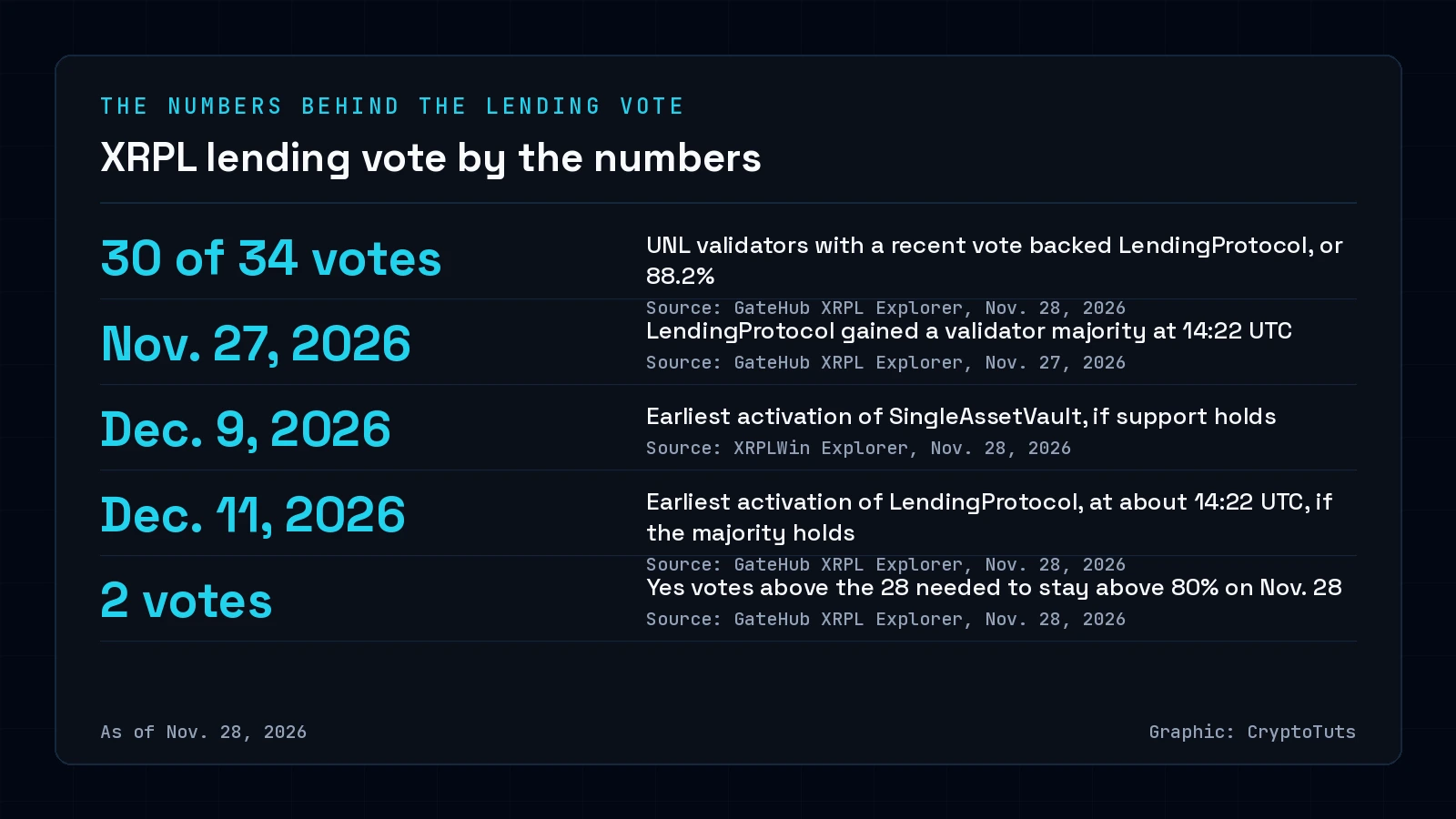
The lending majority came at a flag ledger at 14:22 UTC on Nov. 27, when 29 of 35 validators, or 82.9%, voted yes. A pseudo-transaction in the next ledger, 108,607,489, recorded it. That majority superseded U.Today's same-day report of 28 of the 29 votes needed. The outlet also tied lending vaults to a possible Dec. 9 activation, the date that belongs to SingleAssetVault.
Two spare votes keep the clock running
The XRPL.org amendments documentation sets the rule: a change is enabled only after it keeps more than 80% of trusted validators for two weeks. At 80% or less, it loses its majority. The two-week count starts over once a majority returns.
The Nov. 28 count leaves two votes to spare. LendingProtocol and LendingProtocolV1_1 each had 30 yes votes of 34 counted, and 28 are needed to stay above 80%. A 35th validator sits on the list without a recent vote.
The XLS-66 specification itself still carries the status Draft. Its header gives a creation date of Oct. 18, 2024, and a last update on Nov. 25, 2026, while validators already vote on the amendment.
Watch the ledger on Dec. 9 and Dec. 11
For XRP holders, the direct link is that a vault can hold XRP itself. XRP vaults sit outside issuer clawback and freeze rights, which cover token vaults. How much XRP flows into vaults will show on the ledger once vaults exist.
The first checkpoint is Dec. 9 at 19:38:51 UTC, the earliest moment for SingleAssetVault. The second is Dec. 11 at about 14:22 UTC for LendingProtocol and LendingProtocolV1_1. Each activation appears on the ledger as an EnableAmendment pseudo-transaction after a flag ledger.
A tfLostMajority entry, the ledger's record of a lost majority, would reset that amendment's two-week clock.
Link disclosure: Sponsored module: Kalshi sponsors CryptoTuts, and we are compensated when readers sign up through the marked link (*). The reporting is independent of it. Read more
Sources
- GateHub XRPL Explorer: LendingProtocol amendment, flag-ledger history and validator votes · GateHub
- XRPLWin Explorer: LendingProtocolV1_1 amendment · XRPLWin
- XRPLWin Explorer: SingleAssetVault amendment · XRPLWin
- XRPSCAN API: XRPL amendments list · XRPSCAN
- XLS-66 Lending Protocol specification · XRPLF (XRPL-Standards on GitHub)
- XLS-65 Single Asset Vault specification · XRPLF (XRPL-Standards on GitHub)
- XRPL.org: Amendments · XRPL.org
- XRPL.org: Basic data types, Specifying Time · XRPL.org
- XRPL.org: Lending Protocol · XRPL.org
- U.Today: XRP Ledger lending protocol eyes final activation · U.Today
Next step · XRPL
Follow the technical development
For the current state of the XRP Ledger, the next useful page is the XRPL amendments in voting.
About the author

Phil
Founder & Editor-in-Chief · In crypto since 2017
Phil is the founder of CryptoTuts and has explored Bitcoin, cryptocurrencies and blockchain technology since 2017. He explains complex topics clearly, with data and without empty promises.
- XRP and the XRPL
- Bitcoin
- Crypto tax records
- Exchange comparisons
- On-chain analysis