Analysis · Exchanges
Binance withdrawals: 63 coin-network pairs off hours after 'fully lifted'
Maketo counted 63 pairs with withdrawals off at 10:47 UTC on Nov. 27, about 16 hours after Binance's Nov. 26 notice. Why each route is paused is not established.
By Phil5 min read

At 10:47 UTC on Nov. 27, the third-party tracker Maketo counted 63 Binance coin-network pairs with withdrawals switched off and 46 with deposits off. A pair is one coin on one network, so a coin paused on two networks counts twice. The reading came about 16 hours after Binance's Nov. 26 notice, posted at about 18:30 UTC, declared the withdrawal suspension from its October security breach fully lifted. If you plan to move funds off the exchange, check your exact coin and network first.
Withdrawals still depend on your coin and network
Binance's Nov. 26 notice speaks to the suspension imposed after the hack. The same notice says withdrawals on some networks remain paused. It puts the affected share at a very small percentage of regular traffic and gives no figure.
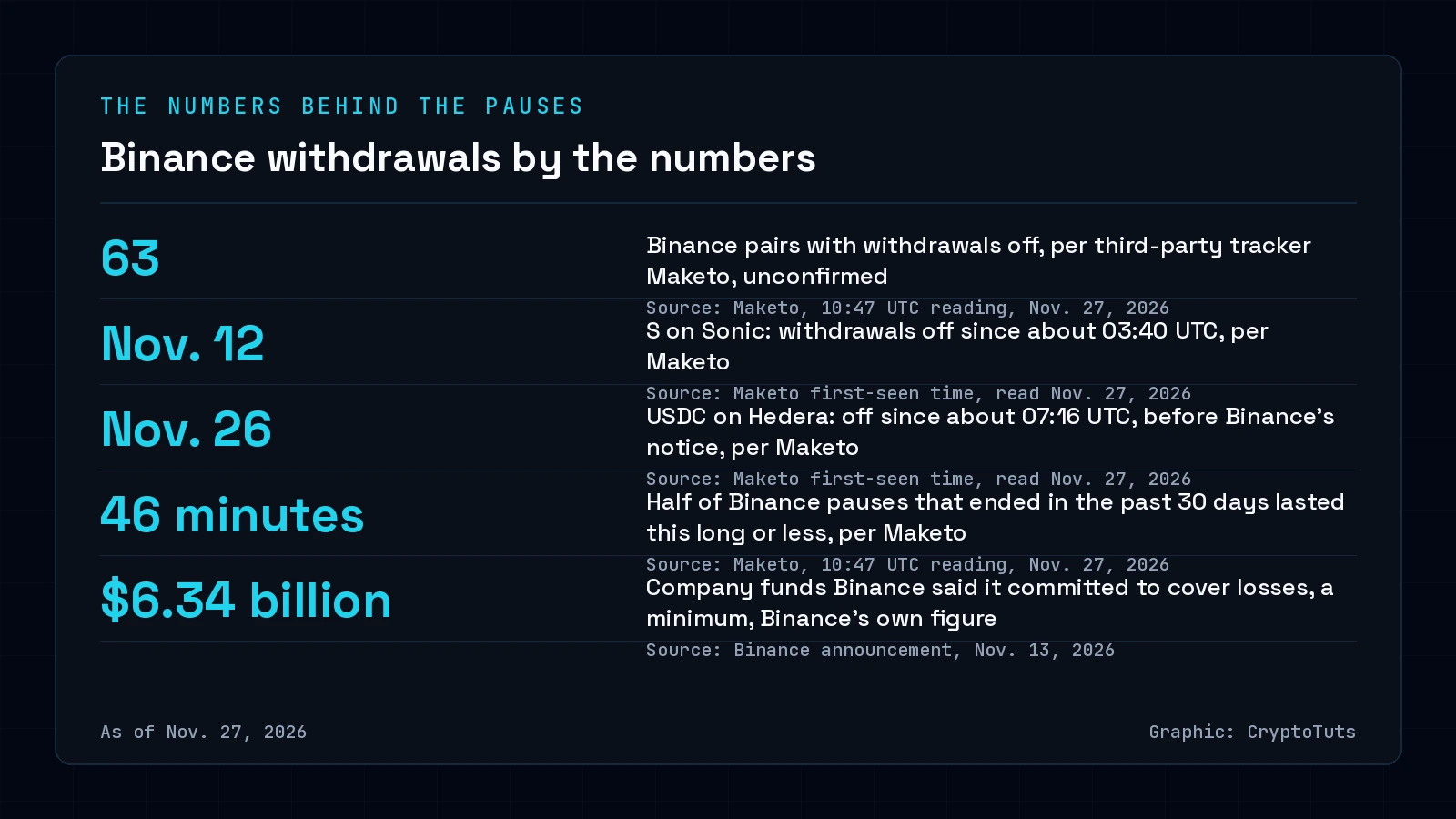
So you cannot yet withdraw every coin on every network. At Maketo's 10:47 UTC reading, the paused routes included USDC on Hedera and S on the Sonic network. USDT on Solana had come back on at about 09:00 UTC.
Maketo flags its rows as unconfirmed by a second source, and its count mixes long-running, delisting-related and short pauses. Its daily table records zero changes from Oct. 14 through Oct. 31, a window that includes the post-breach suspension. That leaves the 63 without a pre-hack baseline. Why each route is paused would show in a Binance list of paused networks with causes, or a full timestamped read of its network status data.
The named pauses began weeks or hours apart
Maketo's first-seen times show how far apart the pauses began. Withdrawals of S on the Sonic network have been off since about 03:40 UTC on Nov. 12, two weeks before Binance's notice. They were still off at the Nov. 27 reading.
USDC on Hedera went off at about 07:16 UTC on Nov. 26, hours before the notice went out. That route was still closed at 10:47 UTC the next day.
USDT on Solana shows how a single route can switch off and on. It was off for 11 hours on Nov. 24, then for most of Nov. 25 and 26, until it reopened on Nov. 27.
Unchained reported that early Friday, Nov. 27, Binance's network listings showed USDT on Solana blocked as "Low Hot Wallet Balance." It listed Sonic under "Security Issues" and USDC under the low-balance label on Hedera and World Chain. Benzinga reported the Sonic and USDC pauses as well. A hot wallet is the internet-connected wallet an exchange pays withdrawals from.
Hindustan Times reported partial withdrawal suspensions on Binance's status page early Nov. 27 for ETH, USDT, USDC, TRX and WBTC. Partial means some of a coin's networks are paused, so the network you pick decides whether your withdrawal goes through.
Some pauses began before the hack
Maketo's own data also cuts the other way. The tracker first saw STG withdrawals on the FTM network off on Oct. 6 and WAN withdrawals off on Oct. 13, before the Oct. 29 breach. Both rows were off again at the Nov. 27 reading. Maketo logged no changes from Oct. 14 through Oct. 31, so the rows mark when each pause began and its Nov. 27 status, with late October unrecorded.
Many pauses are also brief. Half of the Binance pauses that ended in the past 30 days lasted 46 minutes or less. In the past week, Binance paused withdrawals or deposits 268 times, while 295 pauses came back on. A closed route can reopen within the hour or, like Sonic, stay shut for two weeks.
Binance declared coverage 13 days before withdrawal recovery
Binance's Oct. 30 update dates the breach to about 20:05 UTC on Oct. 29, when its hot wallets were compromised. Binance put the loss at approximately $6.3 billion worth of token assets.
In the same update, Binance said it had already set aside more than $6.34 billion in company funds. Of that, $5 billion was held in the stolen token types, about 80% of the impacted amount. Binance was buying the remaining tokens through market and over-the-counter channels, meaning direct trades between two parties.
Approximately $3 billion had been frozen on-chain as of Oct. 30. Law enforcement, blockchain intelligence firms, asset issuers and industry partners helped. Freezing locks funds in place, a step short of recovery.
In an announcement dated Nov. 13, Binance said it had completed coverage of assets affected in the incident. It had committed the more than $6.34 billion to cover the losses. Withdrawals were still reopening in phases at that point.
The money came from three pools. The first was a partial deployment of SAFU, the Secure Asset Fund for Users. The others were a portion of the futures insurance fund above the level Binance's risk framework requires and the corporate treasury. Binance gave no amount for each.
That puts 13 days between the Nov. 13 notice, which declared coverage complete, and the Nov. 26 notice, which declared withdrawal recovery complete. Covering the loss and reopening withdrawals were separate milestones.
Binance has committed to refilling SAFU to approximately $1 billion, with no deadline attached. A very small number of tokens Binance no longer supports were also affected. Its delisting process is to handle those tokens and cover their holders.
Check your coin and network before you withdraw
Before you withdraw from Binance
- Find your coin and the exact network on Binance's deposit and withdrawal status page.
- Compare it with Maketo's Binance status tracker, which shows when each pause was first seen.
- If your network is paused, check whether the coin is open on another network that your receiving wallet supports.
Backing rests on Binance's snapshot
Binance's Nov. 26 notice says all assets remain fully backed and that you can check a minimum 1:1 backing on its Proof of Reserves site. Binance's backing figures come from its own snapshot, taken at 00:00 UTC on Nov. 12 and covering 198 tokens, with its proof dated Nov. 14. An outside auditor did not produce them.
On Oct. 30, Binance promised a detailed technical report on what happened, the lessons learned and the safeguards it is adding. At that point, it called a compromised laptop an early lead and said further points of breach had since been found. It also said it had no evidence that private keys had leaked.
Sources
- Binance announcement: Service Recovery Update: Withdrawals Recovery Work Complete (2026-11-26) · Binance
- Binance deposit and withdrawal network status data (public capital API behind binance.com/en/network) · Binance
- Binance announcement: Binance Completes Coverage of Assets Impacted in Security Incident; New Proof of Reserves Published (2026-11-13) · Binance
- Binance announcement: Security Incident Update #2 (2026-10-30) · Binance
- Binance Withdrawal and Deposit Status | Maketo · Maketo
- Unchained: Binance Lifts Withdrawal Suspension From $6.3 Billion Hack, Says Recovery Is Complete · Unchained
- Hindustan Times: Binance says withdrawal freeze is lifted, weeks after $6.3 billion crypto heist · Hindustan Times
- Benzinga via TradingView: Binance Lifts Withdrawal Suspension After Record $6.3 Billion Hack, but USDC Withdrawals Stay Paused · Benzinga
About the author

Phil
Founder & Editor-in-Chief · In crypto since 2017
Phil is the founder of CryptoTuts and has explored Bitcoin, cryptocurrencies and blockchain technology since 2017. He explains complex topics clearly, with data and without empty promises.
- XRP and the XRPL
- Bitcoin
- Crypto tax records
- Exchange comparisons
- On-chain analysis