Analysis · XRP
RLUSD Robinhood app launch is expected later in 2026
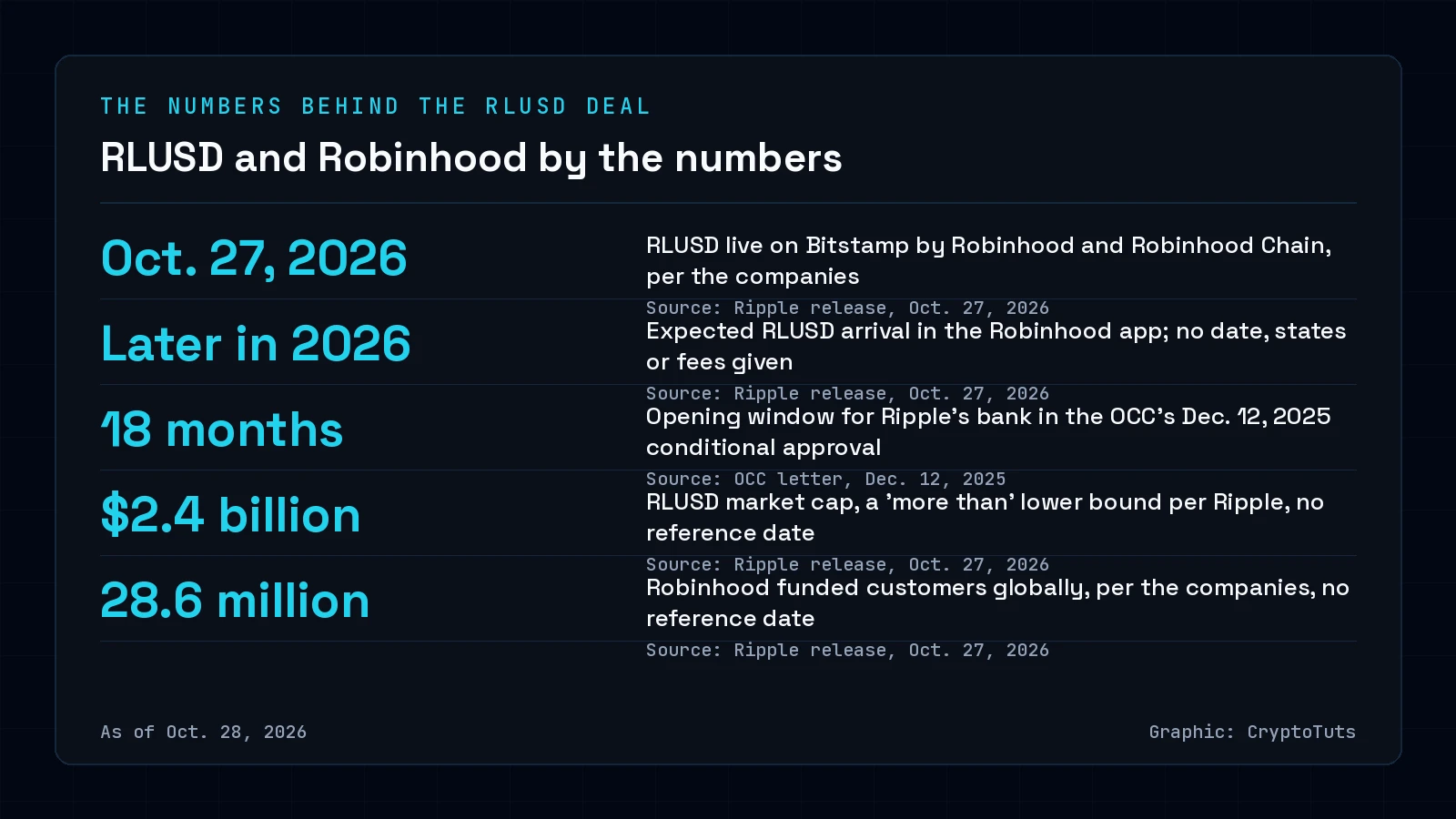
Ripple says the companies expect it later this year, but they gave no date, states or fees. Robinhood's U.S. availability page did not list RLUSD on Oct. 28.
By Phil5 min read
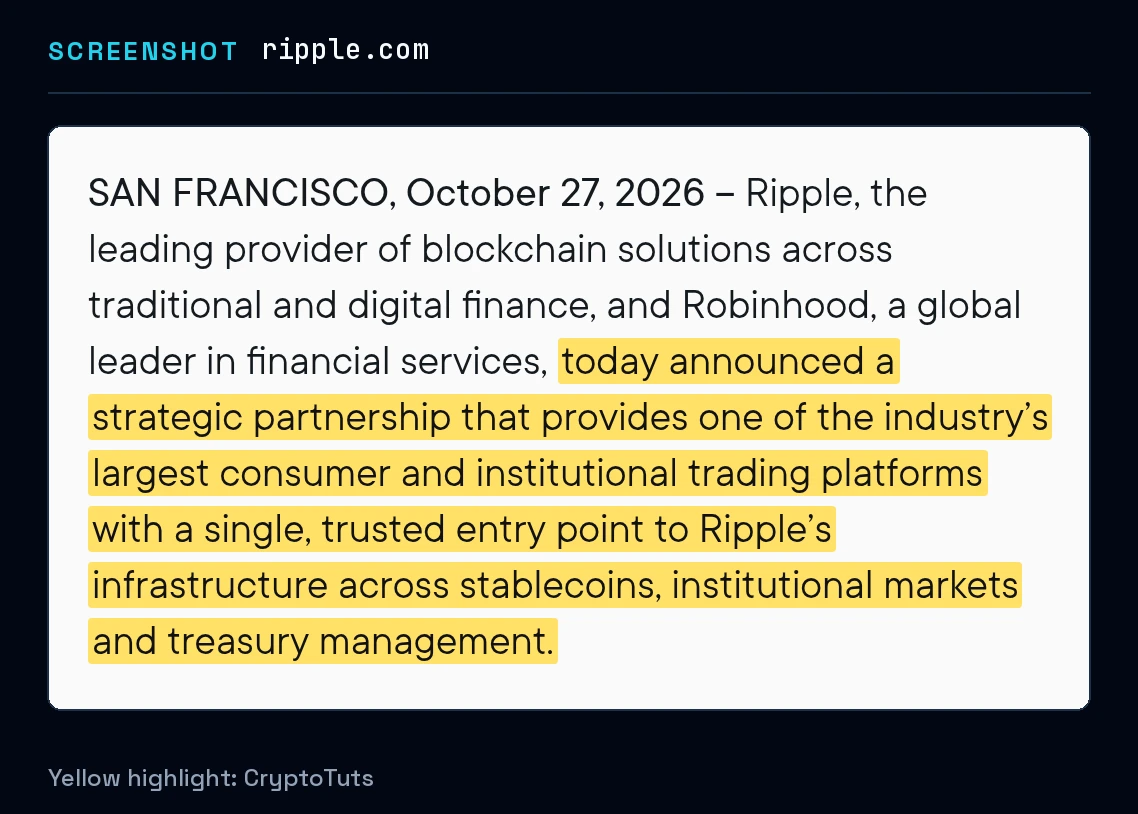
Robinhood's U.S. crypto availability page did not list Ripple's dollar stablecoin RLUSD on Oct. 28, 2026, either as supported crypto or as viewable market data. Robinhood counts 28.6 million funded customers globally, including institutional clients through Bitstamp, according to the companies' partnership announcement. That announcement put RLUSD live a day earlier, on Oct. 27, on Bitstamp by Robinhood and on Robinhood Chain. For app customers, the deal is so far a Bitstamp story.
RLUSD's app launch has a year, not a date
Ripple's release says the companies expect RLUSD to reach the Robinhood app later in 2026. Bitstamp by Robinhood and Robinhood Chain, the two venues where it is live, are separate from the app. The companies have not said when, in which states or at what cost you will be able to buy or hold RLUSD there. Launch terms from Robinhood, or an RLUSD row on its availability page showing routing and state exclusions, would settle all three.
USDC trades via market makers, Texas excluded
Robinhood's availability page shows the terms for USDC, a dollar stablecoin, as of Oct. 28, 2026. USDC trades in the app and on web classic through market maker routing only, without fee tiers. The page excludes Texas from USDC trading.
Market maker routing means Robinhood sends your order to a market maker, a trading firm that quotes buy and sell prices and pays Robinhood for the flow. Robinhood's order routing page puts that payment at $0.95 for every $100 of notional crypto order volume executed this way, as of June 15, 2026. The payment sits inside the spread, the gap between those prices. On $1,000 of orders executed the way USDC trades, Robinhood receives $9.50.
Most of the deal runs through Bitstamp
Johann Kerbrat, senior vice president and general manager of Robinhood Crypto and International, described the deal in three parts in Ripple's release. He listed RLUSD for institutional settlement, Ripple Treasury for operations and Ripple Prime for financing. Robinhood plans to use RLUSD on the XRP Ledger for settlement in Bitstamp by Robinhood's institutional business. It also plans to integrate Ripple Treasury for its global treasury operations, including cash and liquidity management, cash flow forecasting, payments, risk management and intercompany netting.
Under an existing relationship, Ripple Prime provides Bitstamp by Robinhood with lending and margin financing across roughly 20 digital assets. It plans to support perpetual futures, contracts with no expiry date, on Bitstamp later in 2026. Ripple Prime clients can already trade spot there.
For XRP holders, the settlement plan names the XRP Ledger as RLUSD's rail at Bitstamp. Ripple's release puts RLUSD's market capitalization above $2.4 billion since its December 2024 launch.
Ripple's trust bank will take no insured deposits
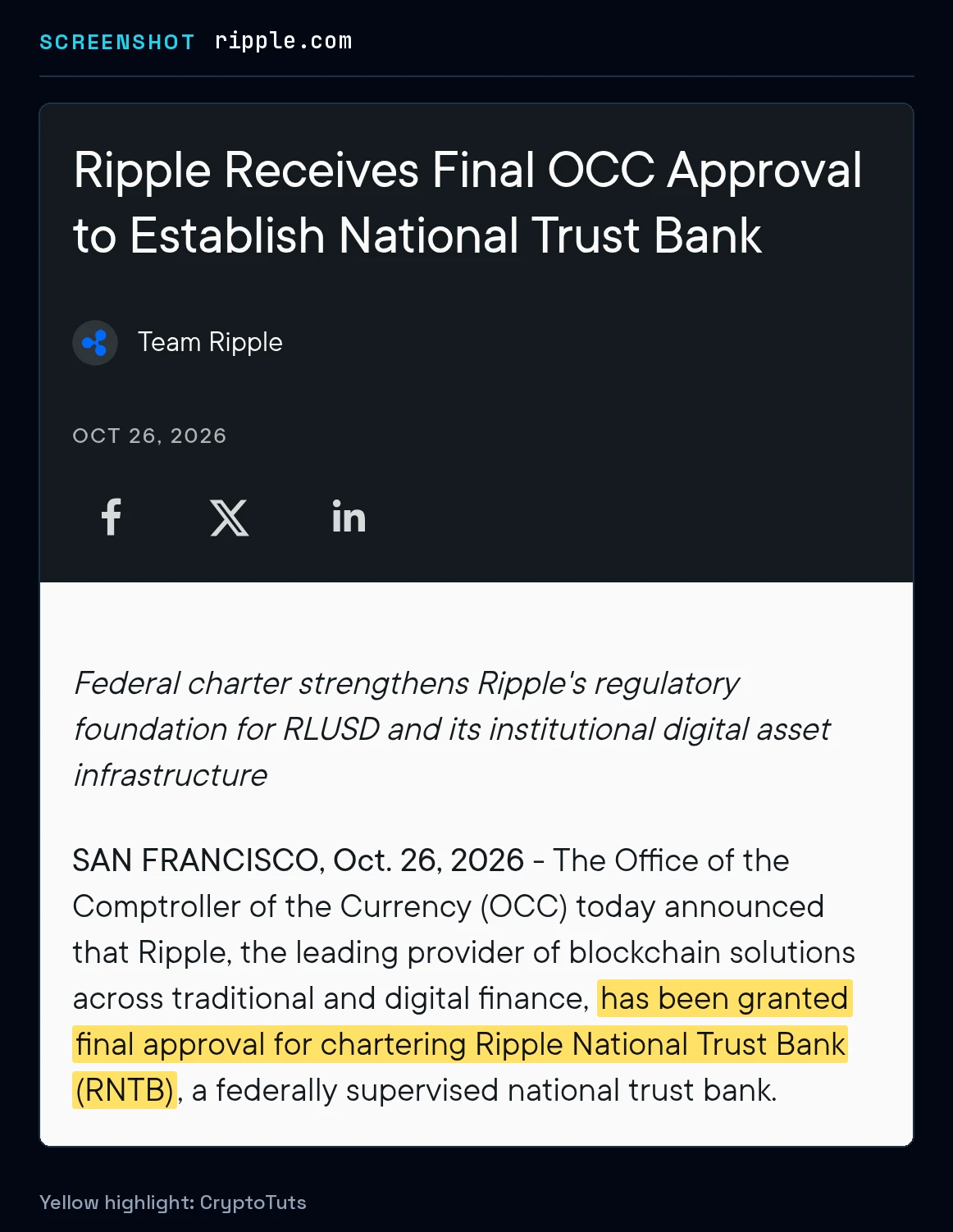
In an Oct. 26 release, Ripple said the Office of the Comptroller of the Currency (OCC) had granted final approval for chartering Ripple National Trust Bank. A national trust bank is a federally chartered bank for custody and fiduciary work. Under the OCC's December 2025 approval letter, this one will not be an insured depository institution.
RLUSD keeps its issuer, Ripple subsidiary Standard Custody & Trust Company. It is a New York limited purpose trust company regulated by the New York State Department of Financial Services. The national trust bank does not currently plan to issue stablecoins.
The bank's planned role includes RLUSD's reserve. It plans to manage the segregated reserve underlying RLUSD on a directed basis and act as collateral trustee for RLUSD holders. A collateral trustee holds the reserve on behalf of holders, much like an escrow agent. The bank also plans to provide crypto custody to affiliates and unaffiliated institutional customers.
Ripple says RLUSD is fully backed by U.S. dollar deposits, U.S. government securities and other cash equivalents, with BNY as the primary reserve custodian. The company publishes monthly third-party attestations of circulating supply and reserve assets. An attestation is an outside firm's report on balances at a point in time, narrower than an audit.
The December letter also set the bank's own capital floor. It must hold at least $11.7 million in tier 1 capital, its core capital, during its first three years of operation. At least the greater of 50% of that capital or $5.85 million must sit in eligible liquid assets. That cushion is separate from the RLUSD reserve.
One condition ties the bank's proposed collateral trustee structure and other activities to the GENIUS Act, the federal stablecoin law. To the extent the law or its implementing rules require, the bank must conform, cease or divest them. The OCC decides whether that step is needed.
Ripple's bank: approval reported after 318 days, not yet open
Ripple's reported final approval came 318 days after the OCC granted preliminary conditional approval on Dec. 12, 2025. That approval gave the bank 12 months to raise capital and 18 months, to about June 12, 2027, to open for business. Final approval thus landed inside the first year of that window.
The bank's custody authorization takes effect upon opening, and Ripple has named no opening date.
Link disclosure: Sponsored module: Kalshi sponsors CryptoTuts, and we are compensated when readers sign up through the marked link (*). The reporting is independent of it. Read more
Sources
- Ripple and Robinhood Partner to Power the Next Generation of Finance (Oct. 27, 2026) · Ripple
- Ripple Receives Final OCC Approval to Establish National Trust Bank (Oct. 26, 2026) · Ripple
- OCC conditional approval decision for Ripple National Trust Bank (Dec. 12, 2025) · Office of the Comptroller of the Currency
- OCC News Release 2025-125: OCC Conditionally Approves National Trust Bank Charters · Office of the Comptroller of the Currency
- Robinhood support: Crypto availability (US) · Robinhood
- Robinhood support: Crypto order routing (US) · Robinhood
Next step · XRPL
Follow the technical development
For the current state of the XRP Ledger, the next useful page is the XRPL amendments in voting.
About the author

Phil
Founder & Editor-in-Chief · In crypto since 2017
Phil is the founder of CryptoTuts and has explored Bitcoin, cryptocurrencies and blockchain technology since 2017. He explains complex topics clearly, with data and without empty promises.
- XRP and the XRPL
- Bitcoin
- Crypto tax records
- Exchange comparisons
- On-chain analysis