Analysis · Taxes
Bill 2221923 would tie South Korea crypto tax to data exchange
Rep. Park Min-kyu and 13 others proposed it Oct. 16, 2026. The start would be Jan. 1 of the second year after the first crypto information exchange, and the ministry names no bill.
By Phil4 min read

South Korea's government wants to push its crypto income tax back two years, but the Jan. 1, 2027, start date is still law. Finance Minister Lee Hyoung-il, who is also deputy prime minister, announced the plan at a Nov. 5, 2026, briefing in Seoul. The Finance Ministry release presents the delay as groundwork for a 2029 start, pursued in consultation with the National Assembly. It names no bill and no vote date for the change.
A lawmakers' bill would tie the start to data sharing instead of a fixed date. Rep. Park Min-kyu and 13 other lawmakers proposed Income Tax Act amendment bill No. 2221923 on Oct. 16, 2026. It would start the tax on Jan. 1 of the second year after the year of the first exchange of crypto-asset trading information under the Act on the Adjustment of International Taxes. Its rationale cites 2029 as the year the U.S. joins CARF, a standard under which tax authorities automatically share crypto transaction data.
The delay becomes law only through the National Assembly. The Jan. 1, 2027, start stays in force unless lawmakers amend the Income Tax Act. The ministry says it will consult the Assembly and pursue the needed legislation.
The ministry's own timeline runs through 2028
The ministry's plan puts the rules themselves on a separate track from the start date. A public-private working group is to hold its launch meeting soon and finish intensive talks by the first half of 2027. Amendments that need legislation then go to the National Assembly's 2027 regular session, which the plan reserves for these system-improvement amendments.
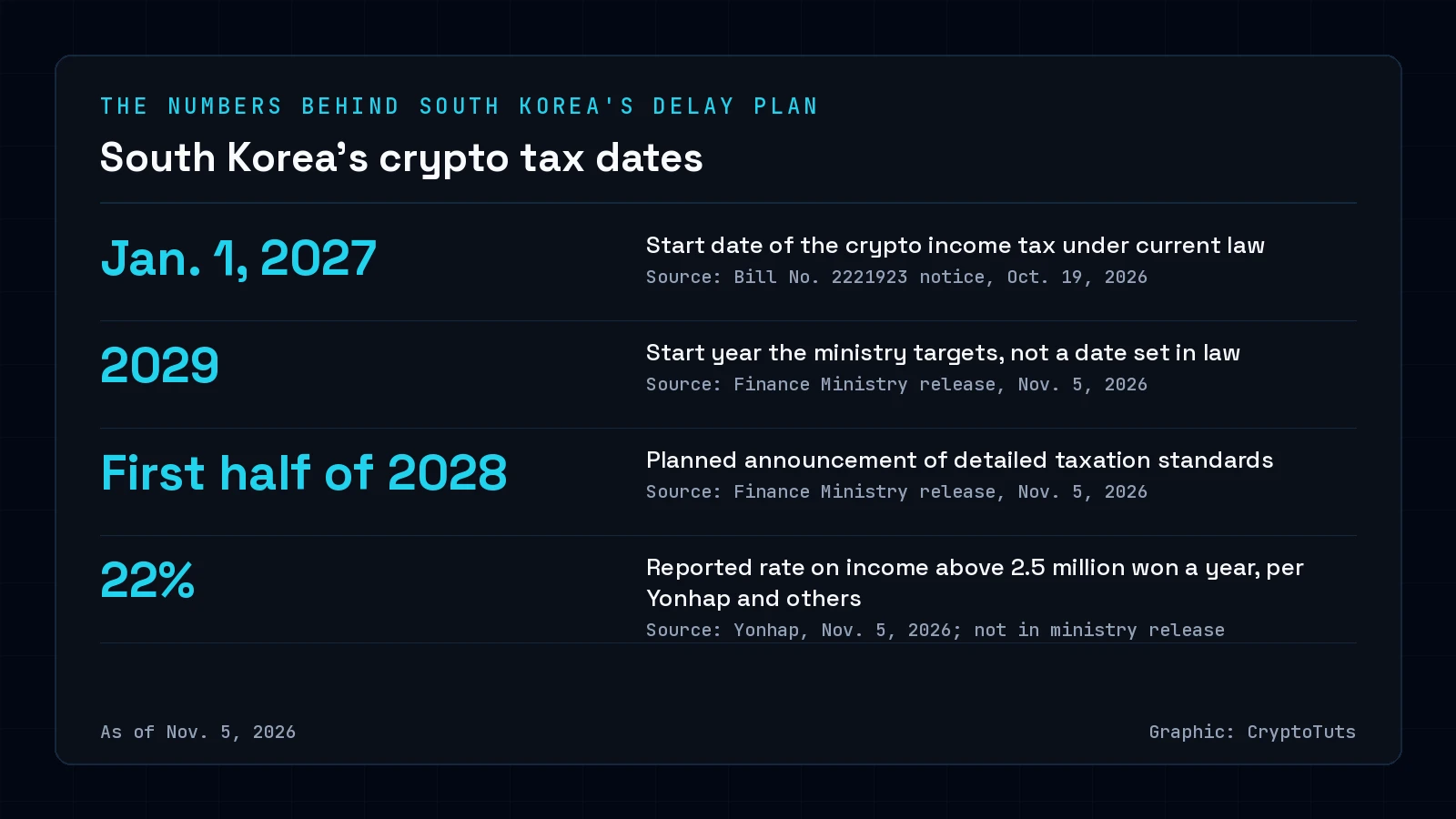
Detailed taxation standards follow in the first half of 2028. For anyone trading in Korea, the two tracks answer different questions. The start date decides when the tax first applies. The standards fill in how it applies.
Seoul waits for U.S. data sharing in 2029
The Finance Ministry release gives two reasons for the delay. The first is timing. Information exchange with the U.S. under CARF starts in 2029, and taxing right away could put Korea's domestic market at a relative disadvantage to overseas markets.
The second is a planned Digital Assets Act, which the government expects to significantly change the institutional framework for the digital asset industry. The stated aim of the delay is to keep the principle that income should be taxed. It also aims to make taxation of domestic and overseas trades more effective and fairer.
The sponsors of bill No. 2221923 make a parallel case. They argue the tax should start only after a Digital Assets Basic Act lays down a basic framework for the crypto market.
A 2025 report warned of a fourth delay
A Nov. 10, 2025, Korea Capital Market Institute report by Kim Gap-rae flagged the risk a year ago. In its reading, missing rules for income such as lending, airdrops, hard forks, mining and staking meant a fourth delay could not be ruled out. The report called for measures to avoid one.
The record behind that warning starts with a Dec. 29, 2020, Income Tax Act amendment (Act No. 17757). It introduced crypto income taxation, originally set to start Jan. 1, 2022. The start has since moved three times: to Jan. 1, 2023, then Jan. 1, 2025, and by a Dec. 31, 2024, amendment to Jan. 1, 2027.
If enacted, the new delay would be the fourth. If the 2029 target holds, a tax first set for Jan. 1, 2022, would start seven years later than planned. The earlier moves added one year, then two, then two; this one would add two more.
Traders would be taxed above a yearly deduction
Yonhap, Cointelegraph and Unchained report a 22% rate, including local income tax, on the portion of annual crypto income above 2.5 million won. The 2.5 million won works as a yearly deduction, so only income beyond it would be taxed.
Current law classifies income from transferring or lending crypto assets as separately taxed other income, kept apart from wages and other earnings. MoneyToday reports that losses cannot be carried forward under it.
For scale, about 10.77 million users had completed KYC and could trade on Korean crypto exchanges as of the first half of 2025. KYC is the identity check exchanges run before trading. The figure comes from a Financial Services Commission survey that KCMI cites.
The first date to watch is Jan. 1, 2027, the start under current law. The ministry's detailed standards follow in the first half of 2028. The planned U.S. data exchange arrives in 2029, the year the government targets for the tax.
Link disclosure: Sponsored module: Kalshi sponsors CryptoTuts, and we are compensated when readers sign up through the marked link (*). The reporting is independent of it. Read more
Sources
- Finance Ministry press release on virtual asset taxation, Nov. 5, 2026 (PDF) · Ministry of Economy and Finance (Republic of Korea)
- Korea.kr policy news: two-year delay of virtual asset income tax sought · Korea.kr (Government of the Republic of Korea)
- National Assembly legislative notice: Income Tax Act amendment bill No. 2221923 · National Assembly of the Republic of Korea
- National Assembly Bill Information System: bill No. 2221923 · National Assembly of the Republic of Korea
- Korea Capital Market Institute, Capital Market Focus No. 2025-23 (Kim Gap-rae, Nov. 10, 2025) · Korea Capital Market Institute
- Yonhap: S. Korea to seek 2-year delay in tax on cryptocurrency gains · Yonhap News Agency
- MoneyToday: fourth delay of virtual asset taxation, government targets 2029 · MoneyToday
- Cointelegraph: South Korea crypto tax fourth delay to 2029 · Cointelegraph
- Unchained: South Korea's Finance Ministry joins push to hold off crypto tax until 2029 · Unchained
- Newsis post on X, Nov. 5, 2026 · Newsis
About the author

Phil
Founder & Editor-in-Chief · In crypto since 2017
Phil is the founder of CryptoTuts and has explored Bitcoin, cryptocurrencies and blockchain technology since 2017. He explains complex topics clearly, with data and without empty promises.
- XRP and the XRPL
- Bitcoin
- Crypto tax records
- Exchange comparisons
- On-chain analysis