Analysis · Regulation
A Form ADV on file is not SEC approval
The SEC says Convergent Wealth and Essential Crypto touted their filings as approval. Forms ADV go live once FINRA accepts them, with no formal review.
By Phil5 min read

Forms ADV filed by Convergent Wealth on May 8, 2025, and Essential Crypto on Sept. 26, 2025, went live once FINRA accepted them, without formal review. A Form ADV is the form an investment adviser files with the SEC, more like a self-filed listing than a license; finding one proves the firm filed.
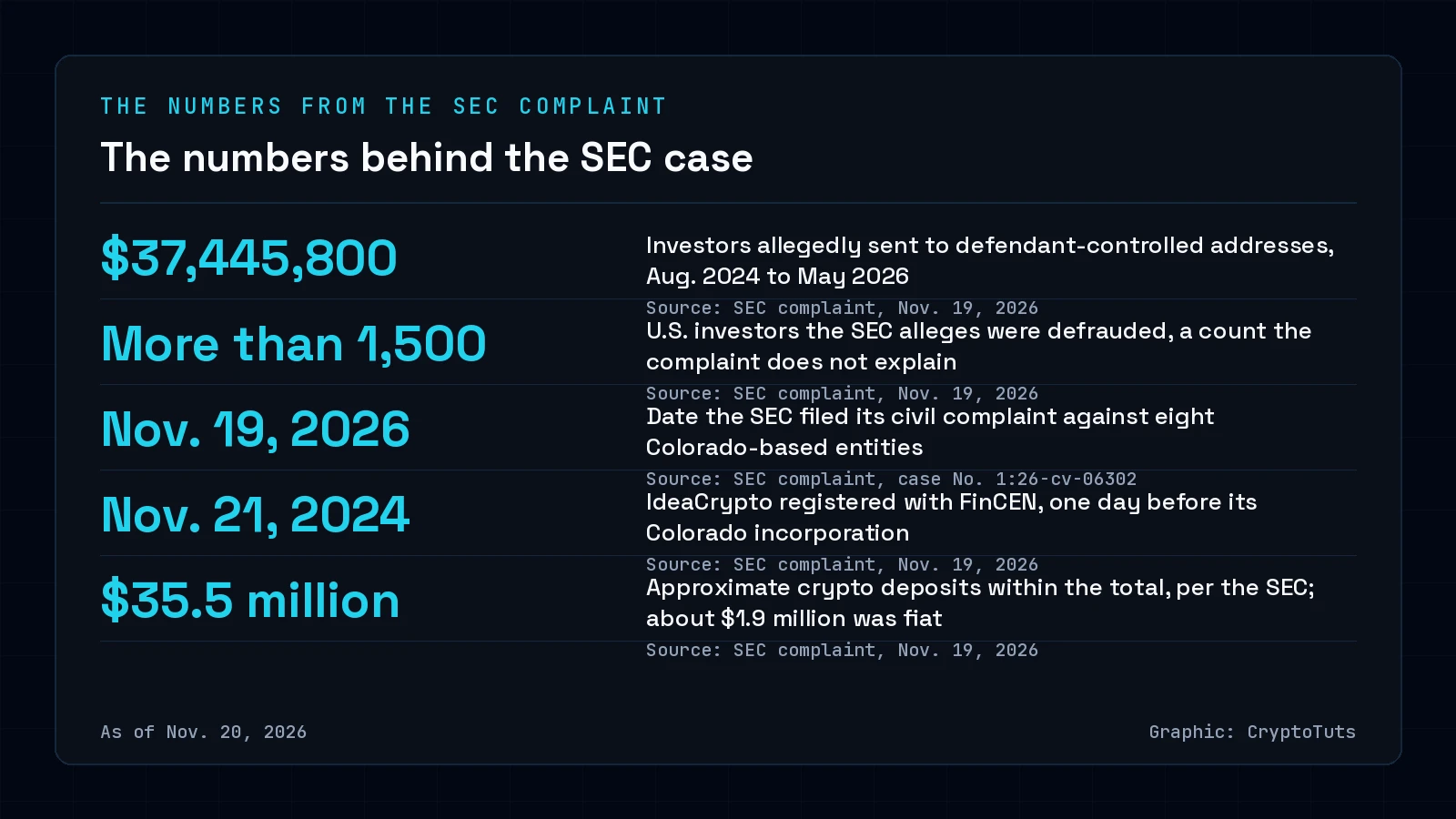
The SEC alleges the firms touted those filings as SEC "regulatory approval" in a complaint filed Nov. 19, 2026, against eight Colorado-based entities. The SEC says investors sent $37,445,800 to addresses the defendants controlled from August 2024 through May 2026.
By the SEC's count, more than 1,500 U.S. investors were defrauded. The SEC says the firms pointed them to real filings with the SEC and FinCEN to look legitimate. A seller who pitches you an investment can cite the same kinds of papers, and you can check each one yourself.
Investor.gov is the SEC's recommended background check on anyone offering or selling you an investment. Filed Forms ADV sit in the SEC's adviser database at adviserinfo.sec.gov. A FinCEN money services business registration is a listing of what the business itself entered, like a directory entry the firm writes. FinCEN's registration site calls a listing no recommendation, certification of legitimacy or endorsement by any government agency.
Check a firm before you send money
On a Form ADV, read who the firm says its clients are. An exempt reporting adviser claims it advises only private funds and files only Part 1 of the form. A firm courting you as a retail client under that status shows the mismatch alleged in this case.
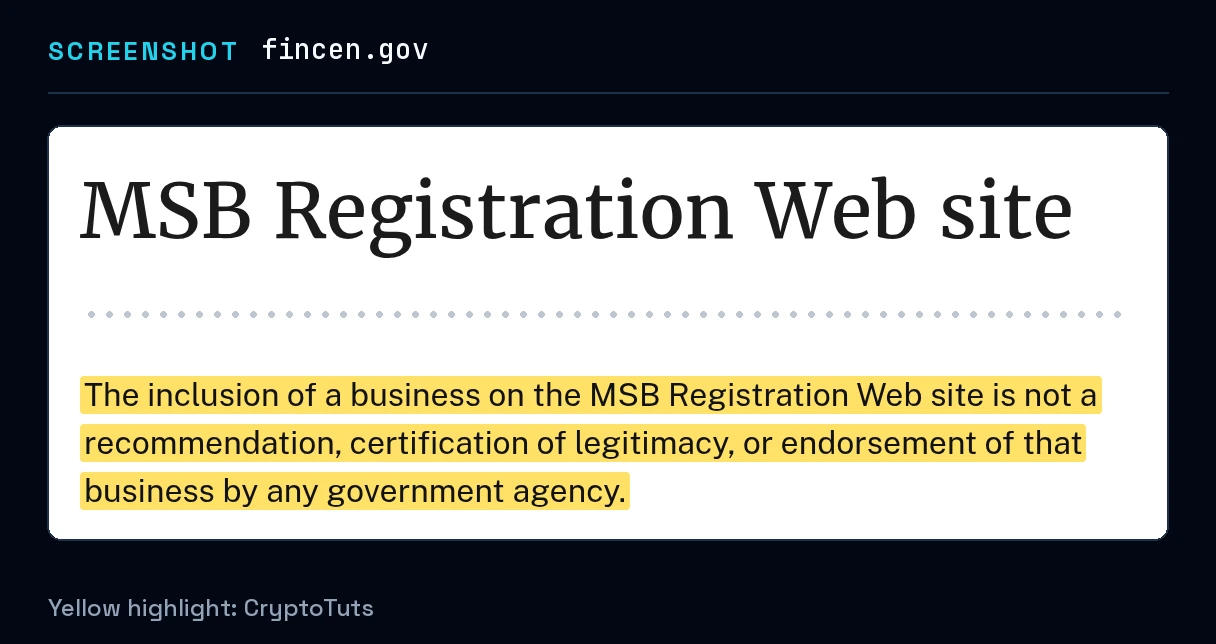
Read a FinCEN listing as the firm's own entry, exactly as the firm provided it, and test it against what the firm tells you. FinCEN confirms no registrations through its Regulatory Helpline or E-Filing Help Desk, so the search page is the record you check. FinCEN's questions and answers on the registrant search spell that out.
The SEC says both Forms ADV listed contacts who aren't real
The complaint alleges both forms claimed exempt reporting adviser status, though the firms gave their advice to retail investors. The forms also listed regulatory contacts who are not real people, with phone numbers and addresses that were fictitious or unrelated to the firms.
The SEC alleges some investors also received fake SEC certificates for Convergent Wealth and Essential Crypto. Both forms have since been removed from the SEC website.
A FinCEN listing shows what firms typed in
All four platforms registered with FinCEN as money services businesses between June 2024 and October 2025, the complaint says. Each adviser falsely touted its partner platform's registration as proof of legitimacy.
FinCEN verifies none of the information registrants submit. IdeaCrypto registered with FinCEN on Nov. 21, 2024, one day before it incorporated in Colorado on Nov. 22, 2024. The federal listing existed before the Colorado company did.
The money left through investors' own wallets
The complaint lays out four successive adviser-platform pairs, each active for roughly six months:
- WeChat and TBAA, about August to December 2024
- HB Wealth and IdeaCrypto, about January to July 2025
- Convergent Wealth and RealSimple, about July to December 2025
- Associated Wealth and Essential Crypto, about January to May 2026
The SEC alleges investors were told to deposit dollars at a well-known U.S. crypto trading platform and buy crypto there. They then moved it to their own non-custodial wallets, whose keys the owner holds, and sent it to accumulation addresses on Ethereum that pooled the deposits. From those four addresses, funds moved through intermediary addresses and cross-chain bridges to the Tron network.
The SEC alleges investors who tried to withdraw their illusory profits faced one more demand: a separate fee, calculated as a percentage of those profits. Holdouts were threatened and pressured.
Crypto carried almost all of the money. Of the $37,445,800, about $35.5 million, or about 95%, arrived as crypto deposits and about $1.9 million, or about 5%, as fiat currency. The accumulation addresses took in at least $7,318,922 for TBAA, $13,641,159 for IdeaCrypto, $10,358,378 for RealSimple and $4,223,863 for Essential Crypto, each figure a lower bound.
Three single cases from the complaint show the individual cost. One HB Wealth/IdeaCrypto client lost nearly $500,000, partly borrowed from a 401(k), a son and a neighbor. A Convergent Wealth/RealSimple client lost about $850,000, including borrowed family money and a liquidated 401(k). An Associated Wealth/Essential Crypto client lost close to $1.6 million, including the investor's house and IRA.
The SEC seeks penalties and a jury trial
The complaint alleges, and the SEC must still prove in court, that all eight entities violated Section 10(b) of the Exchange Act and Rule 10b-5. The four advisers are charged with violating Advisers Act Sections 206(1) and 206(2). Convergent Wealth and Essential Crypto are charged with violating Advisers Act Section 207.
The SEC seeks permanent and conduct-based injunctions, civil penalties and disgorgement with prejudgment interest, and it demands a jury trial. Disgorgement means giving up money gained through the alleged fraud. The request includes an order barring Convergent Wealth and Essential Crypto from filing Forms ADV as exempt reporting advisers. The court decides what to grant.
All eight defendants are entities. The SEC believes the people named in their documents, filings and chats, including the purported advisers, are fictitious. They were untraceable in public records or at listed addresses, and their phone numbers were disconnected. Who ran the firms stays open until a real person is traced through those records.
The SEC infers that people most likely located abroad ran the scheme, citing IP addresses that place actions taken for it outside the United States. Their location stays open until the complaint names a country. The SEC's release thanks regulators in Hong Kong, Singapore, China and Switzerland, among others, for their assistance.
The court docket for case No. 1:26-cv-06302 is the place to watch next.
Sources
- SEC complaint, SEC v. Advisor WeChat Capital et al., U.S. District Court for the District of Colorado · U.S. Securities and Exchange Commission
- SEC press release 2026-115: Eight Entities Used Fake Crypto Asset Trading Platforms to Steal More Than $37 Million From U.S. Investors · U.S. Securities and Exchange Commission
- FinCEN: MSB Registration Web site · Financial Crimes Enforcement Network
- FinCEN: Questions & Answers, General Information about the MSB Registrant Search Web page · Financial Crimes Enforcement Network
- SEC press release 2025-144: SEC Charges Three Purported Crypto Asset Trading Platforms and Four Investment Clubs · U.S. Securities and Exchange Commission
About the author

Phil
Founder & Editor-in-Chief · In crypto since 2017
Phil is the founder of CryptoTuts and has explored Bitcoin, cryptocurrencies and blockchain technology since 2017. He explains complex topics clearly, with data and without empty promises.
- XRP and the XRPL
- Bitcoin
- Crypto tax records
- Exchange comparisons
- On-chain analysis